


JEE Advanced · Mathematics · 27. Definite Integration
Paragraph:
Consider the functions defined implicitly by the equation \(y^3-3 y+x=0\) on various intervals in the real line. If \(x \in(-\infty,-2) \cup(2, \infty)\), the equation implicitly defines a unique real valued differentiable function \(y=f(x)\). If \(x \in(-2,2)\), the equation implicitly defines a unique real valued differentiable function \(y=g(x)\), satisfying \(g(0)=0\).Question:
\(\int_{-1}^1 g^{\prime}(x) d x\) is equal to
- A
\(2 g(-1)\)
- B
0
- C
\(-2 g(1)\)
- D
\(2 g(1)\)
Answer & Solution
Correct Answer
(D)
\(2 g(1)\)
Step-by-step Solution
Detailed explanation
Let \(I=\int_{-1}^1 g^{\prime}(x) d x=[g(x)]_{-1}^1=g(1)-g(-1)\)
Since, \(\quad y^3-3 y+x=0\) and \(\quad y=g(x)\)
\[
\therefore(g(x))^3-3 g(x)+x=0
\]
[by Eq. (i)]
At \(\quad x=1\),
\[
\begin{aligned}
(g(1))^3-3 g(1)+1 & =0 \\
\text { At } \quad x & =-1, \\
(g(-1))^3-3 g(-1)-1 & =0
\end{aligned}
\]
On adding Eqs. (i) and (ii), we get
\[
\begin{array}{rlrl}
& & (g(1))^3+(g(-1))^3-3(g(1)+g(-1))=0 \\
\Rightarrow & & {[g(1)+g(-1)]\left[(g(1))^2+(g(-1))^2-g(1) g(-1)-3\right]=0} \\
\Rightarrow & g(1)+g(-1)=0 \\
\Rightarrow & g(1) & =-g(-1) \\
& \therefore & I & =g(1)-g(-1)=g(1)-(-g(1))=2 g(1)
\end{array}
\]
Since, \(\quad y^3-3 y+x=0\) and \(\quad y=g(x)\)
\[
\therefore(g(x))^3-3 g(x)+x=0
\]
[by Eq. (i)]
At \(\quad x=1\),
\[
\begin{aligned}
(g(1))^3-3 g(1)+1 & =0 \\
\text { At } \quad x & =-1, \\
(g(-1))^3-3 g(-1)-1 & =0
\end{aligned}
\]
On adding Eqs. (i) and (ii), we get
\[
\begin{array}{rlrl}
& & (g(1))^3+(g(-1))^3-3(g(1)+g(-1))=0 \\
\Rightarrow & & {[g(1)+g(-1)]\left[(g(1))^2+(g(-1))^2-g(1) g(-1)-3\right]=0} \\
\Rightarrow & g(1)+g(-1)=0 \\
\Rightarrow & g(1) & =-g(-1) \\
& \therefore & I & =g(1)-g(-1)=g(1)-(-g(1))=2 g(1)
\end{array}
\]
See the Complete Solution
Get step-by-step explanations for this and 2.5 Lakh+ more JEE, NEET & CET questions.
- Unlock all solutions
- Practice the full chapter
- Track accuracy across PYQs
4.8 rated on Google Play · 14,000+ reviews
More questions from Mathematics
- Consider the lines \(L_{1}\) and \(L_{2}\) defined by
\[
L_{1}: x \sqrt{2}+y-1=0 \text { and } L_{2}: x \sqrt{2}-y+1=0
\]
For a fixed constant \(\lambda\), let \(C\) be the locus of a point \(P\) such that the product of the distance of \(P\) from \(L_{1}\) and the distance of \(P\) from \(L_{2}\) is \(\lambda^{2}\). The line \(y=2 x+1\) meets \(C\) at two points \(R\) and \(S\), where the distance between \(R\) and \(S\) is \(\sqrt{270}\).
Let the perpendicular bisector of \(R S\) meet \(C\) at two distinct points \(R^{\prime}\) and \(S^{\prime}\). Let \(D\) be the square of the distance between \(R^{\prime}\) and \(S^{\prime}\).
The value of isJEE Advanced 2021 Hard - Let \(\alpha\) and \(\beta\) be the real numbers such that \(\lim _{x \rightarrow 0} \frac{1}{x^3}\left(\frac{\alpha}{2} \int_0^x \frac{1}{1-t^2} d t+\beta x \cos x\right)=2\). Then the value of \(\alpha+\beta\) is _______JEE Advanced 2025 Hard
- Let the point be the reflection of the point with respect to the line Let and be circle of radii and with centres and respectively. Let be a common tangent to the circle and such that both the circle are on the same side of If is the point of intersection of and the line passing through and then the length of the line segment is ___________.JEE Advanced 2019 Medium
- Let \(\alpha, \beta\) and \(\gamma\) be real numbers such that the system of linear equations
\[
\begin{array}{c}
x+2 y+3 z=\alpha \\
4 x+5 y+6 z=\beta \\
7 x+8 y+9 z=\gamma-1
\end{array}
\]
is consistent. Let \(|M|\) represent the determinant of the matrix
\[
M=\left[\begin{array}{ccc}
\alpha & 2 & \gamma \\
\beta & 1 & 0 \\
-1 & 0 & 1
\end{array}\right]
\]
Let \(P\) be the plane containing all those \((\alpha, \beta, \gamma)\) for which the above system of linear equations is consistent, and \(D\) be the square of the distance of the point \((0,1,0)\) from the plane \(P\).
The value of isJEE Advanced 2021 Easy - The number of points in , for which , is:JEE Advanced 2013 Hard
- Define the collections of ellipses and of rectangles as follows:
rectangle of largest area, with sides parallel to the axes, inscribed in
ellipse of largest area inscribed in
rectangle of largest area, with sides parallel to the axes, inscribed in
Then which of the following options is/are correct?JEE Advanced 2019 Hard
More PYQs from JEE Advanced
- Six point charges are kept at the vertices of a regular hexagon of side \(\mathrm{L}\) and centre \(O\), as shown in the figure.
Given that \(K=\frac{1}{4 \pi \varepsilon_{0}} \frac{q}{L^{2}}\), which of the following statement(s) is (are) correct?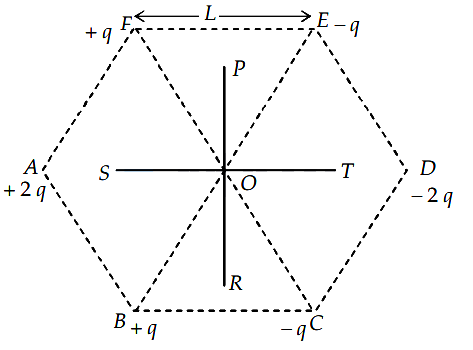 JEE Advanced 2012 Medium
 - Suppose denote the distinct real roots of the quadratic polynomial and suppose denote the distinct complex roots of the quadratic polynomial . Then the value ofJEE Advanced 2020 Medium
- An ideal gas is expanding such that \(p T^2=\) constant. The coefficient of volume expansion of the gas isJEE Advanced 2008 Medium
- Two lines and are coplanar. Then can take value(s)JEE Advanced 2013 Easy
- If the straight lines \(\frac{x-1}{2}=\frac{y+1}{k}=\frac{z}{2}\) and \(\frac{x+1}{5}=\frac{y+1}{2}=\frac{z}{k}\) are coplanar, then the plane (s) containing these two lines is (are)JEE Advanced 2012 Medium
- Let { and } and { is a real number} (Here the inverse trigonometric function assumes values in .)
Let be the function defined by
And be the function defined by .
The correct option is:LIST-I LIST-II A. The range of is P. B. The range of contains Q. (0, 1) C. The domain of contains R. D. The domain of is S. T. U. JEE Advanced 2018 Hard