


JEE Advanced · Chemistry · 9. Redox Reactions
Paragraph:
Redox reaction play a pivotal role in chemistry and biology. The values of standard redox potential \(\left(E^{\circ}\right)\) of two half-cell reactions decide which way the reaction is expected to proceed. A simple example is a Daniel cell in which zinc goes into solution and copper gets deposited. Given below are a set of half-cell reactions (acidic medium) along with their \(E^{\circ}(V\) with respect to normal hydrogen electrode) values. Using this data obtain the correct explanations to Questions 14-19.
\(\mathrm{I}_2+2 e^{-} \longrightarrow 2 \mathrm{I}^{-} E^{\circ}=0.54 \)
\( \mathrm{Cl}_2+2 e^{-} \longrightarrow 2 \mathrm{Cl}^{-} E^{\circ}=1.36 \)
\( \mathrm{Mn}^{3+}+e^{-} \longrightarrow \mathrm{Mn}^{2+} E^{\circ}=1.50 \)
\( \mathrm{Fe}^{3+}+e^{-} \longrightarrow \mathrm{Fe}^{2+} E^{\circ}=0.77 \)
\( \mathrm{O}_2+4 \mathrm{H}^{+}+4 e^{-} \longrightarrow 2 \mathrm{H}_2 \mathrm{O} E^{\circ}=1.23\)
Question:
While \(\mathrm{Fe}^{3+}\) is stable, \(\mathrm{Mn}^{3+}\) is not stable in acid solution because
- A \(\mathrm{O}_2\) oxidises \(\mathrm{Mn}^{2+}\) to \(\mathrm{Mn}^{3+}\)
- B \(\mathrm{O}_2\) oxidises both \(\mathrm{Mn}^{2+}\) and \(\mathrm{Fe}^{2+}\) to \(\mathrm{Fe}^{3+}\)
- C \(\mathrm{Fe}^{3+}\) oxidises \(\mathrm{H}_2 \mathrm{O}\) to \(\mathrm{O}_2\)
- D \(\mathrm{Mn}^{3+}\) oxidises \(\mathrm{H}_2 \mathrm{O}\) to \(\mathrm{O}_2\)
Answer & Solution
Correct Answer
(D) \(\mathrm{Mn}^{3+}\) oxidises \(\mathrm{H}_2 \mathrm{O}\) to \(\mathrm{O}_2\)
Step-by-step Solution
Detailed explanation
\({\left[\mathrm{Mn}^{3+}+e^{-}\right.}\left.\longrightarrow \mathrm{Mn}^{2+}\right] \times 4 \)
\( 2 \mathrm{H}_2 \mathrm{O} \longrightarrow 4 \mathrm{H}^{+}+\mathrm{O}_2+4 e^{-} \)
\( 4 \mathrm{Mn}^{2+}+2 \mathrm{H}_2 \mathrm{O} \longrightarrow 4 \mathrm{Mn}^{2+}+4 \mathrm{H}^{+}+\mathrm{O}_2 \)
\( E_{\text {cell }}^{\circ}= 1.50-1.23=0.27 \mathrm{~V} \)
\( E_{\text {cell }}^{\circ} \text { is + ve }\)
\( 2 \mathrm{H}_2 \mathrm{O} \longrightarrow 4 \mathrm{H}^{+}+\mathrm{O}_2+4 e^{-} \)
\( 4 \mathrm{Mn}^{2+}+2 \mathrm{H}_2 \mathrm{O} \longrightarrow 4 \mathrm{Mn}^{2+}+4 \mathrm{H}^{+}+\mathrm{O}_2 \)
\( E_{\text {cell }}^{\circ}= 1.50-1.23=0.27 \mathrm{~V} \)
\( E_{\text {cell }}^{\circ} \text { is + ve }\)
See the Complete Solution
Get step-by-step explanations for this and 2.5 Lakh+ more JEE, NEET & CET questions.
- Unlock all solutions
- Practice the full chapter
- Track accuracy across PYQs
4.8 rated on Google Play · 14,000+ reviews
More questions from Chemistry
- Match the reactions in List-I with the features of their products in List-II and choose the correct option.
List - I List - II (P) 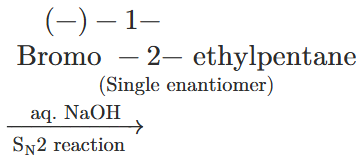
1. Inversion of configuration (Q) 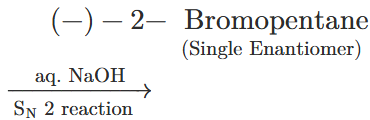
2. Retention of configuration (R) 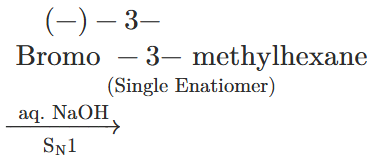
3. Mixture of enantiomers (S) 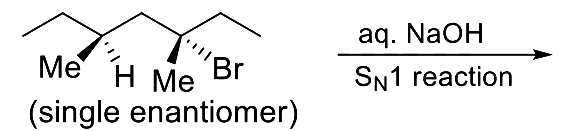
4. Mixture of structural isomers 5. Mixture of diastereomers JEE Advanced 2023 Hard - Statement I Glucose gives a reddish-brown precipitate with Fehling's solution.
Statement II Reaction of glucose with Fehling's solution gives \(\mathrm{CuO}\) and gluconic acid.JEE Advanced 2007 Medium - The boiling point of water in a \(0.1\) molal silver nitrate solution (solution \(\mathbf{A}\) ) is \(\mathbf{x}^{\circ} \mathrm{C}\). To this solution \(\mathbf{A}\), an equal volume of \(0.1\) molal aqueous barium chloride solution is added to make a new solution B. The difference in the boiling points of water in the two solutions \(\mathbf{A}\) and \(\mathbf{B}\) is \(\mathbf{y} \times 10^{-2}{ }^{\circ} \mathrm{C}\).
(Assume: Densities of the solutions \(\mathbf{A}\) and \(\mathbf{B}\) are the same as that of water and the soluble salts dissociate completely.
Use: Molal elevation constant (Ebullioscopic Constant), \(K_{b}=0.5 \mathrm{~K} \mathrm{~kg} \mathrm{~mol}^{-1}\); Boiling point of pure water as \(100^{\circ} \mathrm{C}\).)
The value of is ___.JEE Advanced 2021 Hard - The wave function, \(\psi_{ n , 1, m_{ l }}\) is a mathematical function whose value depends upon spherical polar coordinates \(( r , \theta, \phi)\) of the electron and characterized by the quantum numbers \(n , 1\) and \(m _{ l }\). Here \(r\) is the distance from the nucleus, \(\theta\) is colatitude and \(\phi\) is azimuth. In the mathematical functions given in the Table, Z is the atomic number and \(a_0\) is Bohr radius
For \(\text{He} ^{+}\)ion, the only incorrect combinationColumn 1 Column 2 Column 3 (I) 1s orbital \(\text {(i) } \psi_{ n , 1, m_1}\)
\(\propto\left(\frac{ Z }{ a _{ o }}\right)^{\frac{3}{2}} e ^{-\left(\frac{ Zr }{ e _{ o }}\right)}\)(P) 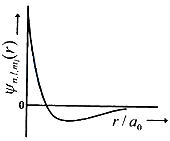
(II) 2s orbital (ii) One radial node (Q) Probability density at the nucleus \(\propto \frac{1}{ a _{ o }^3}\). (III) \(2 p _{ z }\) orbital \(\text {(iii) } \psi_{ n }, 1, m_{ l }\)
\(\propto\left(\frac{ Z }{ a _{ o }}\right)^{\frac{5}{2}} re ^{-\left(\frac{ Zr }{2 a _{ o }}\right)} \cos \theta\)(R) Probability density is maximum at the nucleus. (IV) \(3 d_{ z }^2\) orbital (iv) \(x y\)-plane is a nodal plane (S) Energy needed to excite an electron from \(n =2\) state to \(n =4\) state is \(\frac{27}{32}\) times the energy needed to excite are electron from \(n =2\) state to \(n =6\) state. JEE Advanced 2017 Hard - Consider a reaction \(a G+b H \rightarrow\) products. When concentration of both the reactants \(G\) and \(H\) is doubled, the rate increases by eight times. However, when concentration of \(G\) is doubled keeping the concentration of \(H\) fixed, the rate is doubled. The overall order of the reaction isJEE Advanced 2007 Easy
- One of the products formed from the reaction of permanganate ion with iodide ion in neutral aqueous medium isJEE Advanced 2025 Easy
More PYQs from JEE Advanced
- Two particles of mass \(m\) each are tied at the ends of a light string of length \(2 a\). The whole system is kept on a frictionless horizontal surface with the string held tight so that each mass is at a distance \(a\) from the centre \(P\) (as shown in the figure). Now, the mid-point of the string is pulled vertically upwards with a small but constant force \(F\). As a result, the particles move towards each other on the surface.
The magnitude of acceleration, when the separation between them becomes \(2 x\), is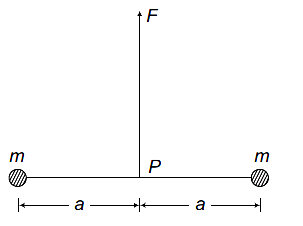 JEE Advanced 2007 Hard
 - A small object is placed at the centre of a large evacuated hollow spherical container. Assume the container is maintained at . At time , the temperature of the object is . The temperature of the object becomes at and at . Assume the object and the container to be ideal black bodies. The heat capacity of the object does not depend on temperature. The ratio _________ .JEE Advanced 2021 Medium
- For , let be a solution of the differential equation such that . Then the maximum value of the function isJEE Advanced 2023 Medium
- List-I contains various reaction sequences and List-II contains different phenolic compounds.
Match each entry in List-I with the appropriate entry in List-II and choose the correct option.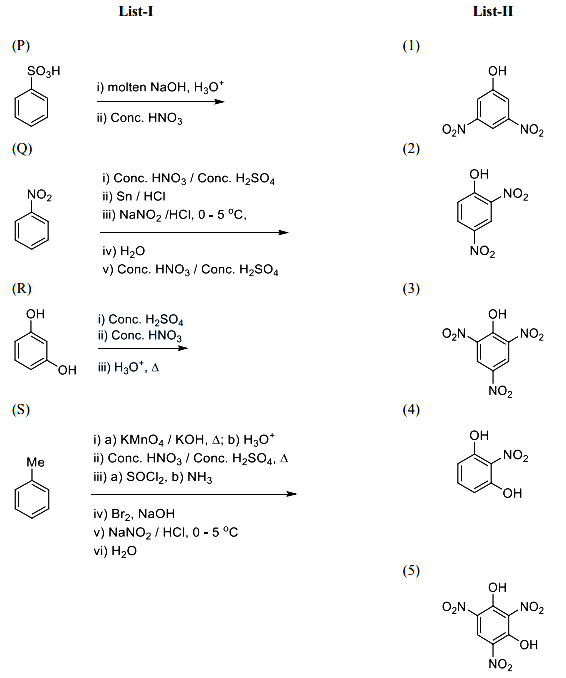 JEE Advanced 2024 Medium
 - Let for all be a continuous function. For if is the area of the region bounded by then isJEE Advanced 2015 Medium
- Paragraph:
The reactions of \(\mathrm{Cl}_{2}\) gas with cold-dilute and hot-concentrated \(\mathrm{NaOH}\) in water give sodium salts of two (different) oxoacids of chlorine, \(\boldsymbol{P}\) and \(\boldsymbol{Q}\), respectively. The \(\mathrm{Cl}_{2}\) gas reacts with \(\mathrm{SO}_{2}\) gas, in presence of charcoal, to give a product \(\boldsymbol{R}\). \(\boldsymbol{R}\) reacts with white phosphorus to give a compound \(\boldsymbol{S}\). On hydrolysis, \(\boldsymbol{S}\) gives an oxoacid of phosphorus, \(\boldsymbol{T}\).
Question:
\(R, S\) and \(T\), respectively, areJEE Advanced 2013 Medium