


JEE Advanced · Mathematics · 32. Probability
A student appears for a quiz consisting of only true-false type questions and answers all the questions. The student knows the answers of some questions and guesses the answers for the remaining questions. Whenever the student knows the answer of a question, he gives the correct answer. Assume that the probability of the student giving the correct answer for a question, given that he has guessed it, is \(\frac{1}{2}\). Also assume that the probability of the answer for a question being guessed, given that the student's answer is correct, is \(\frac{1}{6}\). Then the probability that the student knows the answer of a randomly chosen question is
- A \(\frac{1}{12}\)
- B \(\frac{1}{7}\)
- C \(\frac{5}{7}\)
- D \(\frac{5}{12}\)
Answer & Solution
Correct Answer
(C) \(\frac{5}{7}\)
Step-by-step Solution
Detailed explanation
\(\mathrm{C} \rightarrow\) Correct
\(\mathrm{G} \rightarrow\) Guess
\(\mathrm{K} \rightarrow\) Knows
\(\begin{array}{ll}\mathrm{P}\left(\frac{\mathrm{C}}{\mathrm{G}}\right)=\frac{1}{2} \quad, \quad \mathrm{P}\left(\frac{\mathrm{C}}{\mathrm{K}}\right)=1 \\\mathrm{P}\left(\frac{\mathrm{G}}{\mathrm{C}}\right)=\frac{1}{6}\end{array}\)
\(\begin{aligned} & \text { Let required probability }=\mathrm{x} \\ & \therefore \mathrm{P}\left(\frac{\mathrm{G}}{\mathrm{C}}\right)=\frac{(1-\mathrm{x}) \mathrm{P}\left(\frac{\mathrm{C}}{\mathrm{G}}\right)}{(1-\mathrm{x}) \mathrm{P}\left(\frac{\mathrm{C}}{\mathrm{G}}\right)+\mathrm{x} \cdot \mathrm{P}\left(\frac{\mathrm{C}}{\mathrm{K}}\right)} \\ & \frac{1}{6}=\frac{(1-\mathrm{x})\left(\frac{1}{2}\right)}{(1-\mathrm{x})\left(\frac{1}{2}\right)+(\mathrm{x})(1)} \\ & \Rightarrow \mathrm{x}=\frac{5}{7} \Rightarrow \text { Option (3) is correct. }\end{aligned}\)
\(\mathrm{G} \rightarrow\) Guess
\(\mathrm{K} \rightarrow\) Knows
\(\begin{array}{ll}\mathrm{P}\left(\frac{\mathrm{C}}{\mathrm{G}}\right)=\frac{1}{2} \quad, \quad \mathrm{P}\left(\frac{\mathrm{C}}{\mathrm{K}}\right)=1 \\\mathrm{P}\left(\frac{\mathrm{G}}{\mathrm{C}}\right)=\frac{1}{6}\end{array}\)
\(\begin{aligned} & \text { Let required probability }=\mathrm{x} \\ & \therefore \mathrm{P}\left(\frac{\mathrm{G}}{\mathrm{C}}\right)=\frac{(1-\mathrm{x}) \mathrm{P}\left(\frac{\mathrm{C}}{\mathrm{G}}\right)}{(1-\mathrm{x}) \mathrm{P}\left(\frac{\mathrm{C}}{\mathrm{G}}\right)+\mathrm{x} \cdot \mathrm{P}\left(\frac{\mathrm{C}}{\mathrm{K}}\right)} \\ & \frac{1}{6}=\frac{(1-\mathrm{x})\left(\frac{1}{2}\right)}{(1-\mathrm{x})\left(\frac{1}{2}\right)+(\mathrm{x})(1)} \\ & \Rightarrow \mathrm{x}=\frac{5}{7} \Rightarrow \text { Option (3) is correct. }\end{aligned}\)
See the Complete Solution
Get step-by-step explanations for this and 2.5 Lakh+ more JEE, NEET & CET questions.
- Unlock all solutions
- Practice the full chapter
- Track accuracy across PYQs
4.8 rated on Google Play · 14,000+ reviews
More questions from Mathematics
- For a polynomial with real coefficients, let denote the number of distinct real roots of . Suppose is the set of polynomials with real coefficients defined by . For a polynomial , let and denote its first and second order derivatives respectively. Then the minimum possible value of , where , is ____JEE Advanced 2020 Medium
- Paragraph:
Let \(a\), b and \(c\) be three real numbers satisfying \(\left[\begin{array}{lll}a & b & c\end{array}\right]\left[\begin{array}{lll}1 & 9 & 7 \\ 8 & 2 & 7 \\ 7 & 3 & 7\end{array}\right]=\left[\begin{array}{lll}0 & 0 & 0\end{array}\right]\)Question:
Let \(b=6\), with \(a\) and \(c\) satisfying Eq. (E). If \(\alpha\) and \(\beta\) are the roots of the quadratic equation \(a x^2+b x+c=0\), then \(\sum_{n=0}^{\infty}\left(\frac{1}{\alpha}+\frac{1}{\beta}\right)^n\) isJEE Advanced 2011 Easy - Define the collections of ellipses and of rectangles as follows:
rectangle of largest area, with sides parallel to the axes, inscribed in
ellipse of largest area inscribed in
rectangle of largest area, with sides parallel to the axes, inscribed in
Then which of the following options is/are correct?JEE Advanced 2019 Hard - Let . For let be the number of subsets of , each containing five elements out of which exactly are odd. ThenJEE Advanced 2017 Easy
- Paragraph:
Consider the lines: \(L_1: \frac{x+1}{3}=\frac{y+2}{1}=\frac{z+1}{2}, L_2: \frac{x-2}{1}=\frac{y+2}{2}=\frac{z-3}{3}\)Question:
The unit vector perpendicular to both \(L_1\) and \(L_2\) isJEE Advanced 2008 Easy - If \(\lim _{x \rightarrow 0}\left[1+x \log \left(1+b^2\right)\right]^{1 / x}=2 b \sin ^2 \theta b>0\) and \(\theta \in(-\pi, \pi]\), then the value of \(\theta\) isJEE Advanced 2011 Medium
More PYQs from JEE Advanced
- Let . The sum of all distinct solution of the equation , in the set S is equal toJEE Advanced 2016 Medium
- The IUPAC name of \(\mathrm{C}_6 \mathrm{H}_5 \mathrm{COCl}\) isJEE Advanced 2006 Easy
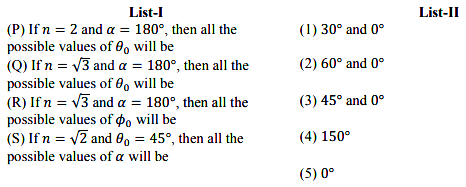
- A light ray is incident on the surface of a sphere of refractive index \(n\) at an angle of incidence \(\theta_0\). The ray partially refracts into the sphere with angle of refraction \(\phi_0\) and then partly reflects from the back surface. The reflected ray then emerges out of the sphere after a partial refraction. The total angle of deviation of the emergent ray with respect to the incident ray is \(\alpha\). Match the quantities mentioned in List-I with their values in List-II and choose the correct option.
 JEE Advanced 2024 Hard
 - In a Young's double slit experiment, the separation between the two slits is \(d\) and the wavelength of the light is \(\lambda\). The intensity of light falling on slit 1 is four times the intensity of light falling on slit 2 . Choose the correct choice(s),JEE Advanced 2008 Medium
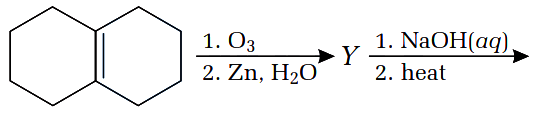
- In the scheme given below, the total number of intramolecular aldol condensation products formed from ' \(Y\) ' is
 JEE Advanced 2010 Hard
 - Let be the cube with the set of vertices . Let be the set of all twelve lines containing the diagonals of the six faces of the cube . Let be the set of all four lines containing the main diagonals of the cube ; for instance, the line passing through the vertices and is in . For lines and , let denote the shortest distance between them. Then the maximum value of , as varies over and varies over , isJEE Advanced 2023 Easy