


JEE Advanced · Chemistry · 6. Thermodynamics (C)
One mole of an ideal gas at in thermal contact with its surroundings expands isothermally from to against a constant pressure of . In this process, the change in entropy of the surroundings in is:
- A
- B
- C
- D
Answer & Solution
Correct Answer
(C)
Step-by-step Solution
Detailed explanation
From law of thermodynamics,
Alternate solution:
For the isothermal process:
Alternate solution:
For the isothermal process:
See the Complete Solution
Get step-by-step explanations for this and 2.5 Lakh+ more JEE, NEET & CET questions.
- Unlock all solutions
- Practice the full chapter
- Track accuracy across PYQs
4.8 rated on Google Play · 14,000+ reviews
More questions from Chemistry
- The correct order of acid strength of the following carboxylic acids is -
 JEE Advanced 2019 Medium
 - For the following reaction scheme, percentage yields are given along the arrow:
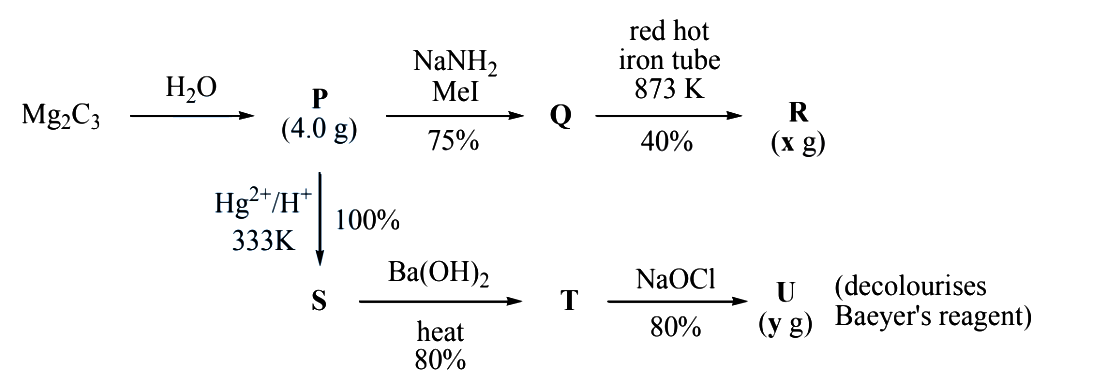
\(\mathbf{x} g\) and \(\mathbf{y} g\) are mass of \(\mathbf{R}\) and \(\mathbf{U}\), respectively.
(Use: Molar mass (in \(\mathrm{g} \mathrm{mol}^{-1}\) ) of \(\mathrm{H}, \mathrm{C}\) and \(\mathrm{O}\) as 1,12 and 16 , respectively)
The value of is ___.JEE Advanced 2021 Medium - The total number of chiral molecules formed from one molecule of on complete ozonolysis is _____
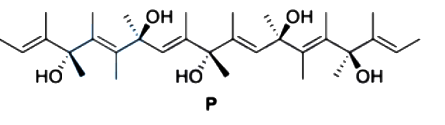 JEE Advanced 2022 Easy
 - A sample \((5.6 \mathrm{~g})\) containing iron is completely dissolved in cold dilute \(\mathrm{HCl}\) to prepare a \(250 \mathrm{~mL}\) of solution. Titration of \(25.0 \mathrm{~mL}\) of this solution requires \(12.5 \mathrm{~mL}\) of \(0.03 \mathrm{M} \mathrm{KMnO}_{4}\) solution to reach the end point. Number of moles of \(\mathrm{Fe}^{2+}\) present in \(250 \mathrm{~mL}\) solution is \(\mathbf{x} \times 10^{-2}\) (consider complete dissolution of \(\mathrm{FeCl}_{2}\) ). The amount of iron present in the sample is \(\mathbf{y} \%\) by weight.
(Assume: \(\mathrm{KMnO}_{4}\) reacts only with \(\mathrm{Fe}^{2+}\) in the solution Use: Molar mass of iron as \(56 \mathrm{~g} \mathrm{~mol}^{-1}\) )
The value of is________ .JEE Advanced 2021 Medium - Paragraph:
An aqueous solution of metal ion \(\mathbf{M} 1\) reacts separately with reagents \(\mathbf{Q}\) and \(\mathbf{R}\) in excess to give tetrahedral and square planar complexes, respectively. An aqueous solution of another metal ion M2 always forms tetrahedral complexes with these reagents. Aqueous solution of \(\mathbf{M} 2\) on reaction with reagent \(\mathbf{S}\) gives white precipitate which dissolves in excess of \(\mathbf{S}\). The reactions are summarized in the scheme given below: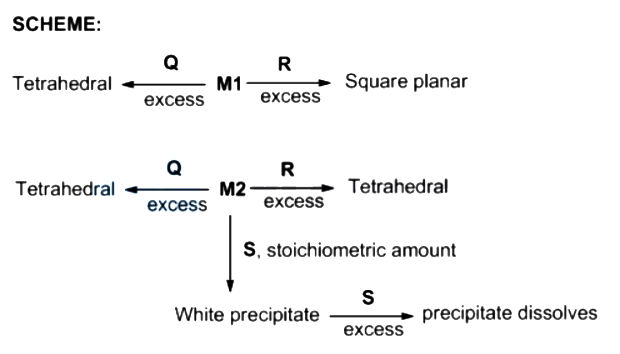
Question:
Reagent \(\mathbf{S}\) isJEE Advanced 2014 Medium - At the reaction of with produces a xenon compound The total number of lone pair(s) of electrons present on the whole molecule of is __________JEE Advanced 2019 Medium
More PYQs from JEE Advanced
- The surface of copper gets tarnished by the formation of copper oxide. gas was passed to prevent the oxide formation during heating of copper at 1250 K. However, the gas contains 1 mole % of water vapour as impurity. The water vapour oxidises copper as per the reaction given below:
Is the minimum partial pressure of (in bar) needed to prevent the oxidation at 1250 K. The value of is ____.
(Given: total pressure \(=1\) bar, R (universal gas constant) \(=8 J K ^{-1} mol^{-1}, \ln (10) =2.3 \cdot Cu (s)\) and \(Cu _2 O (s)\) are mutually immiscible.
At \(1250 K: 2 Cu ( s )+\frac{1}{2} O _2(g) \rightarrow Cu _2 O ( s ) ;\) \(\Delta G^{\ominus}=-78,000 J mol ^{-1}\)
\(H _2(g)+\frac{1}{2} O _2(g) \rightarrow H _2 O ( g ) ; \quad \Delta^{\ominus}=\)\(-1,78,000 J mol ^{-1} ; G\) is the Gibbs energy)/mi> \(\Theta=\) \(-78,000 J mol -1\)
\(H _2(g)+\frac{1}{2} O _2(g) \rightarrow H _2 O ( g ) ; \quad\)\(\Delta^{\ominus}=-1,78,000 J mol ^{-1} ; G\) is the Gibbs energy)JEE Advanced 2018 Hard - Paragraph:
In hexagonal system of crystals, a frequently encountered arrangement of atoms is described as a hexagonal prism. Here, the top and bottom of the cell are regular hexagons and three atoms are sandwiched in between them. A space-filling model of this structure, called hexagonal close-packed (HCP), is constituted of a sphere on a flat surface surrounded in the same plane by six identical spheres as closely as possible. Three spheres are then placed over the first layer so that they touch each other and represent the second layer. Each one of the three spheres touches three spheres of the bottom layer. Finally, the second layer is covered with a third layer that is identical to the bottom layer in relative position. Assume radius of every sphere to be ' \(r\) '.
Question:
The volume of this \(\mathrm{HCP}\) unit cell isJEE Advanced 2008 Medium - Paragraph:
p-amino-N, N-dimethylaniline is added to a strongly acidic solution of \(X\). The resulting solution is treated with a few drops of aqueous solution of \(Y\) to yield blue colouration due to the formation of methylene blue. Treatment of the aqueous solution of \(Y\) with the reagent potassium hexacyanoferrate(II) leads to the formation of an intense blue precipitate. The precipitate dissolves an excess addition of the reagent. Similarly, treatment of the solution of \(Y\) with the solution of potassium hexacyanoferrate(III) leads to a brown colouration due to the formation of \(Z\).
Question:
The compound \(Y\), isJEE Advanced 2009 Medium - Two beads, each with charge \(q\) and mass \(m\), are on a horizontal, frictionless, non-conducting, circular hoop of radius \(R\). One of the beads is glued to the hoop at some point, while the other one performs small oscillations about its equilibrium position along the hoop. The square of the angular frequency of the small oscillations is given by
[ \(\varepsilon_0\) is the permittivity of free space.]JEE Advanced 2024 Hard - Match the transformation in Column I with appropriate options in Column II.
Column I Column II A. \(CO _2(s) \rightarrow CO _2(g)\) p. Phase transition B. \(CaCO _3(s) \rightarrow CaO (s)\) \(+~ CO _2(g)\) q. Allotropic change C. \(2 H \rightarrow H _2(g)\) r. \(\Delta\text{H}\) is positive D. \(P _{\text {(white, solid) }} \rightarrow P _{\text {(red, solid) }}\) s. \(\Delta\text{S}\) is positive t. \(\Delta\text{S}\) is negative JEE Advanced 2011 Easy - For any integer let The value of the expression isJEE Advanced 2015 Easy