


JEE Advanced · Chemistry · 6. Thermodynamics (C)
Using the data provided, calculate the multiple bond energy \(\left(\mathrm{kJ} \mathrm{mol}^{-1}\right)\) of a \(\mathrm{C} \equiv \mathrm{C}\) bond in \(\mathrm{C}_{2} \mathrm{H}_{2}\). That energy is (take the bond energy of a \(\mathrm{C}-\mathrm{H}\) bond as \(350 \mathrm{~kJ} \mathrm{~mol}^{-1}\) ) \(2 \mathrm{C}(\mathrm{s})+\mathrm{H}_{2}(\mathrm{~g}) \longrightarrow \mathrm{HC}=\mathrm{CH}(\mathrm{g}) ; \Delta \mathrm{H}=\) \(225 \mathrm{~kJ} \mathrm{~mol}^{-1}\) \(2 \mathrm{C}(\mathrm{s}) \longrightarrow 2 \mathrm{C}(\mathrm{g}) ; \Delta \mathrm{H}=1410 \mathrm{~kJ} \mathrm{~mol}^{-1}\) \(\mathrm{H}_{2}(\mathrm{~g}) \longrightarrow 2 \mathrm{H}(\mathrm{g}) ; \Delta \mathrm{H}=330 \mathrm{~kJ} \mathrm{~mol}^{-1}\)
- A 1165
- B 837
- C 865
- D 815
Answer & Solution
Correct Answer
(D) 815
Step-by-step Solution
Detailed explanation
(i) \(2 \mathrm{C}(\mathrm{s})+\mathrm{H}_{2}(\mathrm{~g}) \longrightarrow \mathrm{H}-\mathrm{C} \equiv \mathrm{C}-\mathrm{H}(\mathrm{g})\)
\(\Delta \mathrm{H}=225 \mathrm{~kJ} \mathrm{~mol}^{-1}\)
(ii) \(2 \mathrm{C}(\mathrm{s}) \longrightarrow 2 \mathrm{C}(\mathrm{g}) \Delta \mathrm{H}=1410 \mathrm{~kJ} \mathrm{~mol}^{-1}\)
(iii) \(\mathrm{H}_{2}\) (g) \(\longrightarrow 2 \mathrm{H}\) (g) \(\Delta \mathrm{H}=330 \mathrm{~kJ} \mathrm{~mol}^{-1}\)
From equation (i) :
\(225=\left[2 \times \Delta \mathrm{H}_{\mathrm{C}(\mathrm{s}) \longrightarrow \mathrm{C}(\mathrm{g})}+1 \times \mathrm{BE}_{\mathrm{H}-\mathrm{H}}\right] \) \( -\left[2 \times \mathrm{BE}_{\mathrm{C}-\mathrm{H}}+1 \times \mathrm{BE}_{\mathrm{C} \equiv \mathrm{C}}\right] \)
\( 225=[1410+1 \times 330]-[2 \times 350+1~ \times\) \(\mathrm{BE}_{\mathrm{C} \equiv \mathrm{C}}] \)
\( 225=[1410+330]-\left[700+\mathrm{BE}_{\mathrm{C} \equiv \mathrm{C}}\right] \)
\( 225=1740-700-\mathrm{BE}_{\mathrm{C} \equiv \mathrm{C}} \)
\( \mathrm{BE}_{\mathrm{C} \equiv \mathrm{C}}=815 \mathrm{~kJ} \mathrm{~mol}^{-1}\)
\(\Delta \mathrm{H}=225 \mathrm{~kJ} \mathrm{~mol}^{-1}\)
(ii) \(2 \mathrm{C}(\mathrm{s}) \longrightarrow 2 \mathrm{C}(\mathrm{g}) \Delta \mathrm{H}=1410 \mathrm{~kJ} \mathrm{~mol}^{-1}\)
(iii) \(\mathrm{H}_{2}\) (g) \(\longrightarrow 2 \mathrm{H}\) (g) \(\Delta \mathrm{H}=330 \mathrm{~kJ} \mathrm{~mol}^{-1}\)
From equation (i) :
\(225=\left[2 \times \Delta \mathrm{H}_{\mathrm{C}(\mathrm{s}) \longrightarrow \mathrm{C}(\mathrm{g})}+1 \times \mathrm{BE}_{\mathrm{H}-\mathrm{H}}\right] \) \( -\left[2 \times \mathrm{BE}_{\mathrm{C}-\mathrm{H}}+1 \times \mathrm{BE}_{\mathrm{C} \equiv \mathrm{C}}\right] \)
\( 225=[1410+1 \times 330]-[2 \times 350+1~ \times\) \(\mathrm{BE}_{\mathrm{C} \equiv \mathrm{C}}] \)
\( 225=[1410+330]-\left[700+\mathrm{BE}_{\mathrm{C} \equiv \mathrm{C}}\right] \)
\( 225=1740-700-\mathrm{BE}_{\mathrm{C} \equiv \mathrm{C}} \)
\( \mathrm{BE}_{\mathrm{C} \equiv \mathrm{C}}=815 \mathrm{~kJ} \mathrm{~mol}^{-1}\)
See the Complete Solution
Get step-by-step explanations for this and 2.5 Lakh+ more JEE, NEET & CET questions.
- Unlock all solutions
- Practice the full chapter
- Track accuracy across PYQs
4.8 rated on Google Play · 14,000+ reviews
More questions from Chemistry
- In a neutral or faintly alkaline solution, moles of permanganate anion quantitatively oxidize thiosulphate anions to produce moles of a sulphur containing product. The magnitude of is:JEE Advanced 2016 Medium
- Paragraph:
The noble gases have closed-shell electronic configuration and are monoatomic gases under normal conditions. The low boiling points of the lighter noble gases are due to weak dispersion forces between the atoms and the absence of other interatomic interactions.
The direct reaction of xenon with fluorine leads to a series of compounds with oxidation numbers \(+2,+4\) and \(+6 . \mathrm{XeF}_4\) reacts violently with water to give \(\mathrm{XeO}_3\). The compounds of xenon exhibit rich stereochemistry and their geometries can be deduced considering the total number of electron pairs in the valence shell.
Question:
The structure of \(\mathrm{XeO}_3\) isJEE Advanced 2007 Medium - Not considering the electronic spin, the degeneracy of the second excited state (n = ) of H atom is , while the degeneracy of the second excited state of is :JEE Advanced 2015 Medium
- The order of the oxidation state of the phosphorus atom in and isJEE Advanced 2017 Easy
- If the freezing point of a 0.01 molal aqueous solution of a cobalt (III) chloride-ammonia complex (which behaves as a strong electrolyte) is , the number of chloride(s) in the coordination sphere of the complex isJEE Advanced 2015 Medium
- Paragraph:
The concentration of potassium ions inside a biological cell is at least twenty times higher than the outside. The resulting potential difference across the cell is important in several processes such as transmission of nerve impulses and maintaining the ion balance. A simple model for such a concentration cell involving a metal \(\mathrm{M}\) is :
\(
M(s) \mid M^{+}(\alpha q ; 0.05 \text { molar }) \| M^{+}(a q ; 1 \text { molar })\) \(\mid M(s)
\)
For the above electrolytic cell the magnitude of the cell potential \(\left|E_{\text {cell }}\right|=70 \mathrm{mV}\).
Question:
If the \(0.05\) molar solution of \(M^{+}\)is replaced by a \(0.0025\) molar \(M^{+}\) solution, then the magnitude of the cell potential would beJEE Advanced 2010 Medium
More PYQs from JEE Advanced
- A point charge is placed just outside an imaginary hemispherical surface of radius R as shown in the figure. Which of the following statements is/are correct?
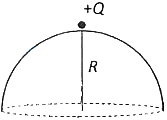 JEE Advanced 2017 Medium
 - A horizontal forceis applied at the centre of mass of a cylindrical object of massand radius, perpendicular to its axis as shown in the figure. The coefficient of friction between the object and the ground is. The centre of mass of the object has an acceleration. The acceleration due to gravity is. Given that the object rolls without slipping, which of the following statement(s) is (are) correct?
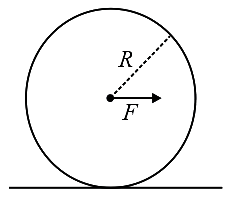 JEE Advanced 2021 Hard
 - The compound(s) with \(\mathrm{P}-\mathrm{H}\) bond(s) is(are)JEE Advanced 2025 Easy
- Paragraph :
When liquid medicine of density \(\rho\) is to be put in the eye, it is done with the help of a dropper. As the bulb on the top of the dropper is pressed, a drop forms at the opening of the dropper. We wish to estimate the size of the drop.
We first assume that the drop formed at the opening is spherical because that requires a minimum increase in its surface energy. To determine the size, we calculate the net vertical force due to the surface tension \(T\) when the radius of the drop is \(R\). When this force becomes smaller than the weight of the drop, the drop gets detached from the dropper.Question :
After the drop detaches, its surface energy isJEE Advanced 2010 Easy - Let the position vectors of points and be and , respectively. Then which of the following statements is true?JEE Advanced 2023 Medium
- Let and be three events having probabilities and and let
For any event , if denotes its complement, then which of the following statements is (are) TRUE ?JEE Advanced 2021 Medium