


JEE Advanced · Physics · 11. Properties of Fluids
A spherical soap bubble inside an air chamber at pressure \(P_0=10^5 \mathrm{~Pa}\) has a certain radius so that the excess pressure inside the bubble is \(\Delta P=144 \mathrm{~Pa}\). Now, the chamber pressure is reduced to \(8 P_0 / 27\) so that the bubble radius and its excess pressure change. In this process, all the temperatures remain unchanged. Assume air to be an ideal gas and the excess pressure \(\Delta P\) in both the cases to be much smaller than the chamber pressure. The new excess pressure \(\Delta P\) in \(\mathrm{Pa}\) is ________ .
- A 92
- B 94
- C 98
- D 96
Answer & Solution
Correct Answer
(D) 96
Step-by-step Solution
Detailed explanation
Case-1
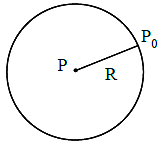
\(\begin{aligned} & \mathrm{P}-\mathrm{P}_0=\Delta \mathrm{P}=\frac{4 \mathrm{~T}}{\mathrm{R}} \\ & \mathrm{P}=\left(\mathrm{P}_0+\frac{4 \mathrm{~T}}{\mathrm{R}}\right)\end{aligned}\)
Case-2
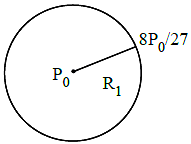
\(\begin{aligned} & \mathrm{P}_1-\frac{8 \mathrm{P}_0}{27}=\Delta \mathrm{P}_1=\frac{4 \mathrm{~T}}{\mathrm{R}_1} \\ & \mathrm{P}_1=\frac{4 \mathrm{~T}}{\mathrm{R}_1}+\frac{8 \mathrm{P}_0}{27}\end{aligned}\)
Constant temperature process
\(\mathrm{PV}=\mathrm{P}_1 \mathrm{~V}_1 \)
\( \left(\mathrm{P}_0+\frac{4 \mathrm{~T}}{\mathrm{R}}\right) \frac{4}{3} \pi \mathrm{R}^3=\left(\frac{4 \mathrm{~T}}{\mathrm{R}_1}+\frac{8 \mathrm{P}_0}{27}\right) \frac{4}{3} \pi \mathrm{R}_1^3 ;\) \(\left(\frac{4 \mathrm{~T}}{\mathrm{R}}\right),\left(\frac{4 \mathrm{~T}}{\mathrm{R}_1}\right) \rightarrow \text { (Neglected) } \)
\( \mathrm{R}=\frac{2}{3} \mathrm{R}_1 \Rightarrow \mathrm{R}_1=\frac{3}{2} \mathrm{R} \)
\( \Delta \mathrm{P}_1=\frac{4 \mathrm{~T}}{\mathrm{R}_1}=\frac{4 \mathrm{~T}}{3 \mathrm{R}} \times 2=\frac{2}{3} \times(144)=96 \mathrm{~Pa}\)
\(\begin{aligned} & \mathrm{P}-\mathrm{P}_0=\Delta \mathrm{P}=\frac{4 \mathrm{~T}}{\mathrm{R}} \\ & \mathrm{P}=\left(\mathrm{P}_0+\frac{4 \mathrm{~T}}{\mathrm{R}}\right)\end{aligned}\)
Case-2
\(\begin{aligned} & \mathrm{P}_1-\frac{8 \mathrm{P}_0}{27}=\Delta \mathrm{P}_1=\frac{4 \mathrm{~T}}{\mathrm{R}_1} \\ & \mathrm{P}_1=\frac{4 \mathrm{~T}}{\mathrm{R}_1}+\frac{8 \mathrm{P}_0}{27}\end{aligned}\)
Constant temperature process
\(\mathrm{PV}=\mathrm{P}_1 \mathrm{~V}_1 \)
\( \left(\mathrm{P}_0+\frac{4 \mathrm{~T}}{\mathrm{R}}\right) \frac{4}{3} \pi \mathrm{R}^3=\left(\frac{4 \mathrm{~T}}{\mathrm{R}_1}+\frac{8 \mathrm{P}_0}{27}\right) \frac{4}{3} \pi \mathrm{R}_1^3 ;\) \(\left(\frac{4 \mathrm{~T}}{\mathrm{R}}\right),\left(\frac{4 \mathrm{~T}}{\mathrm{R}_1}\right) \rightarrow \text { (Neglected) } \)
\( \mathrm{R}=\frac{2}{3} \mathrm{R}_1 \Rightarrow \mathrm{R}_1=\frac{3}{2} \mathrm{R} \)
\( \Delta \mathrm{P}_1=\frac{4 \mathrm{~T}}{\mathrm{R}_1}=\frac{4 \mathrm{~T}}{3 \mathrm{R}} \times 2=\frac{2}{3} \times(144)=96 \mathrm{~Pa}\)
See the Complete Solution
Get step-by-step explanations for this and 2.5 Lakh+ more JEE, NEET & CET questions.
- Unlock all solutions
- Practice the full chapter
- Track accuracy across PYQs
4.8 rated on Google Play · 14,000+ reviews
More questions from Physics
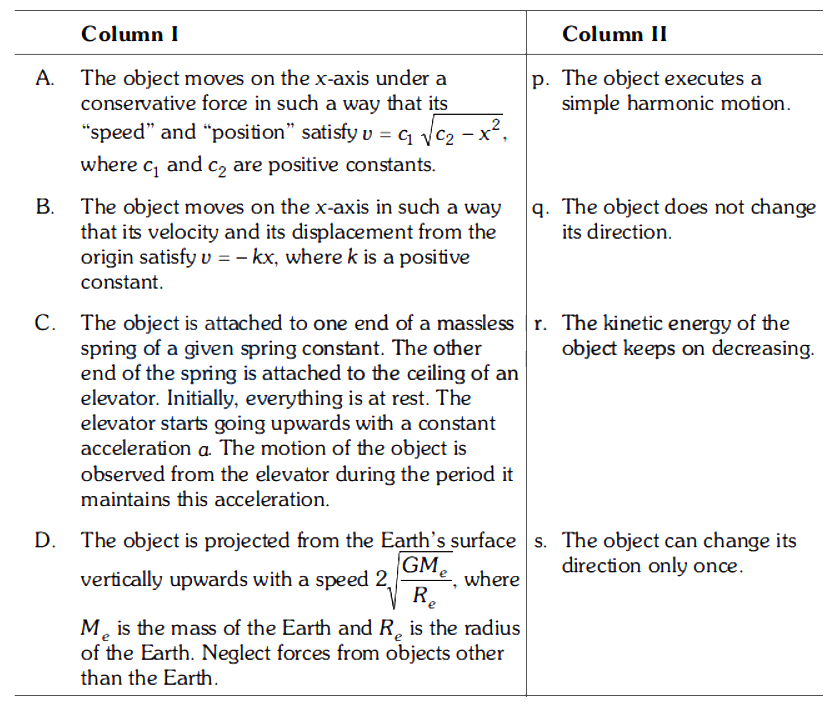
- Column I describes some situations in which a small object moves. Column II describes some characteristics of these motions. Match the situations in Column I with the characteristics in Column II and indicate your answer by darkening appropriate bubbles in the \(4 \times 4\) matrix given in the ORS.
 JEE Advanced 2007 Hard
 - The minimum kinetic energy needed by an alpha particle to cause the nuclear reaction in a laboratory frame is (in ). Assume that is at rest in the laboratory frame. The masses of and can be taken to be , and , respectively, where . The value of is
If the numerical value has more than two decimal places, truncate/round-off the value to TWO decimal places.JEE Advanced 2022 Medium - A particle of mass is attached to one end of a massless spring of force constant , lying on a frictionless horizontal plane. The other end of the spring is fixed. The particle starts moving horizontally from its equilibrium position at time with an initial velocity . When the speed of the particle is , it collides elastically with a rigid wall. After this collision :JEE Advanced 2013 Medium
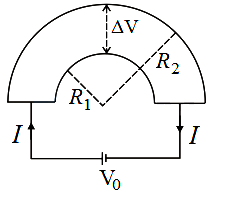
- Shown in the figure is a semicircular metallic strip that has thickness and resistivity . Its inner radius is and outer radius is . If a voltage is applied between its two ends, a current flows in it. In addition, it is observed that a transverse voltage develops between its inner and outer surfaces due to purely kinetic effects of moving electrons (ignore any role of the magnetic field due to the current). Then (figure is schematic and not drawn to scale)
 JEE Advanced 2020 Hard
 - A charged particle is introduced at the origin with a given initial velocity . A uniform electric field and a uniform magnetic field exist everywhere. The velocity , electric field and a uniform magnetic field are given in the columns below
In which case will the particle describe a helical path with axis along positive z direction?Column 1 Column 2 Column 3 1. Electron with (i) (P) 2. Electron with (ii) (Q) 3.Proton with =0 (iii) (R) 4. Proton with (iv) (S) JEE Advanced 2017 Medium - A soft plastic bottle, filled with water of density \(1 \mathrm{gm} / \mathrm{cc}\), carries an inverted glass test-tube with some air (ideal gas) trapped as shown in the figure. The test-tube has a mass of \(5 \mathrm{gm}\), and it is made of a thick glass of density \(2.5 \mathrm{gm} / \mathrm{cc}\). Initially the bottle is sealed at atmospheric pressure \(p_{0}=10^{5} \mathrm{~Pa}\) so that the volume of the trapped air is \(v_{0}=3.3 \mathrm{cc}\). When the bottle is squeezed from outside at constant temperature, the pressure inside rises and the volume of the trapped air reduces. It is found that the test tube begins to sink at pressure \(p_{0}+\Delta p\) without changing its orientation. At this pressure, the volume of the trapped air is \(v_{0}-\Delta v\).
Let \(\Delta v=X\) cc and \(\Delta p=Y \times 10^{3} \mathrm{~Pa}\).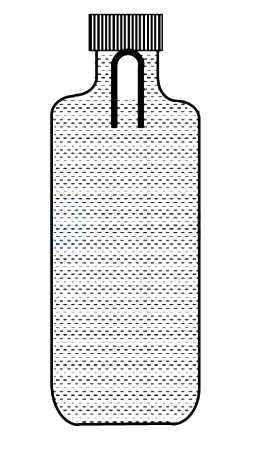
The value of is ____.JEE Advanced 2021 Hard
More PYQs from JEE Advanced
- The reduction potential , in of is
\(\left[\right.\)Given: \(E _{\left( MnO _4^{-}( aq ) / MnO _2(s)\right)}^{ o }=1.68 V ;\) \( E _{\left( MnO _2(s) / Mn ^{2+}( aq )\right)}^{ o }=\) \(1.21 V ; E _{\left( Mn ^{2+}( aq ) / Mn ( s )\right)}^{ o }\) \(=-1.03 V]\)
Truncate/round-off the value to TWO decimal places.JEE Advanced 2022 Medium - For a real number if the system of linear equations, has infinitely many solutions, thenJEE Advanced 2017 Medium
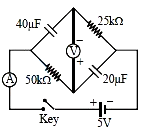
- In the circuit shown below, the key is pressed at time t = 0. Which of the following statement(s) is(are) true?
 JEE Advanced 2016 Hard
 - Let and
where denotes the transpose of the matrix Then which of the following options is/are correct?JEE Advanced 2019 Medium - Let be non-zero complex numbers and be the set of solutions of the equation , where . Then, which of the following statement(s) is (are) TRUE?JEE Advanced 2018 Medium
- Two beads, each with charge \(q\) and mass \(m\), are on a horizontal, frictionless, non-conducting, circular hoop of radius \(R\). One of the beads is glued to the hoop at some point, while the other one performs small oscillations about its equilibrium position along the hoop. The square of the angular frequency of the small oscillations is given by
[ \(\varepsilon_0\) is the permittivity of free space.]JEE Advanced 2024 Hard