


JEE Advanced · Chemistry · 23. Coordination Compounds
The ionization isomer of \(\left[\mathrm{Cr}\left(\mathrm{H}_2 \mathrm{O}\right)_4 \mathrm{Cl}\left(\mathrm{NO}_2\right)\right] \mathrm{Cl}\) is
- A \(\left[\mathrm{Cr}\left(\mathrm{H}_2 \mathrm{O}\right)_4\left(\mathrm{O}_2 \mathrm{~N}\right)\right] \mathrm{Cl}_2\)
- B \(\left[\mathrm{Cr}\left(\mathrm{H}_2 \mathrm{O}\right)_4 \mathrm{Cl}_2\right]\left(\mathrm{NO}_2\right)\)
- C \(\left[\mathrm{Cr}\left(\mathrm{H}_2 \mathrm{O}\right)_4 \mathrm{Cl}(\mathrm{ONO})\right] \mathrm{Cl}\)
- D \(\left[\mathrm{Cr}\left(\mathrm{H}_2 \mathrm{O}\right)_4 \mathrm{Cl}_2\left(\mathrm{NO}_2\right)\right] \cdot \mathrm{H}_2 \mathrm{O}\)
Answer & Solution
Correct Answer
(B) \(\left[\mathrm{Cr}\left(\mathrm{H}_2 \mathrm{O}\right)_4 \mathrm{Cl}_2\right]\left(\mathrm{NO}_2\right)\)
Step-by-step Solution
Detailed explanation
The ionization isomer of \(\left[\mathrm{Cr}\left(\mathrm{H}_2 \mathrm{O}\right)_4 \mathrm{Cl}\left(\mathrm{NO}_2\right)\right] \mathrm{Cl}\) is \(\left[\mathrm{Cr}\left(\mathrm{H}_2 \mathrm{O}\right)_4 \mathrm{Cl}_2\right] \mathrm{NO}_2\) because of exchanging of ligand and counter ions
Coordination chemistry
Straight conceptual
II
Coordination chemistry
Straight conceptual
II
See the Complete Solution
Get step-by-step explanations for this and 2.5 Lakh+ more JEE, NEET & CET questions.
- Unlock all solutions
- Practice the full chapter
- Track accuracy across PYQs
4.8 rated on Google Play · 14,000+ reviews
More questions from Chemistry
- LIST-I contains compounds and LIST-II contains reactions
Match each compound in LIST-I with its formation reaction(s) in LIST-II, and choose the correct optionList - I List - II (I) \(H _2 O _2\) (P) \(Mg \left( HCO _3\right)_2+ Ca\) \((OH)_2 \rightarrow\) (II) \(Mg ( OH )_2\) (Q) \(BaO _2+ H _2 SO _4 \rightarrow\) (III) \(BaCl _2\) (R) \(Ca \left( OH _2\right) 2\) \(+ MgCl _2 \rightarrow\) (IV) \(CaCO _3\) (S) \(BaO _2+ HCl \rightarrow\) (T) \(Ca \left( HCO _3\right)_2\) \(+ Ca ( OH )_2\) JEE Advanced 2022 Easy - In a conductometric titration, small volume of titrant of higher concentration is added stepwise to a larger volume of titrate of much lower concentration, and the conductance is measured after each addition.
The limiting ionic conductivity \(\left(\Lambda_0\right)\) values (in \(\mathrm{mS} \mathrm{m}^2 \mathrm{~mol}^{-1}\)) for different ions in aqueous solutions are given below:
For different combinations of titrates and titrants given in List-I, the graphs of 'conductance' versus 'volume of titrant' are given in List-II.
Match each entry in List-I with the appropriate entry in List-II and choose the correct option.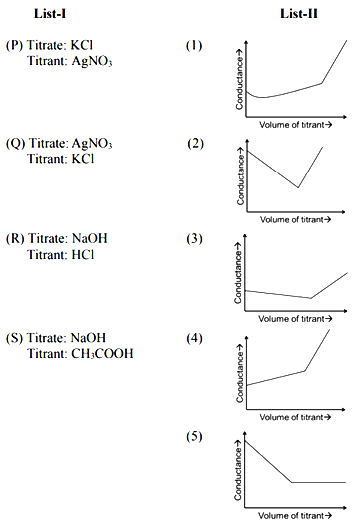 JEE Advanced 2024 Easy
 - Consider the following complex ions, P, Qand R.

The correct order of the complex ions, according to their spin-only magnetic moment values (in B.M.) isJEE Advanced 2013 Medium - The carbon-based reduction method is NOT used for the extraction ofJEE Advanced 2013 Easy
- The sum of the number of lone pairs of electrons on each central atom in the following species is \(\left[ TeBr _6\right]^{2-},\left[ Br F _2\right]^{+}, S N F_3\) and \(\left[ XeF _3\right]^{-}\)[Atomic number : \(N=7, F=9, S =16, B r=35,\) \(T e=52, X e=54]\)JEE Advanced 2017 Medium
- Paragraph:
Chemical reactions involve interaction of atoms and molecules. A large number of atoms/molecules (approximately \(6.023 \times 10^{23}\) ) are present in a few grams of any chemical compound varying with their atomic/molecular masses. To handle such large numbers conveniently, the mole concept was introduced. This concept has implications in diverse areas such as analytical chemistry, biochemistry, electrochemistry and radiochemistry. The following example illustrates a typical case, involving chemical/electrochemical reaction, which requires a clear understanding of the mole concept.
A \(4.0\) molar aqueous solution of \(\mathrm{NaCl}\) is prepared and \(500 \mathrm{~mL}\) of this solution is electrolysed. This leads to the evolution of chlorine gas at one of electrodes (atomic mass: \(\mathrm{Na}=23, \mathrm{Hg}=200 ; 1\) faraday \(=96500\) coulombs).
Question:
The total charge (coulombs) required for complete electrolysis isJEE Advanced 2007 Medium
More PYQs from JEE Advanced
- \(\mathrm{CuSO}_4\) decolourises on addition of \(\mathrm{KCN}\), the product isJEE Advanced 2006 Medium
- Consider the parabola . Let be the focus of the parabola. A pair of tangents drawn to the parabola from the point meet the parabola at and . Let and be points on the lines and respectively such that is perpendicular to and is perpendicular to . Then, which of the following is/are TRUE?JEE Advanced 2022 Medium
- Sometimes it is convenient to construct a system of units so that all quantities can be expressed in terms of only one physical quantity. In one such system, dimensions of different quantities are given in terms of a quantity as follows: ; ;; . ThenJEE Advanced 2020 Medium
- The total number of compounds having at least one bridging oxo group among the molecules given below is
\(\text N _2\text O _5,\)\(\text P _4\text O _6,\)\(\text P _4\text O _8,\)\(\text H _4\text P _2\text O _5,\)\(\text H _5\text P _3\text O _{10},\) \(\text H _2\text S_2\text O _3,\text H _2\text S_2\text O _5\)JEE Advanced 2018 Medium - For , a transition takes place from the orbit of radius to the orbit of radius . The wavelength (in ) of the emitted photon during the transition is
Bohr radius,
Rydberg constant,
Planck's constant,
Speed of light, ]JEE Advanced 2023 Easy - A tangent \(P T\) is drawn to the circle \(x^{2}+y^{2}=4\) at the point \(P(\sqrt{3}, 1)\). A straight line \(L\), perpendicular to \(P T\) is a tangent to the circle \((x-3)^{2}+y^{2}-1\).
Question: A possible equation of \(L\) isJEE Advanced 2012 Medium