


JEE Advanced · Chemistry · 17. Electrochemistry
In a conductometric titration, small volume of titrant of higher concentration is added stepwise to a larger volume of titrate of much lower concentration, and the conductance is measured after each addition.
The limiting ionic conductivity \(\left(\Lambda_0\right)\) values (in \(\mathrm{mS} \mathrm{m}^2 \mathrm{~mol}^{-1}\)) for different ions in aqueous solutions are given below:

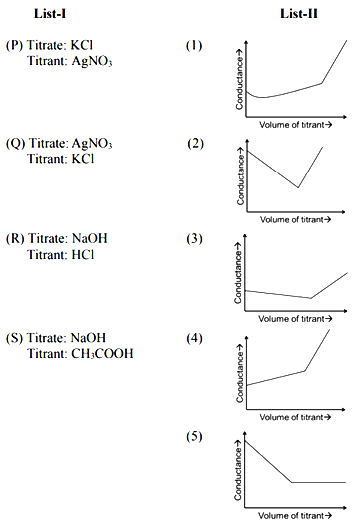
For different combinations of titrates and titrants given in List-I, the graphs of 'conductance' versus 'volume of titrant' are given in List-II.
Match each entry in List-I with the appropriate entry in List-II and choose the correct option.
- A \(\mathrm{P}-4, \mathrm{Q}-3, \mathrm{R}-2, \mathrm{~S}-5\)
- B \(\mathrm{P}-2, \mathrm{Q}-4, \mathrm{R}-3, \mathrm{~S}-1\)
- C \(\mathrm{P}-3, \mathrm{Q}-4, \mathrm{R}-2, \mathrm{~S}-5\)
- D \(\mathrm{P}-4, \mathrm{Q}-3, \mathrm{R}-2, \mathrm{~S}-1\)
Answer & Solution
Correct Answer
(C) \(\mathrm{P}-3, \mathrm{Q}-4, \mathrm{R}-2, \mathrm{~S}-5\)
Step-by-step Solution
Detailed explanation
Option (P) :
On adding \(\mathrm{AgNO}_3\) solution to \(\mathrm{KCl}\) solution precipitation of \(\mathrm{AgCl}\) will occur due to which \(\mathrm{Cl}^{-}\)already present will be replaced by \(\mathrm{NO}_3^{-}\)ions. So conductance of solution will decrease till equivalence point. After complete precipitation of \(\mathrm{AgCl}\), further added \(\mathrm{AgNO}_3\) will increase the number of ions in resulting solution so conductance will increase.
Option \((\mathbf{Q})\) :
On adding \(\mathrm{KCl}\) solution to \(\mathrm{AgNO}_3\) solution precipitation of \(\mathrm{AgCl}\) will occur due to which already present \(\mathrm{Ag}^{+}\)ions will be replaced by \(\mathrm{K}^{+}\)ions in solution. So conductance of solution will increase. After complete precipitation of \(\mathrm{AgCl}\) further added \(\mathrm{KCl}\) will increase the number of ions in resulting solution so conductance will increase further.
Option (R) :
On adding \(\mathrm{HCl}\) solution to \(\mathrm{NaOH}\) solution, \(\mathrm{OH}^{-}\)will be replaced by \(\mathrm{Cl}^{-}\)ions so conductance of solution decreases. After complete neutralisation further added \(\mathrm{HCl}\) will increase number of ions in the solution. So conductance will increase further.
Option (S) :
On adding \(\mathrm{CH}_3 \mathrm{COOH}\) solution to \(\mathrm{NaOH}\) solution \(\mathrm{OH}^{-}\)will be replaced by \(\mathrm{CH}_3 \mathrm{COO}^{-}\)ions, so conductance of solution decreases. After complete neutralisation further added \(\mathrm{CH}_3 \mathrm{COOH}\) will remain undissociated because it is a weak acid and there is also common ion effect on acetate ions. So number of ions in solution will remain almost constant therefore conductance of solution will remain constant.
On adding \(\mathrm{AgNO}_3\) solution to \(\mathrm{KCl}\) solution precipitation of \(\mathrm{AgCl}\) will occur due to which \(\mathrm{Cl}^{-}\)already present will be replaced by \(\mathrm{NO}_3^{-}\)ions. So conductance of solution will decrease till equivalence point. After complete precipitation of \(\mathrm{AgCl}\), further added \(\mathrm{AgNO}_3\) will increase the number of ions in resulting solution so conductance will increase.
Option \((\mathbf{Q})\) :
On adding \(\mathrm{KCl}\) solution to \(\mathrm{AgNO}_3\) solution precipitation of \(\mathrm{AgCl}\) will occur due to which already present \(\mathrm{Ag}^{+}\)ions will be replaced by \(\mathrm{K}^{+}\)ions in solution. So conductance of solution will increase. After complete precipitation of \(\mathrm{AgCl}\) further added \(\mathrm{KCl}\) will increase the number of ions in resulting solution so conductance will increase further.
Option (R) :
On adding \(\mathrm{HCl}\) solution to \(\mathrm{NaOH}\) solution, \(\mathrm{OH}^{-}\)will be replaced by \(\mathrm{Cl}^{-}\)ions so conductance of solution decreases. After complete neutralisation further added \(\mathrm{HCl}\) will increase number of ions in the solution. So conductance will increase further.
Option (S) :
On adding \(\mathrm{CH}_3 \mathrm{COOH}\) solution to \(\mathrm{NaOH}\) solution \(\mathrm{OH}^{-}\)will be replaced by \(\mathrm{CH}_3 \mathrm{COO}^{-}\)ions, so conductance of solution decreases. After complete neutralisation further added \(\mathrm{CH}_3 \mathrm{COOH}\) will remain undissociated because it is a weak acid and there is also common ion effect on acetate ions. So number of ions in solution will remain almost constant therefore conductance of solution will remain constant.
See the Complete Solution
Get step-by-step explanations for this and 2.5 Lakh+ more JEE, NEET & CET questions.
- Unlock all solutions
- Practice the full chapter
- Track accuracy across PYQs
4.8 rated on Google Play · 14,000+ reviews
More questions from Chemistry
- For the process at and 1 atmosphere pressure, the correct choice isJEE Advanced 2014 Medium
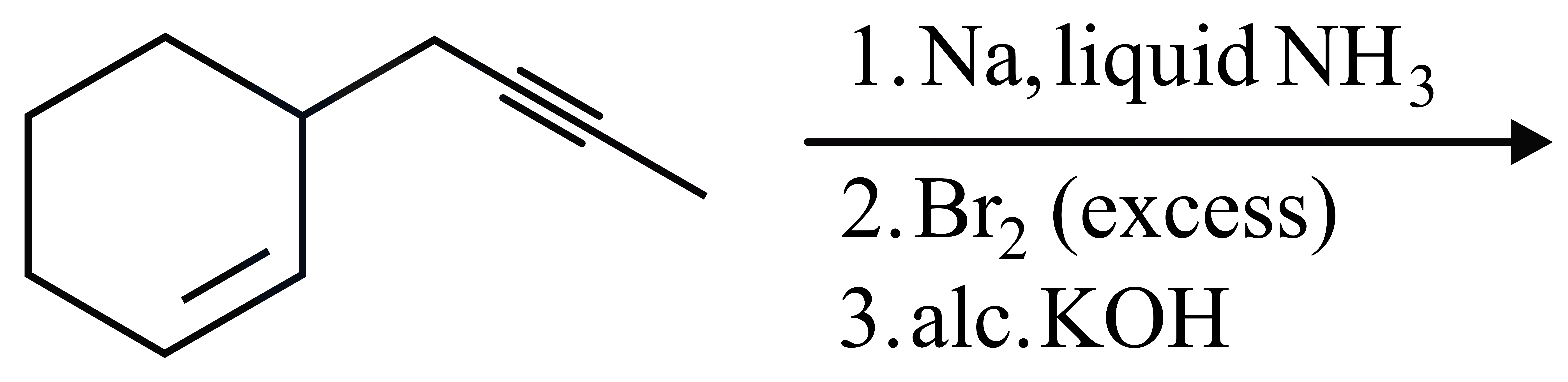
- The number of isomeric tetraenes (NOT containing sp-hybridized carbon atoms) that can be formed from the following reaction sequence is _____ .
 JEE Advanced 2022 Hard
 - Match the gases under specified conditions listed in Column I with their properties/laws in Column II. Indicate your answer by darkening the appropriate bubbles of \(4 \times 4\) matrix given in the ORS.
Column I Column II A. Hydrogen gas
\((P=200 atm,\) \(T=273 K)\)p. Compressibility factor \(\neq 1\) B. Hydrogen gas
\((P \sim 0,\) \(T=273 K)\)q. Attractive forces are dominant C. \(CO _2(P=1 atm,\) \(T=273 K)\) r. \(P V=n R T\) D. Real gas with very large molar volume s. \(P(V-n b)=n R T\) JEE Advanced 2007 Medium - The standard enthalpies of formation of and glucose (s) at are , and , respectively. The standard enthalpy combustion per gram of glucose at isJEE Advanced 2013 Hard
- The direct conversion of \(A\) to \(B\) is difficult, hence it is carried out by the following shown path.
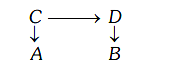
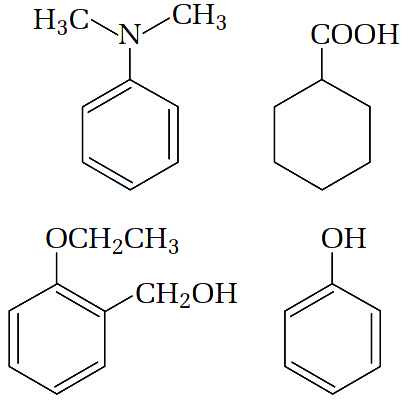
Given \(\Delta S_{(A \rightarrow C)}=50 \mathrm{eu}, \quad \Delta S_{(C \rightarrow D)}=30 \mathrm{eu}, \quad\) \(\Delta S_{(B \rightarrow D)}=20 \mathrm{eu}\) where eu is entropy unit, then \(\Delta S_{(A \rightarrow B)}\) isJEE Advanced 2006 Medium - Amongst the following, the total number of compounds soluble in aqueous \(\mathrm{NaOH}\) is
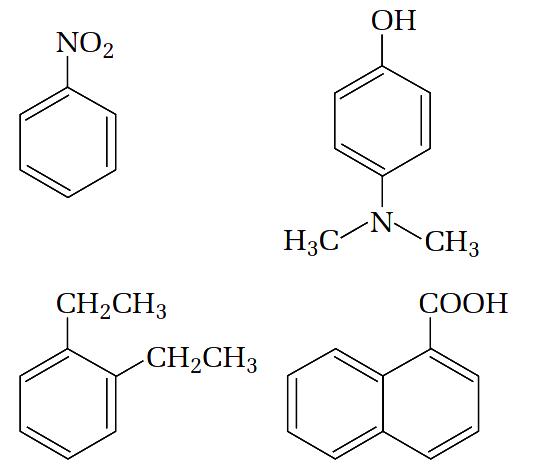 JEE Advanced 2010 Hard
More PYQs from JEE Advanced
- An ideal gas is expanded from under different conditions. The correct statement(s) among the following is(are)JEE Advanced 2017 Medium
- The total number of cyclic isomers possible for a hydrocarbon with the molecular formula \(\mathrm{C}_4 \mathrm{H}_6\) isJEE Advanced 2010 Medium
- Atom occupies the fcc lattice sites as well as alternate tetrahedral voids of the same lattice. The packing efficiency (in ) of the resultant solid is closest toJEE Advanced 2022 Medium
- A hyperbola, having the transverse axis of length \(2 \sin \theta\), is confocal with the ellipse \(3 x^2+4 y^2=12\). Then, its equation isJEE Advanced 2007 Medium
- For non-negative integers let
Assuming takes values in which of the following options is/are correct?JEE Advanced 2019 Medium - Let and let be given by thenJEE Advanced 2014 Hard