


JEE Advanced · Chemistry · 8. Ionic Equilibrium
Aqueous solutions of \(\mathrm{HNO}_3, \mathrm{KOH}\), \(\mathrm{CH}_3 \mathrm{COOH}\), and \(\mathrm{CH}_3 \mathrm{COONa}\) of identical concentrations are provided. The pair(s) of solutions which form a buffer upon mixing is(are)
- A \(\mathrm{HNO}_3\) and \(\mathrm{CH}_3 \mathrm{COOH}\)
- B \(\mathrm{KOH}\) and \(\mathrm{CH}_3 \mathrm{COONa}\)
- C \(\mathrm{HNO}_3\) and \(\mathrm{CH}_3 \mathrm{COONa}\)
- D \(\mathrm{CH}_3 \mathrm{COOH}\) and \(\mathrm{CH}_3 \mathrm{COONa}\)
Answer & Solution
Correct Answer
(D) \(\mathrm{CH}_3 \mathrm{COOH}\) and \(\mathrm{CH}_3 \mathrm{COONa}\)
Step-by-step Solution
Detailed explanation
\(\mathrm{HNO}_3\) and \(\mathrm{CH}_3 \mathrm{COONa}\) can form buffer if the amount of \(\mathrm{HNO}_3\) is limited. However concentrations are same but the amount can differ with manipulation of volume.
Ionic equilibrium
Conceptual
II
Ionic equilibrium
Conceptual
II
See the Complete Solution
Get step-by-step explanations for this and 2.5 Lakh+ more JEE, NEET & CET questions.
- Unlock all solutions
- Practice the full chapter
- Track accuracy across PYQs
4.8 rated on Google Play · 14,000+ reviews
More questions from Chemistry
- Amongst the following, the total number of compounds soluble in aqueous \(\mathrm{NaOH}\) is
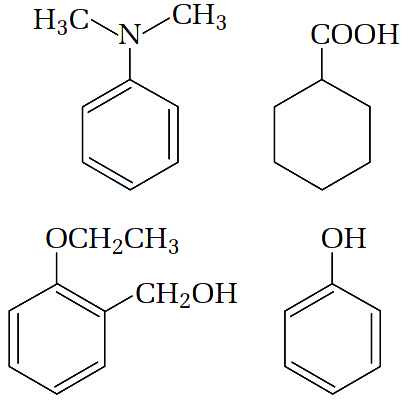
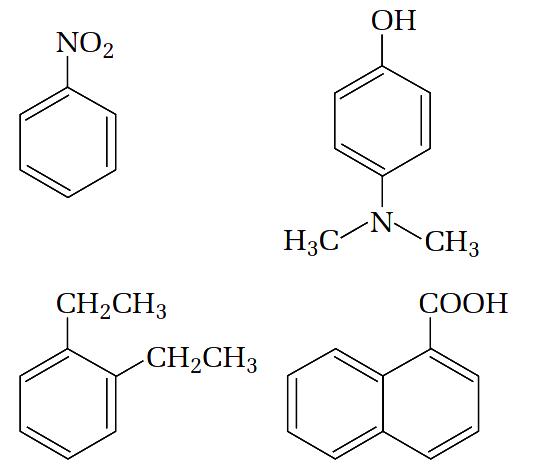 JEE Advanced 2010 Hard
 - For the following reaction scheme, percentage yields are given along the arrow:
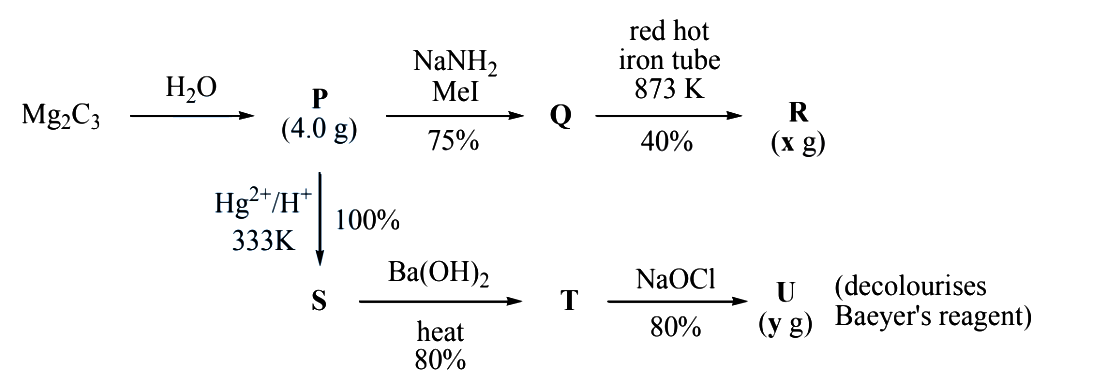
\(\mathbf{x} g\) and \(\mathbf{y} g\) are mass of \(\mathbf{R}\) and \(\mathbf{U}\), respectively.
(Use: Molar mass (in \(\mathrm{g} \mathrm{mol}^{-1}\) ) of \(\mathrm{H}, \mathrm{C}\) and \(\mathrm{O}\) as 1,12 and 16 , respectively)
The value of is ___.JEE Advanced 2021 Medium - The Henry's law constant for the solubility of \(\mathrm{N}_2\) gas in water at \(298 \mathrm{~K}\) is \(1.0 \times 105 \mathrm{~atm}\). The mole fraction of \(\mathrm{N}_2\) in air is \(0.8\). The number of moles of \(\mathrm{N}_2\) from air dissolved in 10 moles of water of \(298 \mathrm{~K}\) and \(5 \mathrm{~atm}\) pressure isJEE Advanced 2009 Medium
- Upon treatment with ammoniacal , the metal ion that precipitates as a sulphide isJEE Advanced 2013 Easy
- The shape of \(\mathrm{XeO}_{2} \mathrm{~F}_{2}\) molecule isJEE Advanced 2012 Medium
- Statement I In water, orthoboric acid behaves as a weak monobasic acid.
Statement II In water, orthoboric acid acts as proton donor.JEE Advanced 2007 Easy
More PYQs from JEE Advanced
- A rectangular conducting loop of length and width is in the -plane, as shown in the figure. It is being moved away from a thin and long conducting wire along the direction with a constant speed . The wire is carrying a steady current in the positive -direction. A current of flows through the loop when it is at a distance from the wire. If the resistance of the loop is , then the value of is _____ .
[Given: The permeability of free space ]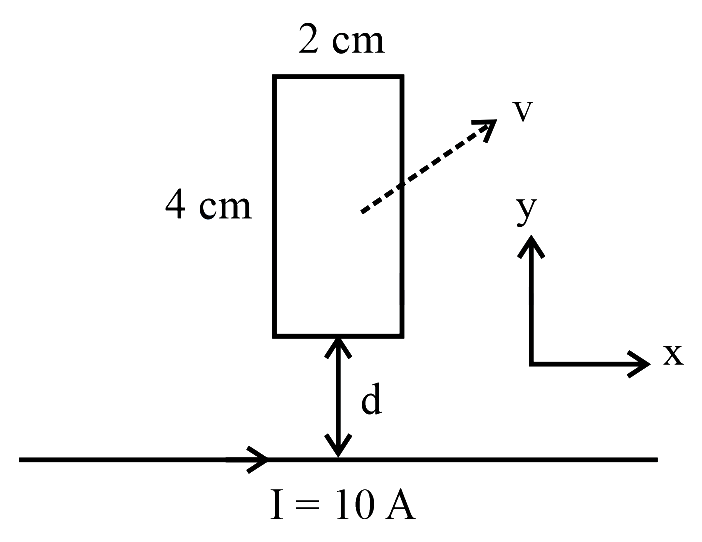 JEE Advanced 2023 Medium
 - The electrochemical cell shown below is a concentration cell. \(\mathrm{M} \mid \mathrm{M}^{2+}\) (saturated solution of a sparingly soluble salt, \(\left.\mathrm{MX}_{2}\right) \| \mathrm{M}^{2 \perp}\left(0.001 \mathrm{~mol} \mathrm{dm}^{-3}\right) \mid \mathrm{M}\).
The emf of the cell depends on the difference in concentrations of \(\mathrm{M}^{2+}\) ions at the two electrodes. The emf of the cell at \(298 \mathrm{~K}\) is \(0.059 \mathrm{~V}\).
Question:
The value of \(\Delta \mathrm{G}\left(\mathrm{kJ} \mathrm{mol}^{-1}\right)\) for the given cell is (take 1 \(\mathrm{F}=96500 \mathrm{Cmol}^{-1}\) )JEE Advanced 2012 Medium - Parallel rays of light of intensity are incident on a spherical black body kept in surroundings of temperature 300 K. Take Stefan-Boltzmann constant and assume that the energy exchange with the surroundings is only through radiation. The final steady state temperature of the black body is close toJEE Advanced 2014 Medium
- A particle of mass \(m\) is moving in a circular orbit under the influence of the central force \(F(r)=-k r\), corresponding to the potential energy \(V(r)=k r^2 / 2\), where \(k\) is a positive force constant and \(r\) is the radial distance from the origin. According to the Bohr's quantization rule, the angular momentum of the particle is given by \(L=n \hbar\), where \(\hbar=h /(2 \pi), h\) is the Planck's constant, and \(n\) a positive integer. If \(v\) and \(E\) are the speed and total energy of the particle, respectively, then which of the following expression(s) is(are) correct?JEE Advanced 2024 Medium
- Let be an integer. Take n distinct points on a circle and join each pair of points by a line segment. Colour the line segment joining every pair of adjacent points by blue and the rest by red. If the number of red and blue line segments are equal, then the value of n is ________JEE Advanced 2014 Hard
- \(29.2 \%(\mathrm{w} / \mathrm{w}) \mathrm{HCl}\) stock solution has a density of \(1.25 \mathrm{gmL}^{-1}\). The molecular weight of \(\mathrm{HCl}\) is \(36.5 \mathrm{~g} \mathrm{~mol}^{-1}\). The volume \((\mathrm{mL})\) of stock solution required to prepare a 200 \(\mathrm{mL}\) solution of \(0.4 \mathrm{M} \mathrm{HCl}\) is :JEE Advanced 2012 Medium