


JEE Advanced · Chemistry · 17. Electrochemistry
Paragraph:
The concentration of potassium ions inside a biological cell is at least twenty times higher than the outside. The resulting potential difference across the cell is important in several processes such as transmission of nerve impulses and maintaining the ion balance. A simple model for such a concentration cell involving a metal \(\mathrm{M}\) is :
\(M(s) \mid M^{+}(\alpha q ; 0.05 \text { molar }) \| M^{+}(a q ; 1 \text { molar })\) \(\mid M(s)\)
For the above electrolytic cell the magnitude of the cell potential \(\left|E_{\text {cell }}\right|=70 \mathrm{mV}\).
Question
For the above cell
- A \(E_{\text {cell }} < 0 ; \Delta G>0\)
- B \(E_{\text {cell }}>0 ; \Delta G < 0\)
- C \(E_{\text {cell }} < 0 ; \Delta G^{\circ}>0\)
- D \(E_{\text {cell }}>0 ; \Delta G^{\circ} < 0\)
Answer & Solution
Correct Answer
(B) \(E_{\text {cell }}>0 ; \Delta G < 0\)
Step-by-step Solution
Detailed explanation
The given cell is electrolytic concentration cell, So \(E_{\text {cell }}^{\circ}=0\)
Anode :
\(\begin{gathered}
M(s) \longrightarrow M^{+}(a q)+e^{-} \\
\text {Cathode }: \quad M^{+}(a q)+e^{-} \longrightarrow M(s) \\
\hline M^{+}(a q) \text { cathode } \rightleftharpoons M^{+}(a q) \text { anode } \\
E_{\text {cell }}=E_{\text {cell }}^{\circ}-\frac{0.0591}{1} \log \frac{\left[M^{+}\right]_{\text {anodic }}}{\left[M^{+}\right]_{\text {cathodic }}} \\
=0-\frac{0.0591}{1} \log \frac{0.05}{1} \\
E_{\text {cell }}=70 \mathrm{mV}(+\text { ve }) \\
\text { Hence, } \Delta G=-n F E_{\text {cell }}=-\text { ve }
\end{gathered}\)
Anode :
\(\begin{gathered}
M(s) \longrightarrow M^{+}(a q)+e^{-} \\
\text {Cathode }: \quad M^{+}(a q)+e^{-} \longrightarrow M(s) \\
\hline M^{+}(a q) \text { cathode } \rightleftharpoons M^{+}(a q) \text { anode } \\
E_{\text {cell }}=E_{\text {cell }}^{\circ}-\frac{0.0591}{1} \log \frac{\left[M^{+}\right]_{\text {anodic }}}{\left[M^{+}\right]_{\text {cathodic }}} \\
=0-\frac{0.0591}{1} \log \frac{0.05}{1} \\
E_{\text {cell }}=70 \mathrm{mV}(+\text { ve }) \\
\text { Hence, } \Delta G=-n F E_{\text {cell }}=-\text { ve }
\end{gathered}\)
See the Complete Solution
Get step-by-step explanations for this and 2.5 Lakh+ more JEE, NEET & CET questions.
- Unlock all solutions
- Practice the full chapter
- Track accuracy across PYQs
4.8 rated on Google Play · 14,000+ reviews
More questions from Chemistry
- The maximum number of possible isomers (including stereoisomers) which may be formed on mono-bromination of -methylcyclohex- -ene using and light is ___.JEE Advanced 2021 Medium
- Consider a efficient hydrogen-oxygen fuel cell working under standard conditions at bar and . Its cell reaction is The work derived from the cell on the consumption of of is used to compress of a monoatomic ideal gas in a thermally insulated container. What is the change in the temperature (in ) of the ideal gas? The standard reduction potentials for the two half-cells are given below. \(O _2(g)+4 H ^{+}( aq )+4 e ^{-} \rightarrow 2 H _2 O ( l ),\) \(E ^0=1.23 V\) Use .JEE Advanced 2020 Hard
- The atomic masses of and are and , respectively. The value of the de Broglie wavelength of gas at is "M" times that of the de Broglie wavelength of at . M is:JEE Advanced 2013 Medium
- Newman projections and are shown below:
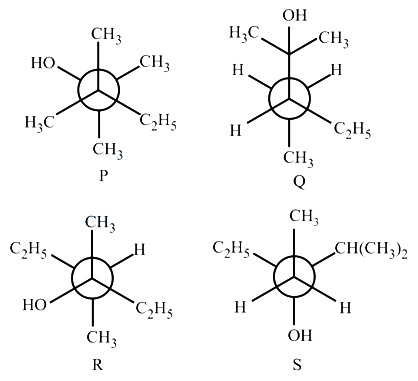
Which one of the following options represent identical molecules?JEE Advanced 2020 Medium - ( moles) reacts completely with acidified aqueous potassium permanganate solution. In this reaction, the number of moles of water produced is , and the number of moles of electrons involved is . The value of isJEE Advanced 2023 Easy
- Among cellulose, polyvinyl chloride, nylon and natural rubber, the polymer in which the intermolecular force of attraction is weakest inJEE Advanced 2009 Medium
More PYQs from JEE Advanced
- Two small particles of equal masses start moving in opposite directions from a point \(A\) in a horizontal circular orbit. Their tangential velocities are \(v\) and \(2 v\) respectively, as shown in the figure. Between collisions, the particles move with constant speeds. After making how many elastic collisions, other than that at \(A\), these two particles will again reach the point \(A\) ?
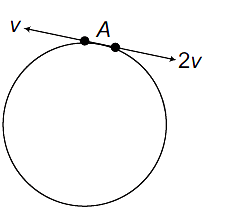 JEE Advanced 2009 Medium
 - The pair(s) of reagents that yield paramagnetic species is/areJEE Advanced 2014 Medium
- A circular insulated copper wire loop is twisted to form two loops of area and as shown in the figure. At the point of crossing the wires remain electrically insulated from each other. The entire loop lies in the plane (of the paper). A uniform magnetic field points into the plane of the paper. At , the loop starts rotating about the common diameter as axis with a constant angular velocity in the magnetic field. Which of the following options is/are correct?
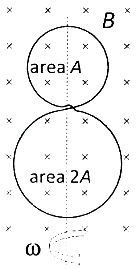 JEE Advanced 2017 Hard
 - A student performs an experiment to determine the Young's modulus of a wire, exactly \(2 \mathrm{~m}\) long, by Searle's method. In a particular reading, the student measures the extension in the length of the wire to be \(0.8 \mathrm{~mm}\) with an uncertainty of \(\pm 0.05 \mathrm{~mm}\) at a load of exactly \(1.0 \mathrm{~kg}\). The student also measures the diameter of the wire to be \(0.4 \mathrm{~mm}\) with an uncertainty of \(\pm 0.01 \mathrm{~mm}\). Take \(g=9.8 \mathrm{~m} / \mathrm{s}^2\) (exact). The Young's modulus obtained from the reading isJEE Advanced 2007 Easy
- An electric dipole with dipole moment is held fixed at the origin in the presence of an uniform electric field of magnitude If the potential is constant on a circle of radius centered at the origin as shown in figure, then the correct statement(s) is/are:
( is permittivity of free space, dipole size)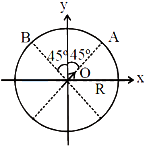 JEE Advanced 2019 Hard
 - A decapeptide (molecular weight 796) on complete hydrolysis gives glycine (molecular weight 75), alanine and phenylalanine. Glycine contributes \(47.0 \%\) to the total weight of the hydrolysed products. The number of glycine units present in the decapeptide isJEE Advanced 2011 Hard