


JEE Advanced · Physics · 1. Math in Physics
A student performs an experiment to determine the Young's modulus of a wire, exactly \(2 \mathrm{~m}\) long, by Searle's method. In a particular reading, the student measures the extension in the length of the wire to be \(0.8 \mathrm{~mm}\) with an uncertainty of \(\pm 0.05 \mathrm{~mm}\) at a load of exactly \(1.0 \mathrm{~kg}\). The student also measures the diameter of the wire to be \(0.4 \mathrm{~mm}\) with an uncertainty of \(\pm 0.01 \mathrm{~mm}\). Take \(g=9.8 \mathrm{~m} / \mathrm{s}^2\) (exact). The Young's modulus obtained from the reading is
- A \((2.0 \pm 0.3) 10^{11} \mathrm{~N} / \mathrm{m}^2\)
- B \((2.0 \pm 0.2) \times 10^{11} \mathrm{~N} / \mathrm{m}^2\)
- C \((2.0 \pm 0.1) \times 10^{11} \mathrm{~N} / \mathrm{m}^2\)
- D \((2.0 \pm 0.05) \times 10^{11} \mathrm{~N} / \mathrm{m}^2\)
Answer & Solution
Correct Answer
(B) \((2.0 \pm 0.2) \times 10^{11} \mathrm{~N} / \mathrm{m}^2\)
Step-by-step Solution
Detailed explanation
\(Y =\frac{F L}{A l}=\frac{4 F L}{\pi d^2 l} \)
\( =\frac{(4)(1.0 \times 9.8)(2)}{\pi\left(0.4 \times 10^{-3}\right)^2\left(0.8 \times 10^{-3}\right)}=20 \times 10^{11} \mathrm{~N} / \mathrm{m}^2\)
Further \(\quad \frac{\Delta Y}{Y}=2\left(\frac{\Delta d}{d}\right)+\left(\frac{\Delta l}{l}\right)\)
\(\therefore \Delta Y =\) \(\left\{2\left(\frac{\Delta d}{d}\right)+\left(\frac{\Delta l}{l}\right)\right\} Y=\left\{2 \times \frac{0.01}{0.4}+\frac{0.05}{0.8}\right\}\) \(\times~ 2.0 \times 10^{11} \)
\( =0.2 \times 10^{11} \mathrm{~N} / \mathrm{m}^2 \text { or }(Y+\Delta Y)=(2+0.2)\) \(\times~ 10^{11} \mathrm{~N} / \mathrm{m}^2\)
The correct option is (b).
\( =\frac{(4)(1.0 \times 9.8)(2)}{\pi\left(0.4 \times 10^{-3}\right)^2\left(0.8 \times 10^{-3}\right)}=20 \times 10^{11} \mathrm{~N} / \mathrm{m}^2\)
Further \(\quad \frac{\Delta Y}{Y}=2\left(\frac{\Delta d}{d}\right)+\left(\frac{\Delta l}{l}\right)\)
\(\therefore \Delta Y =\) \(\left\{2\left(\frac{\Delta d}{d}\right)+\left(\frac{\Delta l}{l}\right)\right\} Y=\left\{2 \times \frac{0.01}{0.4}+\frac{0.05}{0.8}\right\}\) \(\times~ 2.0 \times 10^{11} \)
\( =0.2 \times 10^{11} \mathrm{~N} / \mathrm{m}^2 \text { or }(Y+\Delta Y)=(2+0.2)\) \(\times~ 10^{11} \mathrm{~N} / \mathrm{m}^2\)
The correct option is (b).
See the Complete Solution
Get step-by-step explanations for this and 2.5 Lakh+ more JEE, NEET & CET questions.
- Unlock all solutions
- Practice the full chapter
- Track accuracy across PYQs
4.8 rated on Google Play · 14,000+ reviews
More questions from Physics
- Consider two identical galvanometers and two identical resistors with resistance R. If the internal resistance of the galvanometers which of the following statement(s) about any one of the galvanometers
is(are) true ?JEE Advanced 2016 Medium - A proton is fired from very far away towards a nucleus with charge \(Q=120 e\), where \(e\) is the electronic charge. It makes a closest approach of \(10 \mathrm{fm}\) to the nucleus. The de Broglie wavelength (in units of \(\mathrm{fm}\) ) of the proton at its start is: (take the proton mass, \(m_{p}=(5 / 3) \times 10^{-27} \mathrm{~kg} ; h / e=4.2 \times\) \(10^{-15} \mathrm{~J} . \mathrm{S} / \mathrm{C}\);
\(\frac{1}{4 \pi \varepsilon_{0}}=9 \times 10^{9} \mathrm{~m} / \mathrm{F} ; 1 \mathrm{fm}=10^{-15} \mathrm{~m}\)JEE Advanced 2012 Medium - A large square container with thin transparent vertical walls and filled with water is kept on a horizontal table. A student holds a thin straight wire vertically inside the water from one of its corners, as shown schematically in the figure. Looking at the wire from this corner, another student sees two images of the wire, located symmetrically on each side of the line of sight as shown. The separation (in ) between these images is ________.
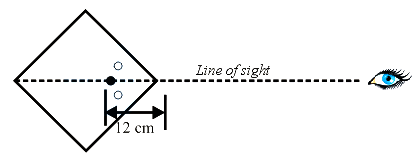 JEE Advanced 2020 Hard
 - A cylindrical furnace has height and diameter both . It is maintained at temperature . The air gets heated inside the furnace at constant pressure and its temperature becomes . The hot air with density rises up a vertical chimney of diameter and height above the furnace and exits the chimney (see the figure). As a result, atmospheric air of density , pressure and temperature enters the furnace. Assume air as an ideal gas, neglect the variations in and inside the chimney and the furnace. Also ignore the viscous effects.
[Given: The acceleration due to gravity and ]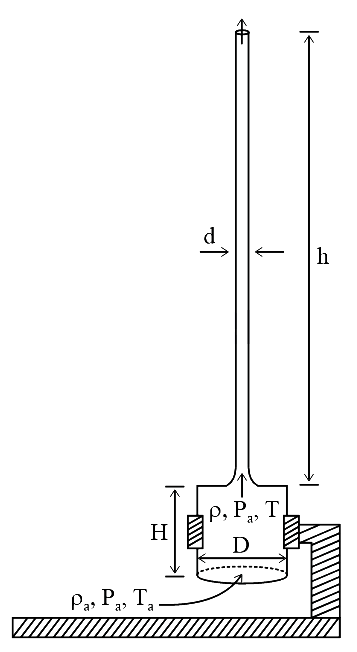
Considering the air flow to be streamline, the steady mass flow rate of air exiting the chimney is _____ .JEE Advanced 2023 Medium - A block hangs vertically at the bottom end of a uniform rope of constant mass per unit length. The top end of the rope is attached to a fixed rigid support at O. A transverse wave pulse (Pulse 1) of wavelength is produced at point O on the rope. The pulse takes time to reach point A. If the wave pulse of wavelength is produced at point A (Pulse 2) without disturbing the position of M it takes time to reach point O. Which of the following options is/are correct?
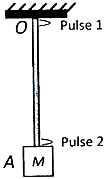 JEE Advanced 2017 Medium
 - Two vehicles, each moving with speed u on the same horizontal straight road, are approaching each other. Wind blows along the road with velocity w. One of these vehicles blows a whistle of frequency f1. An observer in the other vehicle hears the frequency of the whistle to be f2. The speed of sound in still air is V. The correct statement (s) is (are) :JEE Advanced 2013 Medium
More PYQs from JEE Advanced
- Let be the sample space of all matrices with entries from the set Let the events and be given by
and
sum of entries of is
If a matrix is chosen at random from then the conditional probability equals____JEE Advanced 2019 Medium - Let be the set of all complex numbers satisfying . Then which of the following statements is/are TRUE?JEE Advanced 2020 Hard
- Match the column.
Normals at \(P, Q, R\) are drawn to \(y^2=4 x\) which intersect at \((3,0)\). Then,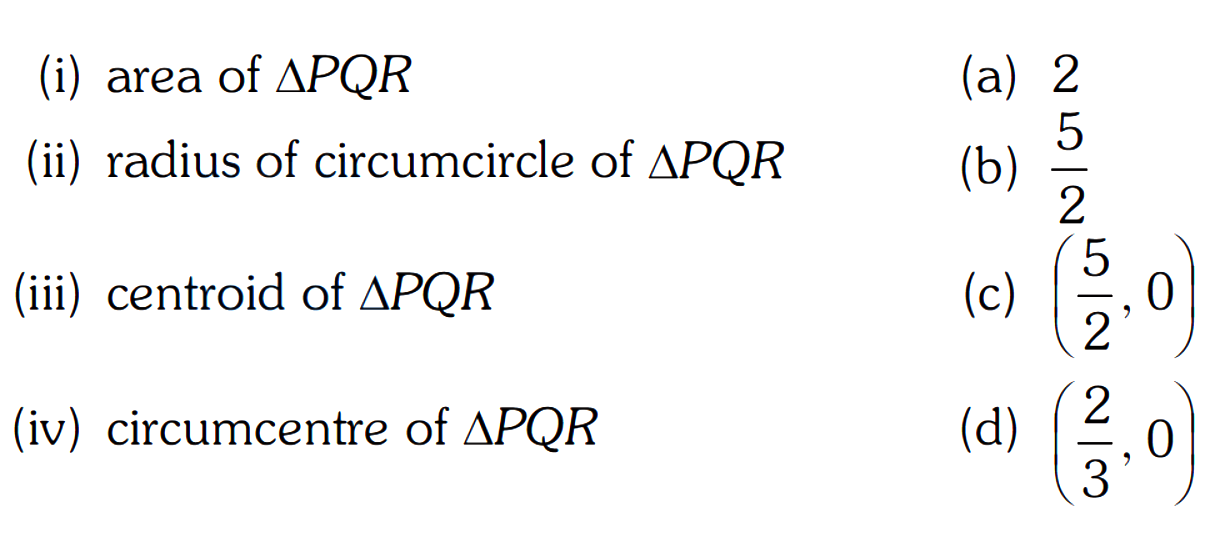 JEE Advanced 2006 Medium
 - Let denote the set of all the terms of an infinite arithmetic progression with first term a and common difference If then equals ____JEE Advanced 2019 Medium
- Let be a differentiable function such that and . Then,JEE Advanced 2016 Medium
- Paragraph:
The figure shows a circular loop of radius \(a\) with two long parallel wires (numbered \(1\) and \(2\) ) all in the plane of the paper. The distance of each wire from the centre of the loop is \(d\). The loop and the wires are carrying the same current \(I\). The current in the loop is in the counterclockwise direction if seen from above.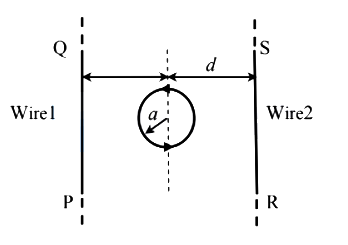
Question:
Consider \(d \gg a\), and the loop is rotated about its diameter parallel to the wires by \(30^{\circ}\) from the position shown in the figure. If the currents in the wires are in the opposite directions, the torque on the loop at its new position will be (assume that the net field due to the wires is constant over the loop)JEE Advanced 2014 Hard