


JEE Advanced · Chemistry · 26. Aldehydes & Ketones
In the following reactions, P, Q, R and S are the major products.
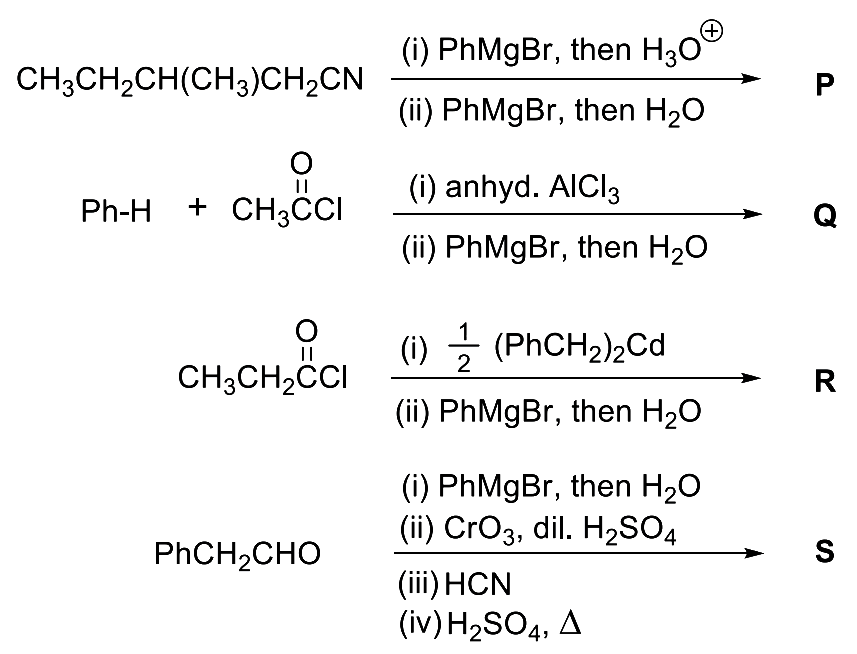
The correct statement(s) about P, Q, R and S is(are)
- A Both P and Q have asymmetric carbon(s)
- B Both Q and R have asymmetric carbon(s)
- C Both P and R have asymmetric carbon(s)
- D P has asymmetric carbon(s), S does not have any asymmetric carbon
Answer & Solution
Correct Answer
(D) P has asymmetric carbon(s), S does not have any asymmetric carbon
Step-by-step Solution
Detailed explanation
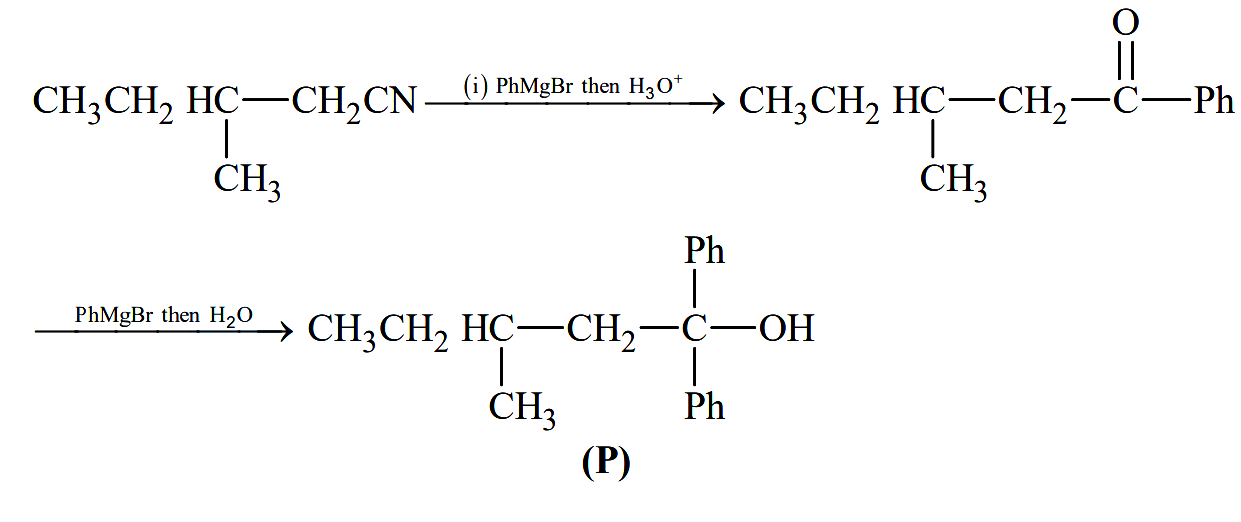
The cyanide part undergoes reaction with phenyl magnesium bromide followed by acidic water give a ketone. The ketone undergoes reaction with phenyl magnesium bromide again to get a tertiary alcohol.
Benzene undergo Friedel craft acylation and gives acetophenone. Acetophenone gives a tertiary alcohol upon reaction with phenyl magnesium bromide.

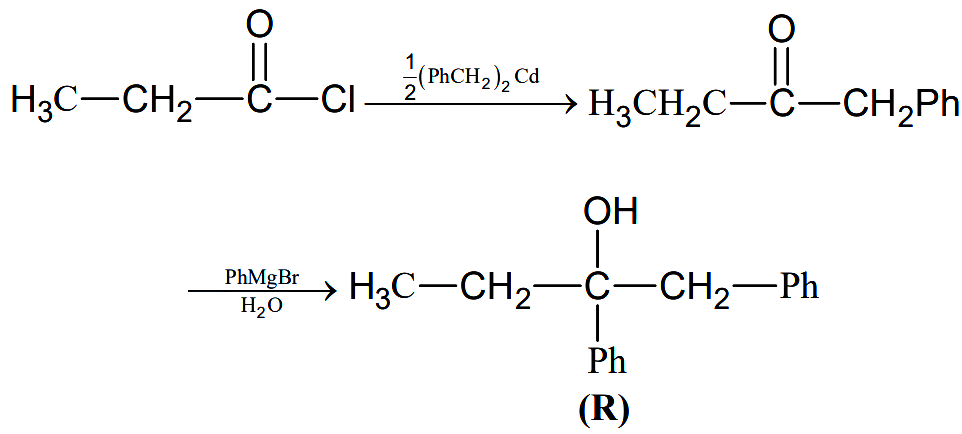
Propanoyl chloride when treated with dibenzyl cadmium gives a ketone. The ketone give tertiary alcohol on reaction with phenyl magnesium bromide.
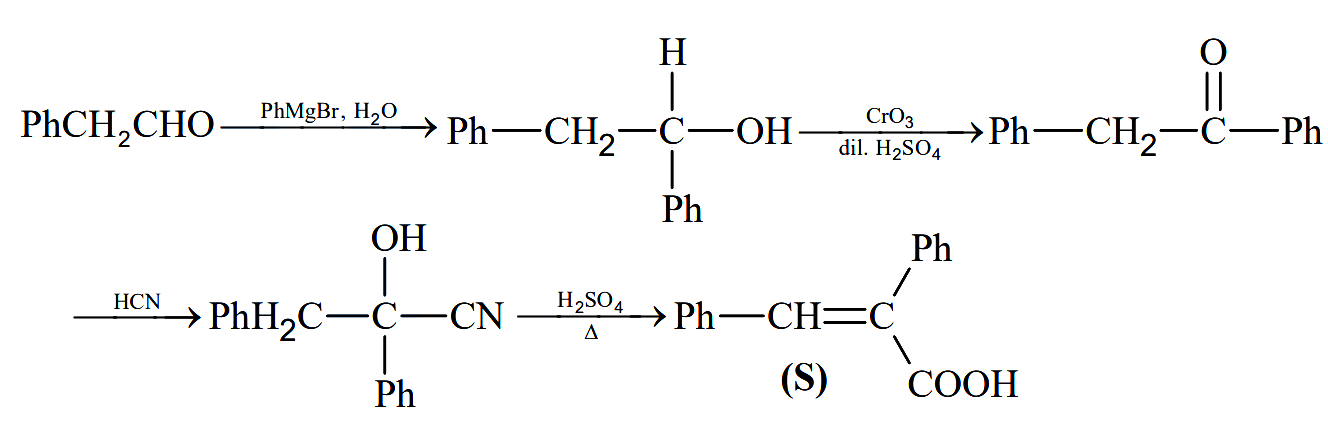
2-phenyl ethanal gives 1,2-diphenylethanol. The secondaryalcohol formed gives a ketone up on reaction with Jone's reagent. The ketone formed undergo nucleophilic addition reaction with hydrogen cyanide to give cyano hydrin which undergo hydrolysis followed elimination give the final product as shown below.
Benzene undergo Friedel craft acylation and gives acetophenone. Acetophenone gives a tertiary alcohol upon reaction with phenyl magnesium bromide.
Propanoyl chloride when treated with dibenzyl cadmium gives a ketone. The ketone give tertiary alcohol on reaction with phenyl magnesium bromide.
2-phenyl ethanal gives 1,2-diphenylethanol. The secondaryalcohol formed gives a ketone up on reaction with Jone's reagent. The ketone formed undergo nucleophilic addition reaction with hydrogen cyanide to give cyano hydrin which undergo hydrolysis followed elimination give the final product as shown below.
See the Complete Solution
Get step-by-step explanations for this and 2.5 Lakh+ more JEE, NEET & CET questions.
- Unlock all solutions
- Practice the full chapter
- Track accuracy across PYQs
4.8 rated on Google Play · 14,000+ reviews
More questions from Chemistry
- If the bond length of \(\mathrm{CO}\) bond in carbon monoxide is \(1.128 \mathrm{~A}^{\circ}\), then what is the value of \(\mathrm{CO}\) bond length in \(\mathrm{Fe}(\mathrm{CO})_5\) ?JEE Advanced 2006 Easy
- For the elementary reaction , the rate of disappearance of increases by a factor of upon doubling the concentration of . The order of the reaction with respect to isJEE Advanced 2014 Easy
- The compound (s) having peroxide linkage is(are) :JEE Advanced 2024 Easy
- The pair(s) of coordination complexes/ions exhibiting the same kind of isomerism is (are)JEE Advanced 2013 Medium
- Paragraph:
The reaction of compound \(\mathbf{P}\) with \(\mathrm{CH}_{3} \mathrm{MgBr}\) (excess) in \(\left(\mathrm{C}_{2} \mathrm{H}_{5}\right)_{2} \mathrm{O}\) followed by addition of \(\mathrm{H}_{2} \mathrm{O}\) gives \(\mathbf{Q}\). The compound \(\mathbf{Q}\) on treatment with \(\mathrm{H}_{2} \mathrm{SO}_{4}\) at \(0^{\circ} \mathrm{C}\) gives \(\mathbf{R}\). The reaction of \(\mathbf{R}\) with \(\mathrm{CH}_{3} \mathrm{COCl}\) in the presence of anhydrous \(\mathrm{AlCl}_{3}\) in \(\mathrm{CH}_{2} \mathrm{Cl}_{2}\) followed by treatment with \(\mathrm{H}_{2} \mathrm{O}\) produces compound \(\mathbf{S}\). [Et in compound \(\mathbf{P}\) is ethyl group]
Question :
The reactions, \(\mathbf{Q}\) to \(\mathbf{R}\) and \(\mathbf{R}\) to \(\mathbf{S}\), areJEE Advanced 2017 Hard - Reaction of \(\mathbf{x}\) g of \(\mathrm{Sn}\) with \(\mathrm{HCl}\) quantitatively produced a salt. Entire amount of the salt reacted with \(\mathbf{y} g\) of nitrobenzene in the presence of required amount of \(\mathrm{HCl}\) to produce \(1.29 \mathrm{~g}\) of an organic salt (quantitatively).
(Use Molar masses (in \(\mathrm{g} \mathrm{mol}^{-1}\) ) of \(\mathrm{H}, \mathrm{C}, \mathrm{N}, \mathrm{O}, \mathrm{Cl}\) and \(\mathrm{Sn}\) as \(1,12,14,16,35\) and 119 , respectively).
The value of is_________ .JEE Advanced 2021 Easy
More PYQs from JEE Advanced
- Paragraph
The key feature of Bohr's theory of spectrum of hydrogen atom is the quantization of angular momentum when an electron is revolving around a proton. We will extend this to a general rotational motion to find quantized rotational energy of a diatomic molecule assuming it to be rigid. The rule to be applied is Bohr's quantization condition.
Question:
It is found that the excitation frequency from ground to the first excited state of rotation for the \(\mathrm{CO}\) molecule is close to \(\frac{4}{\pi} \times 10^{11} \mathrm{~Hz}\). Then the moment of inertia of CO molecule about its centre of mass is close to (Take \(h=2 \pi \times 10^{-34} J-s\) )JEE Advanced 2010 Hard - Among the following complexes \((K-P), \mathrm{K}_3\left[\mathrm{Fe}(\mathrm{CN})_6\right](K)\),
\(\left[\right.\) Co \(\left.\left(\mathrm{NH}_3\right)_6\right] \mathrm{Cl}_3(L), \mathrm{Na}_3\left[\mathrm{Co}(\mathrm{ox})_3\right](M)\),
\(\left[\mathrm{Ni}\left(\mathrm{H}_2 \mathrm{O}\right)_6\right] \mathrm{Cl}_2(\mathrm{~N}) ; \mathrm{K}_2\left[\mathrm{Pt}(\mathrm{CN})_4\right](\mathrm{O})\) and \(\left[\mathrm{Zn}\left(\mathrm{H}_2 \mathrm{O}\right)_6\right]\left(\mathrm{NO}_3\right)_2(P)\)
the diamagnetic complexes areJEE Advanced 2011 Medium - In a one-litre flask, moles of undergoes the reaction . The progress of product formation at two temperatures (in Kelvin), and , is shown in the figure:
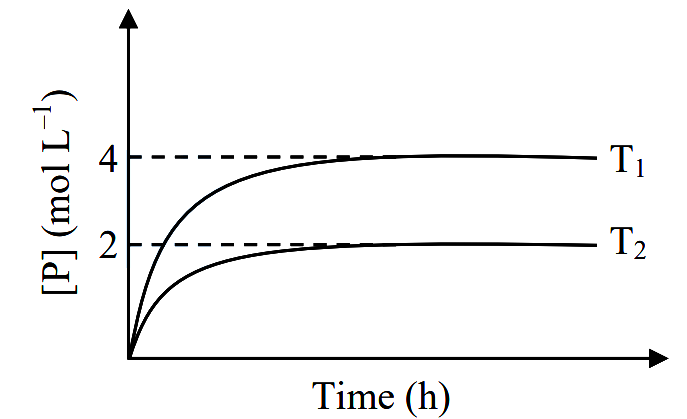 If and , then the value of is
[ and are standard Gibb's free energy change for the reaction at temperatures and , respectively.]JEE Advanced 2023 Medium - System shown in figure is in equilibrium and at rest. The spring and string are massless, now the string is cut. The acceleration of mass \(2 m\) and \(m\) just after the string is cut will be
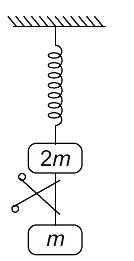 JEE Advanced 2006 Medium
 - The unbalanced chemical reactions given in List I show missing reagent or condition (?) which are provided in list II. match List I with List II and select the correct answer using the code given below the lists :
List - I List - II A. \(PbO _2+ H _2 SO _4 \xrightarrow{?}\) \(PbSO _4 + O _2+\) other product P. \(\text{NO}\) B. \(Na _2 S_2 O _3+ H _2 O \xrightarrow{?}\) \(NaHSO _4~+\) other product Q. \(\text{I}_2\) C. \(N _2 H _4 \xrightarrow{?} N_2 +\) other product R. Warm D. \(XeF _2 \xrightarrow{?} Xe ~+\) other product S. \(\text{Cl}_2\) JEE Advanced 2013 Easy - If , then x =JEE Advanced 2013 Medium