


JEE Advanced · Chemistry · 23. Coordination Compounds
Geometrical shapes of the complexes formed by the reaction of \(\mathrm{Ni}^{2+}\) with \(\mathrm{Cl}^{-}\), \(\mathrm{CN}^{-}\)and \(\mathrm{H}_2 \mathrm{O}\), respectively, are
- A octahedral, tetrahedral and square planar
- B tetrahedral, square planar and octahedral
- C square planar, tetrahedral and octahedral
- D octahedral, square planar and octahedral
Answer & Solution
Correct Answer
(B) tetrahedral, square planar and octahedral
Step-by-step Solution
Detailed explanation
\(\mathrm{Ni}^{2+}+4 \mathrm{CN}^{-} \longrightarrow\left[\text{Ni} (\text{CN})_4\right]^{2-}\). Here \(\text{Ni} ^{2+}\) has \(\text d^8\) configuration with \(\text{CN} ^{-}\)as strong ligand.
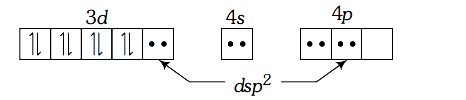
\(d^8\)-configuration in strong ligand field gives \(d s p^2\)-hybridisation, hence square planar geometry.
\(\mathrm{Ni}^{2+}+4 \mathrm{Cl}^{-} \longrightarrow\left[\mathrm{NiCl}_4\right]^{2-}\)
Here \(\mathrm{Ni}^{2+}\) had \(d^8\)-configuration with \(\mathrm{Cl}^{-}\)as weak ligand.

\(d^8\)-configuration in weak ligand field gives \(s p^3\) hydridisation, hence tetrahedral geometry. \(\mathrm{Ni}^{2+}\) with \(\mathrm{H}_2 \mathrm{O}\) forms \(\left[\mathrm{Ni}\left(\mathrm{H}_2 \mathrm{O}\right)_6\right]^{2+}\) complex and \(\mathrm{H}_2 \mathrm{O}\) is a weak ligand.

\(\text { Therefore, } \mathrm{Ni}\left(\mathrm{H}_2 \mathrm{O}\right)^{2+} \text { has octahedral geometry. }\)
\(d^8\)-configuration in strong ligand field gives \(d s p^2\)-hybridisation, hence square planar geometry.
\(\mathrm{Ni}^{2+}+4 \mathrm{Cl}^{-} \longrightarrow\left[\mathrm{NiCl}_4\right]^{2-}\)
Here \(\mathrm{Ni}^{2+}\) had \(d^8\)-configuration with \(\mathrm{Cl}^{-}\)as weak ligand.
\(d^8\)-configuration in weak ligand field gives \(s p^3\) hydridisation, hence tetrahedral geometry. \(\mathrm{Ni}^{2+}\) with \(\mathrm{H}_2 \mathrm{O}\) forms \(\left[\mathrm{Ni}\left(\mathrm{H}_2 \mathrm{O}\right)_6\right]^{2+}\) complex and \(\mathrm{H}_2 \mathrm{O}\) is a weak ligand.
\(\text { Therefore, } \mathrm{Ni}\left(\mathrm{H}_2 \mathrm{O}\right)^{2+} \text { has octahedral geometry. }\)
See the Complete Solution
Get step-by-step explanations for this and 2.5 Lakh+ more JEE, NEET & CET questions.
- Unlock all solutions
- Practice the full chapter
- Track accuracy across PYQs
4.8 rated on Google Play · 14,000+ reviews
More questions from Chemistry
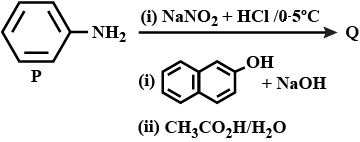
- Consider the reaction sequence from to shown below. The overall yield of the major product from What is the amount in grams of obtained from ? (Use density of Molar mass of and )
 JEE Advanced 2020 Medium
 - The total number of alkenes possible by dehydrobromination of 3-bromo-3-cyclopentylhexane using alcoholic \(\mathrm{KOH}\) isJEE Advanced 2011 Hard
- A plot of the number of neutrons against the number of protons of the stable nuclei exhibits upwards deviation from linearity for atomic number, . For an unstable nucleus having ratio less than , the possible mode(s) of decay is (are):JEE Advanced 2016 Medium
- A sample \((5.6 \mathrm{~g})\) containing iron is completely dissolved in cold dilute \(\mathrm{HCl}\) to prepare a \(250 \mathrm{~mL}\) of solution. Titration of \(25.0 \mathrm{~mL}\) of this solution requires \(12.5 \mathrm{~mL}\) of \(0.03 \mathrm{M} \mathrm{KMnO}_{4}\) solution to reach the end point. Number of moles of \(\mathrm{Fe}^{2+}\) present in \(250 \mathrm{~mL}\) solution is \(\mathbf{x} \times 10^{-2}\) (consider complete dissolution of \(\mathrm{FeCl}_{2}\) ). The amount of iron present in the sample is \(\mathbf{y} \%\) by weight.
(Assume: \(\mathrm{KMnO}_{4}\) reacts only with \(\mathrm{Fe}^{2+}\) in the solution Use: Molar mass of iron as \(56 \mathrm{~g} \mathrm{~mol}^{-1}\) )
The value of is________ .JEE Advanced 2021 Medium - Different possible thermal decomposition pathways for peroxyesters are shown below. Match each pathway from List I with an appropriate structure from List II and select the correct answer using the code given below the lists.
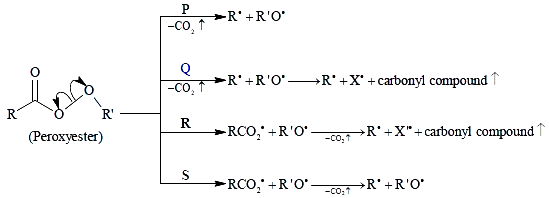
List – I List – II A Pathway P P. 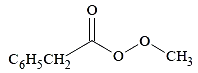
B. Pathway Q Q. 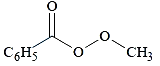
C. Pathway R R. 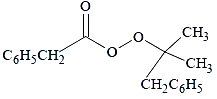
D. Pathway S S. 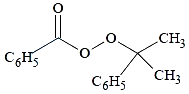 JEE Advanced 2014 Medium
 - Match each of the diatomic molecules in Column I with its property/properties in Column II.
Column I Column II A. \(B _2\) p. Paramagnetic B. \(N_2\) q. Undergoes oxidation C. \(O _2^{-}\) r. Undergoes reduction D. \(O _2\) s. Bond order t. Mixing of 's' and 'p' orbitals JEE Advanced 2009 Medium
More PYQs from JEE Advanced
- A compound with molar weight of 80g is dissolved in a solvent having density of . Assuming no change in volume upon dissolution, the molality of a 3.2 molar solution isJEE Advanced 2014 Medium
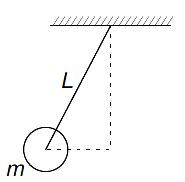
- A ball of mass \((m) 0.5 \mathrm{~kg}\) is attached to the end of a string having length \((L) 0.5 \mathrm{~m}\). The ball is rotated on a horizontal circular path about vertical axis. The maximum tension that the string can bear is \(324 \mathrm{~N}\). The maximum possible value of angular velocity of ball (in rad/s) is
 JEE Advanced 2011 Easy
 - Let \(P(6,3)\) be a point on the hyperbola \(\frac{x^2}{a^2}-\frac{y^2}{b^2}=1\). If the normal at the point \(P\) intersects the \(X\)-axis at \((9,0)\), then the eccentricity of the hyperbola isJEE Advanced 2011 Easy
- Match the following.
List – I List – II (A) The number of polynomials f(x) with non – negative integer coefficients of degree satisfying f(0) =0 and (P) 8 (B) The number of point in the interval at which attains its maximum value, is (Q) 2 (C) equals (R) 4 (D) (S) 0 JEE Advanced 2014 Hard - A horizontal stretched string, fixed at two ends, is vibrating in its fifth harmonic according to the equation, \(y ( x , t )=(0.01 m) \sin \left[\left(62.8 m^{-1}\right) x \right]\) \(\cos \left[\left(628 s^{-1}\right) t \right]\). Assuming \(\pi=3.14\), the correct statement(s) is (are)JEE Advanced 2013 Hard
- The diffusion coefficient of an ideal gas is proportional to its mean free path and mean speed. The absolute temperature of an ideal gas is increased times and its pressure times. As a result, the diffusion coefficient of this gas increases times. The value of is:JEE Advanced 2016 Hard