


JEE Advanced · Mathematics · 23. C&D
Let \(\int(x)=\left\{\begin{array}{r}x^{2}\left|\cos \frac{\pi}{x}\right|, \quad x \neq 0 \\ 0, \quad x=0\end{array}, x \in R\right.\) then \(\int\) is
- A differentiable both at \(x=0\) and at \(x=2\)
- B differentiable at \(x=0\) but not differentiable at \(x=2\)
- C not differentiable at \(x=0\) but differentiable at \(x=2\)
- D differentiable neither at \(x=0\) nor at \(x=2\)
Answer & Solution
Correct Answer
(B) differentiable at \(x=0\) but not differentiable at \(x=2\)
Step-by-step Solution
Detailed explanation
\(f^{\prime}\left(0^{+}\right)=\lim _{h \rightarrow 0} \frac{f(0+h)-f(0)}{h}\)
\(\begin{aligned}
=\lim _{h \rightarrow 0} \frac{h^{2}\left|\cos \frac{\pi}{h}\right|}{h} &=\lim _{h \rightarrow 0} h\left|\cos \frac{\pi}{h}\right| \\
&=0 \times \text { some finite value }=0
\end{aligned}\)
\(\begin{array}{c}
=0 \times \text { some finite value }=0 \\
\text { and } f^{\prime}\left(0^{-}\right)=\lim _{h \rightarrow 0} \frac{f(0-h)-f(0)}{-h}=\lim _{h \rightarrow 0} \frac{h^{2}\left|\cos \frac{\pi}{-h}\right|}{-h} \\
=\lim _{h \rightarrow 0}-h\left|\cos \frac{\pi}{h}\right|=0 \times \text { some finite value }=0
\end{array}\)
\(\begin{array}{l}
\because f^{\prime}\left(0^{+}\right)=f^{\prime}\left(0^{-}\right) \therefore f \text { is differentiable at } x=0 \\
\text { Now } f^{\prime}\left(2^{+}\right)=\lim _{h \rightarrow 0} \frac{f(2+h)-f(2)}{h} \\
\quad=\lim _{h \rightarrow 0} \frac{(2+h)^{2}\left|\cos \frac{\pi}{2+h}\right|-4\left|\cos \frac{\pi}{2}\right|}{h}
\end{array}\)
\(=\lim _{h \rightarrow 0} \frac{(2+h)^{2}\left(\cos \frac{\pi}{2+h}\right)}{h}\)
\(=\lim _{h \rightarrow 0} \frac{(2+h)^{2}}{h} \sin \left(\frac{\pi}{2}-\frac{\pi}{2+h}\right)\)
\(=\lim _{h \rightarrow 0} \frac{(2+h)^{2}}{h} \sin \left(\frac{\pi h}{2(2+h)}\right)\)
\(=\lim _{h \rightarrow 0} \frac{(2+h)^{2}}{h} \times \frac{\sin \left(\frac{\pi h}{2(2+h)}\right)}{\left(\frac{\pi h}{2(2+h)}\right)} \times \frac{\pi h}{2(2+h)}=\pi\)
and \(f^{\prime}\left(2^{-}\right)=\lim _{h \rightarrow 0} \frac{f(2-h)-f(2)}{-h}\)
\(=\lim _{h \rightarrow 0} \frac{(2-h)^{2}\left|\cos \left(\frac{\pi}{2-h}\right)\right|-0}{-h}\)
\(=\lim _{h \rightarrow 0} \frac{-(2-h)^{2} \cos \left(\frac{\pi}{2-h}\right)}{-h}\)
\(=\lim _{h \rightarrow 0} \frac{(2-h)^{2} \sin \left(\frac{\pi}{2}-\frac{\pi}{2-h}\right)}{h}\)
\(=\lim _{h \rightarrow 0} \frac{(2-h)^{2}}{h} \times \frac{\sin \left(\frac{-\pi h}{2(2-h)}\right)}{\left(\frac{-\pi h}{2(2-h)}\right)} \times\left(\frac{-\pi h}{2(2-h)}\right)=-\pi\)
\(\because f^{\prime}\left(2^{+}\right) \neq f^{\prime}\left(2^{-}\right), \therefore f\) is not differentiable at \(x=2 .\)
\(\begin{aligned}
=\lim _{h \rightarrow 0} \frac{h^{2}\left|\cos \frac{\pi}{h}\right|}{h} &=\lim _{h \rightarrow 0} h\left|\cos \frac{\pi}{h}\right| \\
&=0 \times \text { some finite value }=0
\end{aligned}\)
\(\begin{array}{c}
=0 \times \text { some finite value }=0 \\
\text { and } f^{\prime}\left(0^{-}\right)=\lim _{h \rightarrow 0} \frac{f(0-h)-f(0)}{-h}=\lim _{h \rightarrow 0} \frac{h^{2}\left|\cos \frac{\pi}{-h}\right|}{-h} \\
=\lim _{h \rightarrow 0}-h\left|\cos \frac{\pi}{h}\right|=0 \times \text { some finite value }=0
\end{array}\)
\(\begin{array}{l}
\because f^{\prime}\left(0^{+}\right)=f^{\prime}\left(0^{-}\right) \therefore f \text { is differentiable at } x=0 \\
\text { Now } f^{\prime}\left(2^{+}\right)=\lim _{h \rightarrow 0} \frac{f(2+h)-f(2)}{h} \\
\quad=\lim _{h \rightarrow 0} \frac{(2+h)^{2}\left|\cos \frac{\pi}{2+h}\right|-4\left|\cos \frac{\pi}{2}\right|}{h}
\end{array}\)
\(=\lim _{h \rightarrow 0} \frac{(2+h)^{2}\left(\cos \frac{\pi}{2+h}\right)}{h}\)
\(=\lim _{h \rightarrow 0} \frac{(2+h)^{2}}{h} \sin \left(\frac{\pi}{2}-\frac{\pi}{2+h}\right)\)
\(=\lim _{h \rightarrow 0} \frac{(2+h)^{2}}{h} \sin \left(\frac{\pi h}{2(2+h)}\right)\)
\(=\lim _{h \rightarrow 0} \frac{(2+h)^{2}}{h} \times \frac{\sin \left(\frac{\pi h}{2(2+h)}\right)}{\left(\frac{\pi h}{2(2+h)}\right)} \times \frac{\pi h}{2(2+h)}=\pi\)
and \(f^{\prime}\left(2^{-}\right)=\lim _{h \rightarrow 0} \frac{f(2-h)-f(2)}{-h}\)
\(=\lim _{h \rightarrow 0} \frac{(2-h)^{2}\left|\cos \left(\frac{\pi}{2-h}\right)\right|-0}{-h}\)
\(=\lim _{h \rightarrow 0} \frac{-(2-h)^{2} \cos \left(\frac{\pi}{2-h}\right)}{-h}\)
\(=\lim _{h \rightarrow 0} \frac{(2-h)^{2} \sin \left(\frac{\pi}{2}-\frac{\pi}{2-h}\right)}{h}\)
\(=\lim _{h \rightarrow 0} \frac{(2-h)^{2}}{h} \times \frac{\sin \left(\frac{-\pi h}{2(2-h)}\right)}{\left(\frac{-\pi h}{2(2-h)}\right)} \times\left(\frac{-\pi h}{2(2-h)}\right)=-\pi\)
\(\because f^{\prime}\left(2^{+}\right) \neq f^{\prime}\left(2^{-}\right), \therefore f\) is not differentiable at \(x=2 .\)
See the Complete Solution
Get step-by-step explanations for this and 2.5 Lakh+ more JEE, NEET & CET questions.
- Unlock all solutions
- Practice the full chapter
- Track accuracy across PYQs
4.8 rated on Google Play · 14,000+ reviews
More questions from Mathematics
- The value of isJEE Advanced 2013 Medium
- The normal at a point \(P\) on the ellipse \(x^2+4 y^2=16\) meets the \(x\)-axis at \(Q\). If \(M\) is the mid-point of the line segment \(P Q\), then the locus of \(M\) intersects the latusrectum of the given ellipse at the pointsJEE Advanced 2009 Hard
- Let be a continuous odd function, which vanishes exactly at one point and Suppose that for all and for all If then the value of isJEE Advanced 2015 Medium
- Paragraph:
Let \(M=\left\{(x, y) \in \mathbb{R} \times \mathbb{R}: x^{2}+y^{2} \leq r^{2}\right\}\),
where \(r>0 .\) Consider the geometric progression \(a_{n}=\frac{1}{2^{n-1}}, n=1,2,3, \ldots .\) Let \(S_{0}=0\) and, for \(n \geq 1\), let \(S_{n}\) denote the sum of the first \(n\) terms of this progression. For \(n \geq 1\), let \(C_{n}\) denote the circle with center \(\left(S_{n-1}, 0\right)\) and radius \(a_{n}\), and \(D_{n}\) denote the circle with center \(\left(S_{n-1}, S_{n-1}\right)\) and radius \(a_{n}\).
Question:
Consider \(M\) with \(r=\frac{\left(2^{199}-1\right) \sqrt{2}}{2^{198}} .\) The number of all those circles \(D_{n}\) that are inside \(M\) isJEE Advanced 2021 Medium - Let \(f(x)=2+\cos x\) for all real \(x\).
Statement I For each real \(t\), there exists a point \(c\) in \([t, t+\pi]\) such that \(f^{\prime}(c)=0\).
Statement II \(f(t)=f(t+2 \pi)\) for each real \(t\).JEE Advanced 2007 Easy - For any positive integer , define as for all . Here, the inverse trigonometric function assumes values in Then, which of the following statement(s) is (are) TRUE?JEE Advanced 2018 Medium
More PYQs from JEE Advanced
- Match the following.
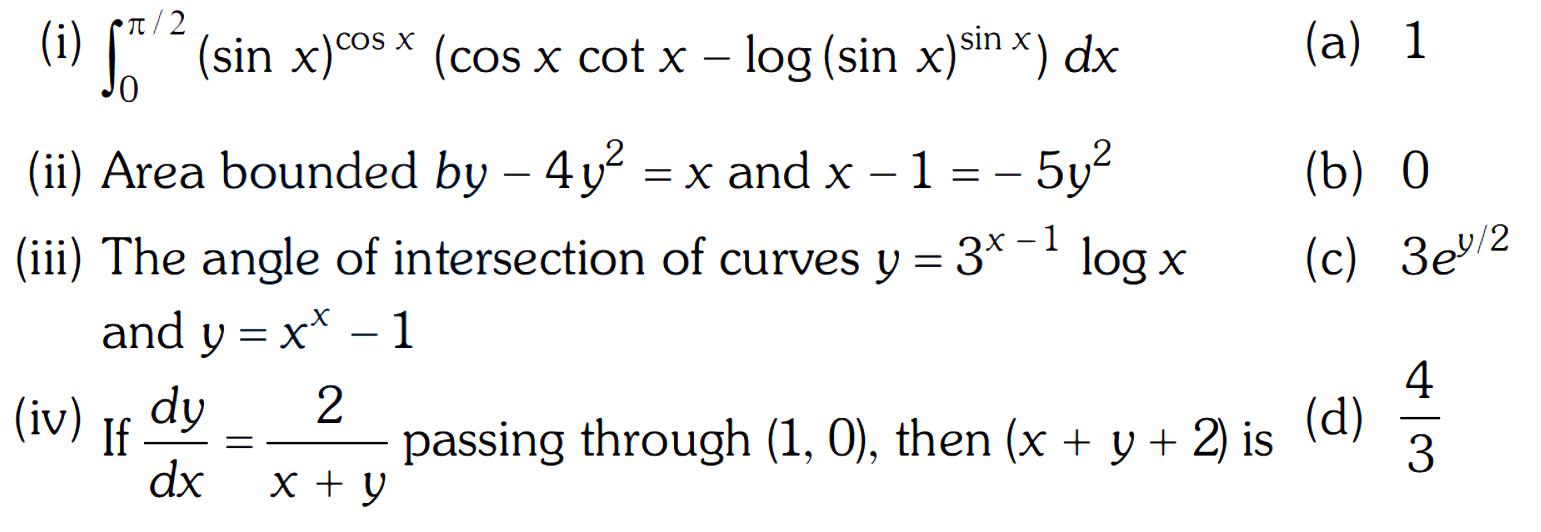 JEE Advanced 2006 Hard
 - For a point P in the plane, let and be the distances of the point P from the lines and respectively. The area of the region R consisting of all points P lying in the first quadrant of the plane and satisfying is ________JEE Advanced 2014 Easy
- Assume that the nuclear binding energy per nucleon \((B / A)\) versus mass number \((A)\) is as shown in the figure. Use this plot to choose the correct choice (s) given below.
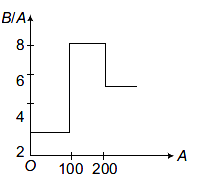 JEE Advanced 2008 Medium
 - Let be the set of all complex numbers satisfying . Then which of the following statements is/are TRUE?JEE Advanced 2020 Hard
- Let \(\mathbf{A}\) be vector parallel to line of intersection of planes \(P_1\) and \(P_2\) through origin. \(P_1\) is parallel to the vectors \(2 \hat{\mathbf{j}}+3 \hat{\mathbf{k}}\) and \(4 \hat{\mathbf{j}}-3 \hat{\mathbf{k}}\) and \(P_2\) is parallel to \(\hat{\mathbf{j}}-\hat{\mathbf{k}}\) and \(3 \hat{\mathbf{i}}+3 \hat{\mathbf{j}}\), then the angle between vector \(\mathbf{A}\) and \(2 \hat{\mathbf{i}}+\hat{\mathbf{j}}-2 \hat{\mathbf{k}}\) isJEE Advanced 2006 Easy
- An aqueous solution of hydrazine \(\left(\mathrm{N}_2 \mathrm{H}_4\right)\) is electrochemically oxidized by \(\mathrm{O}_2\), thereby releasing chemical energy in the form of electrical energy. One of the products generated from the electrochemical reaction is \(\mathrm{N}_2(\mathrm{~g})\).
Choose the correct statement(s) about the above process :JEE Advanced 2024 Easy