


JEE Advanced · Chemistry · 6. Thermodynamics (C)
The direct conversion of \(A\) to \(B\) is difficult, hence it is carried out by the following shown path.
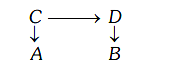
Given \(\Delta S_{(A \rightarrow C)}=50 \mathrm{eu}, \quad \Delta S_{(C \rightarrow D)}=30 \mathrm{eu}, \quad\) \(\Delta S_{(B \rightarrow D)}=20 \mathrm{eu}\) where eu is entropy unit, then \(\Delta S_{(A \rightarrow B)}\) is
- A \(+100 \mathrm{eu}\)
- B \(+60 \mathrm{eu}\)
- C \(-100 \mathrm{eu}\)
- D \(-60\) eu
Answer & Solution
Correct Answer
(B) \(+60 \mathrm{eu}\)
Step-by-step Solution
Detailed explanation
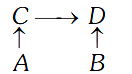
Given: \(\Delta S_{(A \rightarrow C)}=50 \mathrm{eu}, \Delta S_{(C \rightarrow D)}=30 \mathrm{eu}, \Delta S_{(B \rightarrow D)}\)\(=20 \mathrm{eu}\) where eu is entropy unit.
\( \text {Therefore, }\Delta S_{(A \rightarrow B)} =\Delta S_{(A \rightarrow C)}+\Delta S_{(C \rightarrow D)}+\)\(\Delta S_{(D \rightarrow B)} \)
\( =\Delta S_{(A \rightarrow C)}+\Delta S_{(C \rightarrow D)}-\Delta S_{(B \rightarrow D)} \)
\( =50+30-20=60 \mathrm{eu}\)
See the Complete Solution
Get step-by-step explanations for this and 2.5 Lakh+ more JEE, NEET & CET questions.
- Unlock all solutions
- Practice the full chapter
- Track accuracy across PYQs
4.8 rated on Google Play · 14,000+ reviews
More questions from Chemistry
- Upon treatment with ammoniacal , the metal ion that precipitates as a sulphide isJEE Advanced 2013 Easy
- Paragraph: When potassium iodide is added to an aqueous solution of potassium ferricyanide, a reversible reaction is observed in which a complex \(\mathbf{P}\) is formed. In a strong acidic medium, the equilibrium shifts completely towards \(\mathbf{P}\). Addition of zinc chloride to \(\mathbf{P}\) in a slightly acidic medium results in a sparingly soluble complex Q.
Question: The number of zinc ions present in the molecular formula of \(\mathbf{Q}\) isJEE Advanced 2024 Medium - Extra pure \(\mathrm{N}_2\) can be obtained by heatingJEE Advanced 2011 Medium
- Among the following metal carbonyls, the \(\mathrm{C}-\mathrm{O}\) bond order is lowest inJEE Advanced 2007 Easy
- Paragraph:
The amount of energy required to break a bond is same as the amount of energy released when the same bond is formed. In gaseous state, the energy required for homolytic cleavage of a bond is called Bond Dissociation Energy (BDE) or Bond Strength. BDE is affected by \(s\)-character of the bond and the stability of the radicals formed. Shorter bonds are typically stronger bonds. BDEs for some bonds are given below:



Question:
Correct match of the \(\mathbf{C}-\mathbf{H}\) bonds (shown in bold) in Column \(\mathbf{J}\) with their BDE in Column \(\mathbf{K}\) is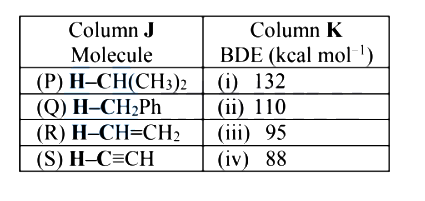 JEE Advanced 2021 Medium
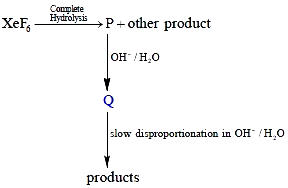
 - Under ambient conditions, the total number of gases released as products in the final step of the reaction scheme shown below is
 JEE Advanced 2014 Easy
More PYQs from JEE Advanced
- A glass tube of uniform internal radius \((r)\) has a valve separating the two identical ends. Initially, the valve is in a tightly closed position. End 1 has a hemispherical soap bubble of radius \(r\). End 2 has sub-hemispherical soap bubble as shown in figure. Just after opening the valve,
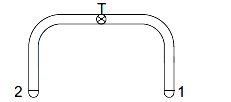 JEE Advanced 2008 Medium
 - In the reaction,
the time taken for reaction of is twice the time taken for reaction of . The concentration of varies with reaction time as shown in the figure.The overall order of the reaction is: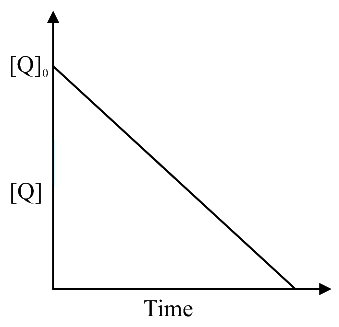 JEE Advanced 2013 Easy
 - A list of species having the formula XZ4 is given below.
\(\text{XeF} _4, \text{SF} _4, \text{SiF} _4, \text{BF} _4^{-}, \text{BrF} _4^{-},\left[\text{Cu} \left(\text{NH} _3\right)_4\right]^{2+},\) \(\left[\text{FeCl} _4\right]^{2-},\left[\text{CoCl} _4\right]^{2-}\) and \(\left[\text{PtCl} _4\right]^{2-}\)
Defining shape on the basis of the location of X and Z atoms, the total number of species having a square planar shape isJEE Advanced 2014 Easy - For every twice differentiable function , which of the following statement(s) is (are) TRUE?JEE Advanced 2018 Hard
- Which of the following statement(s) is (are) correct about the spectrum of hydrogen atom?JEE Advanced 2021 Medium
- Paragraph:
\(RCONH _2\) is converted into \(RNH _2\) by means of Hofmann bromamide degradation.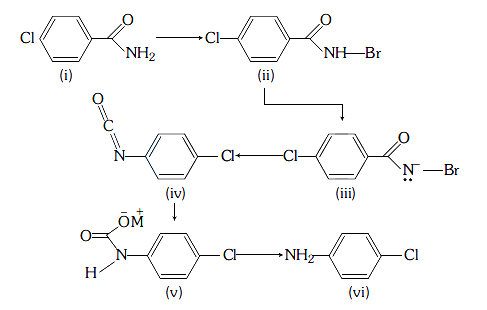
In this reaction, \(R \mathrm{CONHBr}\) is formed from which this reaction has derived its name. Electron donating group at phenyl activates the reaction. Hofmann degradation reaction is an intramolecular reaction.
Question:
Which is the rate determining step in Hofmann bromamide degradation?JEE Advanced 2006 Hard