


JEE Advanced · Mathematics · 27. Definite Integration
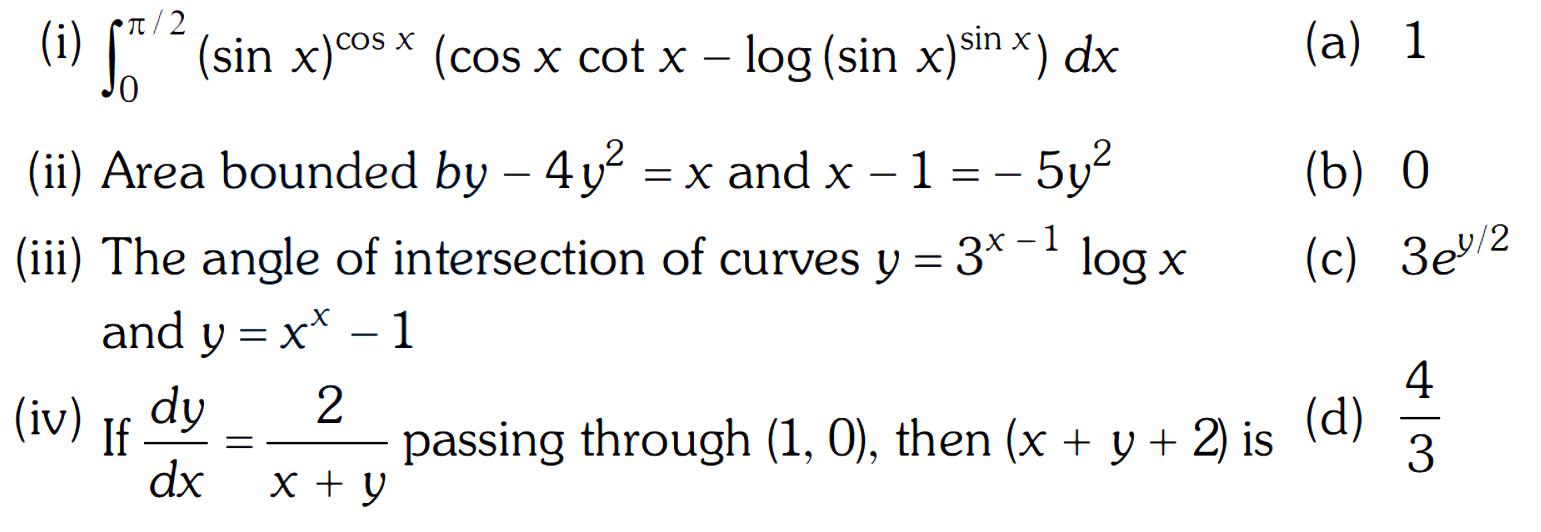
Match the following.
- A
(i) (a), (ii) (b), (iii) (d), (iv) (c)
- B
(i) (c), (ii) (a), (iii) (b), (iv) (d)
- C
(i) (a), (ii) (d), (iii) (b), (iv) (c)
- D
(i) (b), (ii) (a), (iii) (c), (iv) (d)
Answer & Solution
Correct Answer
(C)
(i) (a), (ii) (d), (iii) (b), (iv) (c)
Step-by-step Solution
Detailed explanation
(i) \(I=\int_0^{\pi / 2}(\sin x)^{\cos x}\left(\cos x \cot x-\log (\sin x)^{\sin x}\right) d x=\int_0^{\pi / 2} \frac{d}{d x}(\sin x)^{\cos x} d x=1\)
(ii) The point of intersection of \(-4 y^2=x\) and \(x-1=-5 y^2\) is \((-4,-1)\) and \((-4,1)\).
Hence, required area \(=2\left\{\int_0^1\left(1-5 y^2\right) d y-\int_0^1-4 y^2 d y\right\}=\frac{4}{3}\).
(iii) The point intersection of \(y=3^{x-1} \log x\) and \(y=x^x-1\) is \((1,0)\).
Hence, \(\quad \frac{d y}{d x}=\frac{3^{x-1}}{x}+3^{x-1} \cdot \log 3 \cdot \log x\)
\(\therefore \quad\left(\frac{d y}{d x}\right)_{(1,0)}=1\)
For
\[
\therefore \quad\left(\frac{d y}{d x}\right)_{(1,0)}=1
\]
If \(\theta\) is angle between the curves, then \(\tan \theta=0\).
\[
\because \quad \theta=0^{\circ}
\]
(iv)
\[
\begin{aligned}
& \frac{d y}{d x}=\frac{2}{x+y} \Rightarrow \frac{d x}{d y}-\frac{x}{2}=\frac{y}{2} \\
& \Rightarrow \quad x e^{-y / 2}=\frac{1}{2} \cdot \int y \cdot e^{-y / 2} d y \\
& \Rightarrow \quad x+y+2=k e^{y / 2} \\
& \Rightarrow \quad k=3 \\
& \therefore \quad x+y+2=3 e^{y / 2} \\
&
\end{aligned}
\]
[passing through \((1,0)\) ]
(ii) The point of intersection of \(-4 y^2=x\) and \(x-1=-5 y^2\) is \((-4,-1)\) and \((-4,1)\).
Hence, required area \(=2\left\{\int_0^1\left(1-5 y^2\right) d y-\int_0^1-4 y^2 d y\right\}=\frac{4}{3}\).
(iii) The point intersection of \(y=3^{x-1} \log x\) and \(y=x^x-1\) is \((1,0)\).
Hence, \(\quad \frac{d y}{d x}=\frac{3^{x-1}}{x}+3^{x-1} \cdot \log 3 \cdot \log x\)
\(\therefore \quad\left(\frac{d y}{d x}\right)_{(1,0)}=1\)
For
\[
\therefore \quad\left(\frac{d y}{d x}\right)_{(1,0)}=1
\]
If \(\theta\) is angle between the curves, then \(\tan \theta=0\).
\[
\because \quad \theta=0^{\circ}
\]
(iv)
\[
\begin{aligned}
& \frac{d y}{d x}=\frac{2}{x+y} \Rightarrow \frac{d x}{d y}-\frac{x}{2}=\frac{y}{2} \\
& \Rightarrow \quad x e^{-y / 2}=\frac{1}{2} \cdot \int y \cdot e^{-y / 2} d y \\
& \Rightarrow \quad x+y+2=k e^{y / 2} \\
& \Rightarrow \quad k=3 \\
& \therefore \quad x+y+2=3 e^{y / 2} \\
&
\end{aligned}
\]
[passing through \((1,0)\) ]
See the Complete Solution
Get step-by-step explanations for this and 2.5 Lakh+ more JEE, NEET & CET questions.
- Unlock all solutions
- Practice the full chapter
- Track accuracy across PYQs
4.8 rated on Google Play · 14,000+ reviews
More questions from Mathematics
- Let \(\mathbb{R}\) denote the set of all real numbers. For a real number \(x\), let \([x]\) denote the greatest integer less than or equal to \(x\). Let \(n\) denote a natural number.
Match each entry in List-I to the correct entry in List-II and choose the correct option.
LIST - I LIST - II (P) The minimum value of \(n\) for which the function \(f(x)=\left[\frac{10 x^3-45 x^2+60 x+35}{n}\right]\) is continuous on the interval \([1,2]\),is (1) 8 (Q) The minimum value of \(n\) for which \(g(x)=\left(2 n^2-13 n-15\right)\left(x^3+3 x\right),x \in \mathbb{R}\),is an increasing function on \(\mathbb{R}\),is (2) 9 (R) The smallest natural number \(n\) which is greater than 5,such that \(x=3\) is a point of local minima of \(h(x)=\left(x^2-9\right)^{\mathrm{n}}\left(x^2+2 x+3\right)\),is (3) 5 (S) Number of \(x_0 \in \mathbb{R}\) such that \(l(x)=\sum_{k=0}^4\left(\sin |x-k|+\cos \left|x-k+\frac{1}{2}\right|\right),x \in \mathbb{R}\),is NOT differentiable at \(x_0\),is (4) 6 (5) 10 JEE Advanced 2025 Hard - For any real number \(x\), let \([x]\) denotes the largest integer less than or equal to \(x\). Let \(f\) be a real valued function defined on the interval \([-10,10]\) by \(f(x)=\left\{\begin{array}{cc}x-[x] & \text { if }[x] \text { is odd } \\ 1+[x]-x & \text { if }[x] \text { is even }\end{array}\right.\).
Then the value of \(\frac{\pi^2}{10} \int_{-10}^{10} f(x) \cos \pi x d x\) isJEE Advanced 2010 Hard - Area of the region is equal toJEE Advanced 2016 Medium
- Let \(L_1\) be the line of intersection of the planes given by the equation- \(2 x+3 y+z=4 \text { and } x+2 y+z=5 .\)
Let \(L_2\) be the line passing through the point \(P(2,-1,3)\) and parallel to \(L_1\). Let \(M\) denote the plane given by the equation- \(2 x+y-2 z=6\)
Suppose that the line \(L_2\) meets the plane \(M\) at the point \(Q\). Let \(R\) be the foot of the perpendicular drawn from \(P\) to the plane \(M\).
Then which of the following statements is (are) TRUE?JEE Advanced 2025 Hard - Let and be positive real numbers. Suppose and are the lengths of the sides of a triangle opposite to its angles and respectively. If , then which of the following statements is/are TRUE?JEE Advanced 2020 Medium
- Let \(f_{1}:(0, \infty) \rightarrow \mathbb{R}\) and \(f_{2}:(0, \infty) \rightarrow \mathbb{R}\) be defined by
\[
f_{1}(x)=\int_{0}^{x} \prod_{j=1}^{21}(t-j)^{j} d t, \quad x>0
\]
and
\(
f_{2}(x)=98(x-1)^{50}-600(x-1)^{49}+2450, \quad x>0
\)
where, for any positive integer \(n\) and real numbers \(a_{1}, a_{2}, \ldots, a_{n}, \prod_{i=1}^{n} a_{i}\) denotes the product of \(a_{1}, a_{2}, \ldots, a_{n} .\) Let \(m_{i}\) and \(n_{i}\), respectively, denote the number of points of local minima and the number of points of local maxima of function \(f_{i}, i=1,2\), in the interval \((0, \infty)\).
The value of is _____.JEE Advanced 2021 Medium
More PYQs from JEE Advanced
- Let be a unit vector in and Given that there exists a vector in such that and Which of the following statement(s) is (are) correct ?JEE Advanced 2016 Medium
- Let \(P Q R\) be a triangle of area \(\Delta\) with \(a=2, b=\frac{7}{2}\) and \(c=\frac{5}{2} ;\) where \(a, b\), and \(c\) are the lengths of the sides of the triangle opposite to the angles at \(P, Q\) and \(R\) respectively. Then \(\frac{2 \sin P-\sin 2 P}{2 \sin P+\sin 2 P}\) equals.JEE Advanced 2012 Medium
- Consider three sets and . Two elements are chosen at random, without replacement, from the set , and let denote the set of these chosen elements. Let and . Now two elements are chosen at random, without replacement, from the set and let denote the set of these chosen elements. Let . Finally, two elements are chosen at random, without replacement, from the set and let denote the set of these chosen elements.
Let . Given that , let be the conditional probability of the event . Then the value of isJEE Advanced 2021 Medium - The total number of hybridised carbon atoms in the major product (a non-heterocyclic compound) of the following reaction is
 JEE Advanced 2023 Easy
 - Statement 1 The geometrical isomer of the complex \(\left.\left[\mathrm{M}_{\left(\mathrm{NH}_3\right.}\right)_4 \mathrm{Cl}_2\right]\) are optically inactive.
Statement 2 Both geometrical isomers of the complex \(\left[\mathrm{M}\left(\mathrm{NH}_3\right)_4 \mathrm{Cl}_2\right]\) possess axis of symmetry.JEE Advanced 2008 Medium - Consider the Bohr's model of a one-electron atom where the electron moves around the nucleus. In the following List-I contains some quantities for the orbit of the atom and List-II contains options showing how they depend on .
List - I List - II (I) Radius of the orbit (II) Angular momentum of the electron in the orbit (III) Kinetic energy of the electron in the orbit (IV) Potential energy of the electron in the orbit
Which of the following options has the correct combination considering List-I and List-II?JEE Advanced 2019 Medium