


JEE Advanced · Mathematics · 22. Functions
Paragraph:
If a continuous \(f\) defined on the real line \(R\), assume positive and negative values in \(R\), then the equation \(f(x)=0\) has a root in \(R\). For example, if it is known that a continuous function \(f\) on \(R\) is positive at some point and its minimum values is negative, then the equation \(f(x)=0\) has a root in \(R\).
Consider \(f(x)=k e^x-x\) for all real \(x\), where \(k\) is real constant.Question:
For \(k>0\), the set of all values of \(k\) for which \(k e^x-x=0\) has two distinct roots, is
- A
\(\left(0, \frac{1}{e}\right)\)
- B
\(\left(\frac{1}{e}, 1\right)\)
- C
\(\left(\frac{1}{e}, \infty\right)\)
- D
\((0,1)\)
Answer & Solution
Correct Answer
(A)
\(\left(0, \frac{1}{e}\right)\)
Step-by-step Solution
Detailed explanation
For two distinct roots \(1+\ln k < 0(k>0)\)
\(\ln k < -1 \quad k < \frac{1}{e}\)
Hence, \(k \in\left(0, \frac{1}{e}\right)\)
\(\ln k < -1 \quad k < \frac{1}{e}\)
Hence, \(k \in\left(0, \frac{1}{e}\right)\)
See the Complete Solution
Get step-by-step explanations for this and 2.5 Lakh+ more JEE, NEET & CET questions.
- Unlock all solutions
- Practice the full chapter
- Track accuracy across PYQs
4.8 rated on Google Play · 14,000+ reviews
More questions from Mathematics
- Let \(P(6,3)\) be a point on the hyperbola \(\frac{x^2}{a^2}-\frac{y^2}{b^2}=1\). If the normal at the point \(P\) intersects the \(X\)-axis at \((9,0)\), then the eccentricity of the hyperbola isJEE Advanced 2011 Easy
- Consider the following frequency distribution :
Value 4 5 8 9 6 12 11 Frequency 5 \(f_1\) \(f_2\) 2 1 1 3
Suppose that the sum of the frequencies is 19 and the median of this frequency distribution is 6. For the given frequency distribution, let \(\alpha\) denote the mean deviation about the mean, \(\beta\) denote the mean deviation about the median, and \(\sigma^2\) denote the variance.
Match each entry in List-I to the correct entry in List-II and choose the correct option.
\(\begin{array}{|l|l|l|l|} \hline & \text{LIST - I} & & \text{LIST - II} \\ \hline (P) & 7 f_1+9 f_2 \text{ is equal to} & (1) & 146 \\ \hline (Q) & 19 \alpha \text{ is equal to} & (2) & 47 \\ \hline (R) & 19 \beta \text{ is equal to} & (3) & 48 \\ \hline (S) & 19 \sigma^2 \text{ is equal to} & (4) & 145 \\ \hline & & (5) & 55 \\ \hline \end{array}\)JEE Advanced 2025 Easy - Let \((x, y, z)\) be points with integer coordinates satisfying the system of homogeneous equations \(3 x-y-z=0,-3 x+z=0,-3 x+2 y+z=0\). Then, the number of such points for which \(x^2+y^2+z^2 \leq 100\) isJEE Advanced 2009 Medium
- Match the statements given in Column I with the intervals/union of intervals given in Column II.
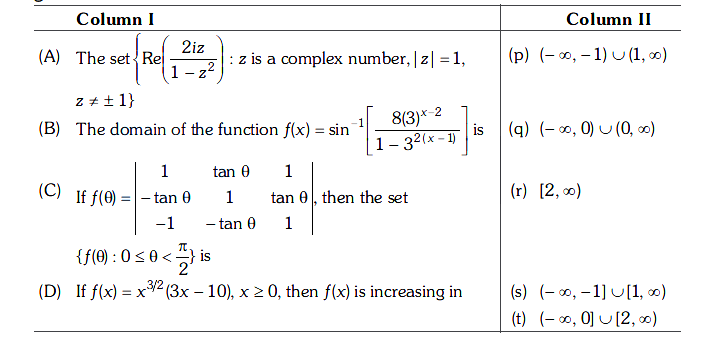 JEE Advanced 2011 Medium
 - For every integer \(n\), let \(a_{n}\) and \(b_{n}\) be real numbers. Let function \(f: I R \rightarrow I R\) be given by
\(f(x)=\left\{\begin{array}{lll}
a_{n}+\sin \pi x, & \text { for } & x \in[2 n, 2 n+1] \\
b_{n}+\cos \pi x, & \text { for } & x \in(2 n-1,2 n)
\end{array}\right.\)
for all integers \(n\). If \(f\) is continuous, then which of the following hold \((s)\) for all \(n\) ?JEE Advanced 2012 Hard - Let \(\omega\) be the complex number \(\cos \frac{2 \pi}{3}+i \sin \frac{2 \pi}{3}\). Then the number of distinct complex number \(z\) satisfying \(\left|\begin{array}{ccc}z+1 & \omega & \omega^2 \\ \omega & z+\omega^2 & 1 \\ \omega^2 & 1 & z+\omega\end{array}\right|=0\) is equal toJEE Advanced 2010 Medium
More PYQs from JEE Advanced
- Three numbers are chosen at random, one after another with replacement, from the set \(S=\{1,2,3, \ldots, 100\}\). Let \(p_{1}\) be the probability that the maximum of chosen numbers is at least 81 and \(p_{2}\) be the probability that the minimum of chosen numbers is at most 40 .
The value of isJEE Advanced 2021 Medium - A disk of radius with uniform positive charge density is placed on the plane with its center at the origin. The Coulomb potential along the -axis is
A particle of positive charge is placed initially at rest at a point on the -axis with and . In addition to the Coulomb force, the particle experiences a vertical force with . Let . Which of the following statement(s) is(are) correct?JEE Advanced 2022 Medium - Match the column.
Normals at \(P, Q, R\) are drawn to \(y^2=4 x\) which intersect at \((3,0)\). Then,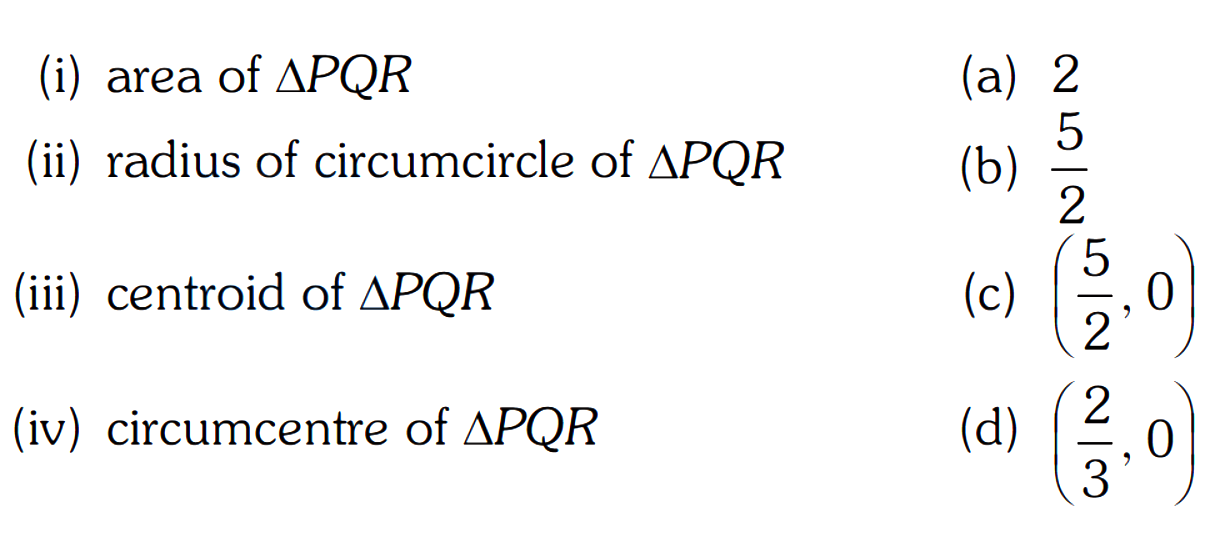 JEE Advanced 2006 Medium
 - Paragraph:
Let \(p\) be an odd prime number and \(T_p\) be the following set of \(2 \times 2\) matrices
\[
T_p=\left\{A=\left[\begin{array}{ll}
a & b \\
c & a
\end{array}\right] ; a, b, c \in\{0,1,2, \ldots, p-1\}\right\}
\]Question:
The number of \(A\) in \(T_p\) such that \(\operatorname{det}(A)\) is not divisible by \(p\), isJEE Advanced 2010 Easy - In an experiment to determine the acceleration due to gravity g, the formula used for the time period of a periodic motion is The values of R and r are measured to be respectively. In five successive measurements, the time period is found to be 0.52s, 0.56s, 0.57s, 0.54s and 0.59s. The least count of the watch used for the measurement of time period is 0.01s. Which of the following statements (s) is (are) true?JEE Advanced 2016 Medium
- Paragraph :
When a particle of mass \(m\) moves on the \(x\)-axis in a potential of the form \(V(x)=k x^2\), it performs simple harmonic motion.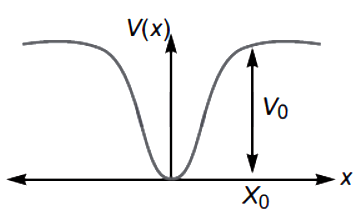
The corresponding time period is proportional to \(\sqrt{\frac{m}{k}}\), as can be seen easily using dimensional analysis. However, the motion of a particle can be periodic even when its potential energy increases on both sides of \(x=0\) in a way different from \(k x^2\) and its total energy is such that the particle does not escape to infinity. Consider a particle of mass \(\mathrm{m}\) moving on the \(x\)-axis. Its potential energy is \(V(x)=\alpha x^4(\alpha>0)\) for \(|x|\) near the origin and becomes a constant equal to \(V_0\) for \(|x| \geq X_0\) (see figure).
Question :
If the total energy of the particle is \(E\), it will perform periodic motion only ifJEE Advanced 2010 Medium