


JEE Advanced · Chemistry · 2. Atomic Structure
According to Bohr's model, the highest kinetic energy is associated with the electron in the
- A first orbit of H atom
- B first orbit of He+
- C second orbit of He+
- D second orbit of Li2+
Answer & Solution
Correct Answer
(B) first orbit of He+
Step-by-step Solution
Detailed explanation
\(K E=+13.6 \times \frac{Z^2}{n^2}\)
(A) \(\mathrm{KE}_{1,11}=+13.6 \times \frac{1^2}{1^2}=13.6 \mathrm{eV}\)
(B) \(\mathrm{KE}_{1, \mathrm{Hc}}=+13.6 \times \frac{2^2}{1^2}=13.6 \times 4 \mathrm{eV}\)
(C) \(\mathrm{KE}_{2, \mathrm{He}^{+}}=+13.6 \times \frac{2^2}{2^2}=13.6 \mathrm{eV}\)
(D) \(\mathrm{KE}_{2, \mathrm{Li}}{ }^{\mathrm{i}^{+}}=+13.6 \times \frac{3^2}{2^2}=13.6 \times \frac{9}{4} \mathrm{eV}\)
(A) \(\mathrm{KE}_{1,11}=+13.6 \times \frac{1^2}{1^2}=13.6 \mathrm{eV}\)
(B) \(\mathrm{KE}_{1, \mathrm{Hc}}=+13.6 \times \frac{2^2}{1^2}=13.6 \times 4 \mathrm{eV}\)
(C) \(\mathrm{KE}_{2, \mathrm{He}^{+}}=+13.6 \times \frac{2^2}{2^2}=13.6 \mathrm{eV}\)
(D) \(\mathrm{KE}_{2, \mathrm{Li}}{ }^{\mathrm{i}^{+}}=+13.6 \times \frac{3^2}{2^2}=13.6 \times \frac{9}{4} \mathrm{eV}\)
See the Complete Solution
Get step-by-step explanations for this and 2.5 Lakh+ more JEE, NEET & CET questions.
- Unlock all solutions
- Practice the full chapter
- Track accuracy across PYQs
4.8 rated on Google Play · 14,000+ reviews
More questions from Chemistry
- At \(25^{\circ} \mathrm{C}\), the concentration of \(\mathrm{H}^{+}\)ions in \(1.00 \times 10^{-3} \mathrm{M}\) aqueous solution of a weak monobasic acid having acid dissociation constant \(\left(K_a\right)=4.00 \times 10^{-11}\) is \(\boldsymbol{X} \times 10^{-7} \mathrm{M}\). The value of \(\boldsymbol{X}\) is _____ .
Use: Ionic product of water \(\left(K_w\right)=1.00 \times 10^{-14}\) at \(25^{\circ} \mathrm{C}\)JEE Advanced 2025 Medium - The freezing point (in \({ }^{\circ} \mathrm{C}\) ) of solution containing \(0.1 \mathrm{~g}\) of \(\mathrm{K}_3\left[\mathrm{Fe}(\mathrm{CN})_6\right]\) (molecular weight 329\()\) in \(100 \mathrm{~g}\) of water \(\left(K_f=1.86 \mathrm{~K} \mathrm{~kg} \mathrm{~mol}^{-1}\right)\) isJEE Advanced 2011 Easy
- At 300 K , an ideal dilute solution of a macromolecule exerts osmotic pressure that is expressed in terms of the height ( h ) of the solution (density \(=1.00 \mathrm{~g} \mathrm{~cm}^{-3}\) ) where h is equal to 2.00 cm . If the concentration of the dilute solution of the macromolecule is \(2.00 \mathrm{~g} \mathrm{dm}^{-3}\), the molar mass of the macromolecule is calculated to be \(\boldsymbol{X} \times 10^4 \mathrm{~g} \mathrm{~mol}^{-1}\). The value of \(\boldsymbol{X}\) is \(\qquad\) .
Use : Universal gas constant \((\mathrm{R})=8.3 \mathrm{~J} \mathrm{~K}^{-1} \mathrm{~mol}^{-1}\) and acceleration due to gravity \((\mathrm{g})=10 \mathrm{~m} \mathrm{~s}^{-2}\)JEE Advanced 2025 Easy - A linear octasaccharide (molar mass \(=1024 \mathrm{~g} \mathrm{~mol}^{-1}\) ) on complete hydrolysis produces three monosaccharides: ribose, 2-deoxyribose and glucose. The amount of 2-deoxyribose formed is \(58.26 \%(\mathrm{w} / \mathrm{w})\) of the total amount of the monosaccharides produced in the hydrolyzed products. The number of ribose unit(s) present in one molecule of octasaccharide is \(\qquad\)
Use : Molar mass \(\left(\right.\) in \(\left.\mathrm{g} \mathrm{mol}^{-1}\right)\) : ribose \(=150,2\)-deoxyribose \(=134\), glucose \(=180\); Atomic mass (in amu): \(\mathrm{H}=1, \mathrm{O}=16\)JEE Advanced 2025 Hard - Paragraph:
An aqueous solution of a mixture of two inorganic salts, when treated with dilute \(H C\) ?, gave a precipitate \((\boldsymbol{P})\) and a filtrate \((\boldsymbol{Q})\). The precipitate \(\boldsymbol{P}\) was found to dissolve in hot water. The filtrate \((\boldsymbol{Q})\) remained unchanged, when treated with \(\mathrm{H}_{2} \mathrm{~S}\) in a dilute mineral acid medium. However, it gave a precipitate \((\boldsymbol{R})\) with \(H_{2} S\) in an ammoniacal medium. The precipitate \(\boldsymbol{R}\) gave a coloured solution \((\boldsymbol{S})\), when treated with \(\mathrm{H}_{2} \mathrm{O}_{2}\) in an aqueous \(\mathrm{NaOH}\) medium.
Question:
The precipitate \(\boldsymbol{P}\) containsJEE Advanced 2013 Medium - Methylene blue, from its aqueous solution, is adsorbed on activated charcoal at 25o C. For this process, the correct statement isJEE Advanced 2013 Medium
More PYQs from JEE Advanced
- Paragraph:
A small block of mass \(1 \mathrm{~kg}\) is released from rest at the top of a rough track. The track is a circular arc of radius \(40 \mathrm{~m}\). The block slides along the track without toppling and a frictional force acts on it in the direction opposite to the instantaneous velocity. The work done in overcoming the friction up to the point \(Q\), as shown in the figure below, is \(150 \mathrm{~J}\). (Take the acceleration due to gravity, \(g=10 \mathrm{~m} \mathrm{~s}^{-2}\) ).
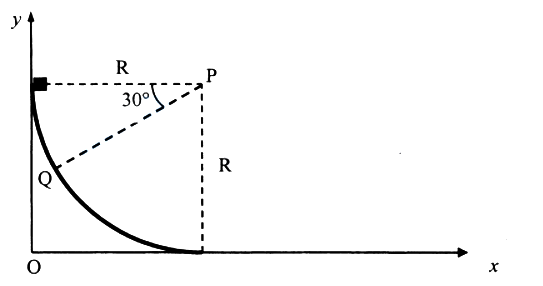
Question:
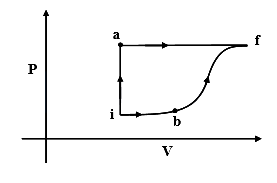
The speed of the block when it reaches the point \(Q\) isJEE Advanced 2013 Medium - A thermodynamic system is taken from an initial state with internal energy to the final state f along two different paths iaf and ibf, as schematically shown in the figure. The work done by the system along the paths af, ib and bf are and respectively. The heat supplied to the system along the path iaf, ib and bf are iaf ib and respectively. If the internal energy of the system in the state b is and , the ratio is
 JEE Advanced 2014 Medium
 - Paragraph :
\(P_{14-16}\) : Paragraph for Questions Nos. 14 to 16 A fixed thermally conducting cylinder has a radius \(R\) and height \(L_0\). The cylinder is open at its bottom and has a small hole at its top. A piston of mass \(M\) is held at a distance \(L\) from the top surface as shown in the figure. The atmospheric pressure is \(p_0\).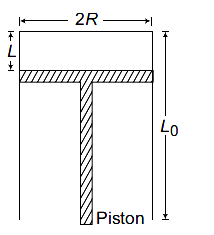
Question :
The piston is now pulled out slowly and held at a distance \(2 L\) from the top. The pressure in the cylinder between its top and the piston will then beJEE Advanced 2007 Easy - Paragraph:
The amount of energy required to break a bond is same as the amount of energy released when the same bond is formed. In gaseous state, the energy required for homolytic cleavage of a bond is called Bond Dissociation Energy (BDE) or Bond Strength. BDE is affected by \(s\)-character of the bond and the stability of the radicals formed. Shorter bonds are typically stronger bonds. BDEs for some bonds are given below:



Question:
\(\mathrm{CH}_{4}(\mathrm{~g})+\mathrm{Cl}_{2}(\mathrm{~g}) \stackrel{\text { light }}{\longrightarrow} \mathrm{CH}_{3} \mathrm{Cl}(\mathrm{g})+\mathrm{HCl}(\mathrm{g})\) the correct statement isJEE Advanced 2021 Medium - Let \(g(x)=\log f(x)\), where \(f(x)\) is a twice differentiable positive function on \((0, \infty)\) such that \(f(x+1)=x f(x)\). Then, for \(N=1,2,3, \ldots . g^{\prime \prime}\left(N+\frac{1}{2}\right)-g^{\prime \prime}\left(\frac{1}{2}\right)\) is equal toJEE Advanced 2008 Hard
- In a galvanic cell, the salt bridgeJEE Advanced 2014 Easy