


JEE Advanced · Mathematics · 22. Functions
Let \(g(x)=\log f(x)\), where \(f(x)\) is a twice differentiable positive function on \((0, \infty)\) such that \(f(x+1)=x f(x)\). Then, for \(N=1,2,3, \ldots . g^{\prime \prime}\left(N+\frac{1}{2}\right)-g^{\prime \prime}\left(\frac{1}{2}\right)\) is equal to
- A
\(-4\left\{1+\frac{1}{9}+\frac{1}{25}+\ldots+\frac{1}{(2 N-1)^2}\right\}\)
- B
\(4\left\{1+\frac{1}{9}+\frac{1}{25}+\ldots+\frac{1}{(2 N-1)^2}\right\}\)
- C
\(-4\left\{1+\frac{1}{9}+\frac{1}{25}+\ldots+\frac{1}{(2 N+1)^2}\right\}\)
- D
\(4\left\{1+\frac{1}{9}+\frac{1}{25}+\ldots+\frac{1}{(2 N+1)^2}\right\}\)
Answer & Solution
Correct Answer
(A)
\(-4\left\{1+\frac{1}{9}+\frac{1}{25}+\ldots+\frac{1}{(2 N-1)^2}\right\}\)
Step-by-step Solution
Detailed explanation
Since, \(\quad f(x)=e^{g(x)}\)
\[
\begin{aligned}
\Rightarrow \quad e^{g(x+1)} & =f(x+1) \\
& =x f(x) \\
& =x e^{g(x)}
\end{aligned}
\]
and
\[
g(x+1)=\log x+g(x)
\]
\[
\Rightarrow \quad g(x+1)-g(x)=\log x
\]
Replacing \(x\) by \(x-\frac{1}{2}\), we get
\[
\begin{aligned}
g\left(x+\frac{1}{2}\right)-g\left(x-\frac{1}{2}\right) & =\log \left(x-\frac{1}{2}\right)=\log (2 x-1)-\log 2 \\
\therefore g^{\prime \prime}\left(x+\frac{1}{2}\right)-g^{\prime \prime}\left(x-\frac{1}{2}\right) & =-\frac{4}{(2 x-1)^2}
\end{aligned}
\]
Substituting, \(x=1,2,3, \ldots, N\) in Eq. (ii) and adding, we get
\[
g^{\prime \prime}\left(N+\frac{1}{2}\right)-g^{\prime \prime}\left(\frac{1}{2}\right)=-4\left\{1+\frac{1}{9}+\frac{1}{25}+\ldots+\frac{1}{(2 N-1)^2}\right\} .
\]
\[
\begin{aligned}
\Rightarrow \quad e^{g(x+1)} & =f(x+1) \\
& =x f(x) \\
& =x e^{g(x)}
\end{aligned}
\]
and
\[
g(x+1)=\log x+g(x)
\]
\[
\Rightarrow \quad g(x+1)-g(x)=\log x
\]
Replacing \(x\) by \(x-\frac{1}{2}\), we get
\[
\begin{aligned}
g\left(x+\frac{1}{2}\right)-g\left(x-\frac{1}{2}\right) & =\log \left(x-\frac{1}{2}\right)=\log (2 x-1)-\log 2 \\
\therefore g^{\prime \prime}\left(x+\frac{1}{2}\right)-g^{\prime \prime}\left(x-\frac{1}{2}\right) & =-\frac{4}{(2 x-1)^2}
\end{aligned}
\]
Substituting, \(x=1,2,3, \ldots, N\) in Eq. (ii) and adding, we get
\[
g^{\prime \prime}\left(N+\frac{1}{2}\right)-g^{\prime \prime}\left(\frac{1}{2}\right)=-4\left\{1+\frac{1}{9}+\frac{1}{25}+\ldots+\frac{1}{(2 N-1)^2}\right\} .
\]
See the Complete Solution
Get step-by-step explanations for this and 2.5 Lakh+ more JEE, NEET & CET questions.
- Unlock all solutions
- Practice the full chapter
- Track accuracy across PYQs
4.8 rated on Google Play · 14,000+ reviews
More questions from Mathematics
- Let denote the parabola Let , and let and be two distinct points on such that the lines and are tangents to . Let be the focus of . Then which of the following statements is (are) TRUE?JEE Advanced 2021 Medium
- For 3 x 3 matrices M and N, which of the following statement(s) is (are) not correct?JEE Advanced 2013 Medium
- Paragraph:
Read the following passage and answer the questions.
For every function \(f(x)\) which is twice differentiable, these will be good approximation of \(\int_a^b f(x) d x \cong\left(\frac{b-a}{2}\right)\{f(a)+f(b)\}\). Now, if we take \(c=\frac{a+b}{2}\), then using above again, we get \(\int_a^b f(x) d x=\int_a^c f(x) d x+\int_c^b f(x) d x \cong \frac{b-a}{4}\{f(a)+f(b)+2 f(c)\}\) and so on.
We get approximation for value of \(\int_a^b f(x) d x\).Question:
If \(\lim _{t \rightarrow a} \frac{\int_a^t f(x) d x-\frac{(t-a)}{2}\{f(t)+f(a)\}}{(t-a)^3}=0\), then degree of polynomial function \(f(x)\) at most isJEE Advanced 2006 Hard - Let and be two functions defined for Define the following sets whose elements are written in the increasing order:
List- contains the sets and List- contains some information regarding these sets.
List- I List- II an arithmetic progression NOT an arithmetic progression
Which of the following is the only correct combination?JEE Advanced 2019 Easy - Five persons and are seated in a circular arrangement. If each of them is given a hat of one of the three colours red, blue and green, then the number of ways of distributing the hats such that the persons seated in adjacent seats get different coloured hats isJEE Advanced 2019 Easy
- An ellipse intersects the hyperbola \(2 x^2-2 y^2=1\) orthogonally. The eccentricity of the ellipse is reciprocal to that of the hyperbola. If the axes of the ellipse are along the coordinate axes, thenJEE Advanced 2009 Hard
More PYQs from JEE Advanced
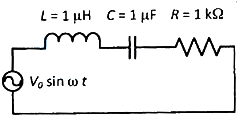
- In the circuit shown, They are connected in series with an a.c. source as shown. Which of the following options is/are correct?
 JEE Advanced 2017 Hard
 - Paragraph:
Tangents are drawn from the point \(P(3,4)\) to the ellipse \(\frac{x^2}{9}+\frac{y^2}{4}=1\) touching the ellipse at points \(A\) and \(B\).Question:
The coordinates of \(A\) and \(B\) areJEE Advanced 2010 Medium - A metal rod of length \(L\) and mass \(m\) is pivoted at one end. A thin disc of mass \(M\) and radius \(R( < L)\) is attached at its centre to the free end of the rod. Consider two ways the disc is attached. Case A-the disc is not free to rotate about its centre and case \(B\)-the disc is free to rotate about its centre. The rod-disc system performs
SHM in vertical plane after being released from the same displaced position. Which of the following statement(s) is/are true?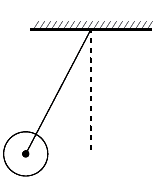 JEE Advanced 2011 Medium
 - Match List-I with List - II and select the correct answer using the code given below the lists
List-I List-II A. Volume of parallelepiped determined by vectors and is . Then the volume of the parallelepiped determined by vectors
and isP. B. Volume of parallel piped determined by vectors and is . Then the volume of the parallelepiped determined by vectors and is Q. C Area of a triangle with adjacent sides determined by vectors and is .Then the area of the triangle with adjacent sides determined by vectors and is R. D Area of a parallelogram with adjacent sides determined by vectors and is . Then the area of the parallelogram with adjacent sides determined by vectors and is S. JEE Advanced 2013 Hard - The dilution processes of different aqueous solutions with water are given in LIST-I. The effects of dilution of the solutions on are given in LIST-II.
(Note: The degree of dissociation of a weak acid and a weak base is the degree of hydrolysis of salt is represents the concentration of ions)List - I List - II A) 10 mL of \(0.1\text{ M NaOH} +20\text{ mL}\) of 0.1 M acetic acid diluted to 60 mL . P) The value of \(\left[\text H ^{+}\right]\)does not change on dilution. B) 20 mL of \(0.1\text{ M NaOH} +20\text{ mL}\) of 0.1 M acetic acid diluted to 80 mL . Q) The value of \(\left[\text H ^{+}\right]\)changes to half of its initial value on dilution. C) 20 mL of \(0.1\text{ M HCl} +20\text{ mL}\) of 0.1 M ammonia solution diluted to 80 mL . R) The value of \(\left[\text H ^{+}\right]\)changes to two times its initial value on dilution. D) 10 mL saturated solution of \(\text{Ni} (\text{OH})_2\) in equilibrium with excess of solid \(\text{Ni} (\text{OH})_2\) is diluted to 20 mL (solid \(\text{Ni} (\text{OH})_2\) is still present after dilution). S) The value of \(\left[\text H ^{+}\right]\)changes to \(\sqrt{ }\) times its initial value on dilution. T) The value of \(\left[\text H ^{+}\right]\)changes to \(\sqrt{2}\) times its initial value on dilution.
Match each process given in LIST-I with one or more effect(s) in LIST-II. The correct option isJEE Advanced 2018 Hard - The correct statement(s) regarding,
(i)
(ii)
(iii) and
(iv) is /areJEE Advanced 2015 Medium