


JEE Advanced · Chemistry · 24. Haloalkanes & Haloarenes
Paragraph:
The amount of energy required to break a bond is same as the amount of energy released when the same bond is formed. In gaseous state, the energy required for homolytic cleavage of a bond is called Bond Dissociation Energy (BDE) or Bond Strength. BDE is affected by \(s\)-character of the bond and the stability of the radicals formed. Shorter bonds are typically stronger bonds. BDEs for some bonds are given below:




Question:
\(\mathrm{CH}_{4}(\mathrm{~g})+\mathrm{Cl}_{2}(\mathrm{~g}) \stackrel{\text { light }}{\longrightarrow} \mathrm{CH}_{3} \mathrm{Cl}(\mathrm{g})+\mathrm{HCl}(\mathrm{g})\) the correct statement is
- A Initiation step is exothermic with .
- B Propagation step involving formation is exothermic with
- C Propagation step involving formation is endothermic with
- D The reaction is exothermic with .
Answer & Solution
Correct Answer
(D) The reaction is exothermic with .
Step-by-step Solution
Detailed explanation
See the Complete Solution
Get step-by-step explanations for this and 2.5 Lakh+ more JEE, NEET & CET questions.
- Unlock all solutions
- Practice the full chapter
- Track accuracy across PYQs
4.8 rated on Google Play · 14,000+ reviews
More questions from Chemistry
- A list of species having the formula XZ4 is given below.
\(\text{XeF} _4, \text{SF} _4, \text{SiF} _4, \text{BF} _4^{-}, \text{BrF} _4^{-},\left[\text{Cu} \left(\text{NH} _3\right)_4\right]^{2+},\) \(\left[\text{FeCl} _4\right]^{2-},\left[\text{CoCl} _4\right]^{2-}\) and \(\left[\text{PtCl} _4\right]^{2-}\)
Defining shape on the basis of the location of X and Z atoms, the total number of species having a square planar shape isJEE Advanced 2014 Easy - Paragraph:
Properties such as boiling point, freezing point and vapour pressure of a pure solvent change when solute molecules are added to get homogeneous solution. These are called colligative properties. Applications of colligative properties are very useful in day-to-day life. One of its examples is the use of ethylene glycol and water mixture as anti-freezing liquid in the radiator automobiles.
A solution \(M\) is prepared by mixing ethanol and water. The mole fraction of ethanol in the mixtrue is \(0.9\)
Given Freezing point depression constant of water \(\left(k^{\text {water }}\right)=1.86 \mathrm{~K} \mathrm{~kg} \mathrm{~mol}^{-1}\)
Freezing point depression constant of ethanol \(\left(k_f^{\text {ethanol }}\right)=2.0 \mathrm{Kkg} \mathrm{mol}^{-1}\)
Boiling point elevation constant of water \(\left(k_b^{\text {water }}\right)=0.52 \mathrm{Kkg} \mathrm{mol}^{-1}\)
Boiling point elevation constant of ethanol \(\left(k_b^{\text {ethanol }}\right)=1.2 \mathrm{Kkg} \mathrm{mol}^{-1}\)
Standard freezing point of water \(=273 \mathrm{~K}\)
Standard freezing point of ethanol \(=155.7 \mathrm{~K}\)
Standard boiling point of water \(=373 \mathrm{~K}\)
Standard boiling point of ethanol \(=351.5 \mathrm{~K}\)
Vapour pressure of pure water \(=328 \mathrm{~mm}\) of \(\mathrm{Hg}\)
Vapour pressure of pure ethanol \(=40 \mathrm{~mm}\) of \(\mathrm{Hg}\)
Molecular weight of water \(=18 \mathrm{~g} \mathrm{~mol}^{-1}\)
Molecular weight of ethanol \(=46 \mathrm{~g} \mathrm{~mol}^{-1}\)
In answering the following questions, consider the solutions to be ideal dilute solutions and solutes to be non-volatile and non-dissociative.
Question:
The vapour pressure of the solution \(M\) isJEE Advanced 2008 Medium - The electrochemical cell shown below is a concentration cell. \(\mathrm{M} \mid \mathrm{M}^{2+}\) (saturated solution of a sparingly soluble salt, \(\left.\mathrm{MX}_{2}\right) \| \mathrm{M}^{2 \perp}\left(0.001 \mathrm{~mol} \mathrm{dm}^{-3}\right) \mid \mathrm{M}\).
The emf of the cell depends on the difference in concentrations of \(\mathrm{M}^{2+}\) ions at the two electrodes. The emf of the cell at \(298 \mathrm{~K}\) is \(0.059 \mathrm{~V}\).
Question:
The solubility product \(\left(\mathrm{K}_{s p} ; \mathrm{mol}^{3} \mathrm{dm}^{-9}\right)\) of \(\mathrm{MX}_{2}\) at \(298 \mathrm{~K}\) based on the information available for the given concentration cell is (take \(2.303 \times \mathrm{R} \times 298 / \mathrm{F}=0.059 \mathrm{~V}\) )JEE Advanced 2012 Medium - Three moles of are completely reacted with methanol. The number of moles of boron containing product formed isJEE Advanced 2015 Medium
- A tin chloride undergoes the following reactions (not balanced)
is a monoanion having pyramidal geometry. Both and are neutral compounds. Choose the correct option(s).JEE Advanced 2019 Hard - Hydrogen bonding plays a central role in the following phenomena:JEE Advanced 2014 Medium
More PYQs from JEE Advanced
- A hydrogen atom in its ground state is irradiated by light of wavelength Taking hc/e = m and the ground state energy of hydrogen atom as , the number of lines present in the emission spectrum isJEE Advanced 2016 Medium
- The quadratic equation with real coefficients has purely imaginary roots. Then the equation hasJEE Advanced 2014 Medium
- A \(2 \mu \mathrm{F}\) capacitor is charged as shown in the figure. The percentage of its stored energy dissipated after the switch \(S\) is turned to position 2 , is
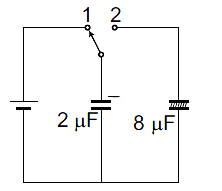 JEE Advanced 2011 Medium
 - The treatment of an aqueous solution of 3.74 g of \(\text{Cu} \left(\text{NO} _3\right)_2\) with excess KI results in a brown solution along with the formation of a precipitate. Passing \(\text{H} _2 \text{S}\) through this brown solution gives another precipitate X . The amount of X (in g ) is _____________ [Given: Atomic mass of \(\text{H} =1, \text{N}=14, \text{O} =16, \text{S}=32, \text{K}=39,\) \(\text{Cu} =63, \text{I} =127]\)JEE Advanced 2022 Easy
- For the first order reaction \(2 \mathrm{~N}_2 \mathrm{O}_5(\mathrm{~g}) \longrightarrow 4 \mathrm{NO}_2(g)+\mathrm{O}_2(g)\)JEE Advanced 2011 Easy
- The value of the limit is _________JEE Advanced 2020 Medium