


JEE Advanced · Chemistry · 17. Electrochemistry
Paragraph:
Tollen's reagent is used for the detection of aldehyde when a solution of \(\mathrm{AgNO}_3\) is added to glucose with \(\mathrm{NH}_4 \mathrm{OH}\) then gluconic acid is formed
\(\mathrm{Ag}^{+}+e^{-} \rightarrow \mathrm{Ag} E_{\text {red }}^{\circ}=0.8 \mathrm{~V} \)
\( \mathrm{C}_6 \mathrm{H}_{12} \mathrm{O}_6+\mathrm{H}_2 \mathrm{O} \rightarrow \text { Gluconic acid }\left(\mathrm{C}_6 \mathrm{H}_{12} \mathrm{O}_7\right)\) \(+~2 \mathrm{H}^{+}+2 e^{-} ; -E_{\mathrm{red}}^{\circ}=-0.05 \mathrm{~V} \)
\( \mathrm{Ag}\left(\mathrm{NH}_3\right)_2^{+}+e^{-} \rightarrow \mathrm{Ag}(s)+2 \mathrm{NH}_3 ; E_{\mathrm{red}}^{\circ}\) \(=0.337 \mathrm{~V}\)
[Use \(2.303 \times \frac{R T}{F}=0.0592\) and \(\frac{F}{R T}=38.92\) at \(298 \mathrm{~K}\)]
Question:
\(2 \mathrm{Ag}^{+}+\mathrm{C}_6 \mathrm{H}_{12} \mathrm{O}_6+\mathrm{H}_2 \mathrm{O} \rightarrow 2 \mathrm{Ag}(\mathrm{s})\) \(+~\mathrm{C}_6 \mathrm{H}_{12} \mathrm{O}_4+2 \mathrm{H}^{+}\). Find \(\ln \mathrm{K}\) of this reaction.
- A \(66.13\)
- B \(58.38\)
- C \(28.30\)
- D \(46.29\)
Answer & Solution
Correct Answer
(B) \(58.38\)
Step-by-step Solution
Detailed explanation
Cell reaction,
(i) \(\mathrm{Ag}^{+}+e^{-} \longrightarrow \mathrm{Ag}(\mathrm{s}), E_{\mathrm{red}}^{\circ}=0.8 \mathrm{~V}\)
(ii) \(\mathrm{C}_6 \mathrm{H}_{12} \mathrm{O}_6+\mathrm{H}_2 \mathrm{O} \longrightarrow \mathrm{C}_6 \mathrm{H}_{12} \mathrm{O}_7~+\) \(2 \mathrm{H}^{+}+2 e^{-}, E_{\text {oxid }}=-0.05 \mathrm{~V}\)
Hence, for reaction
\(2 \mathrm{Ag}^{+}+\mathrm{C}_6 \mathrm{H}_{12} \mathrm{O}_6+\mathrm{H}_2 \mathrm{O} \longrightarrow 2 \mathrm{Ag}(s)~+\) \(\mathrm{C}_6 \mathrm{H}_{12} \mathrm{O} 7+2 \mathrm{H}^{+} \)
\( E_{\text {cell }}^{\circ} =(0.8-0.05)=0.75 \mathrm{~V} \)
\( E_{\text {cell }}^{\circ} =E_{\text {anode }}^{\circ}-E_{\text {cathode }}^{\circ}=[-0.05\) \(-(-0.8)]_{\mathrm{V}}\)
On the basis of oxidised electrode potential \(=0.75 \mathrm{~V}\)
By Nernst equation, \(E_{\text {cell }}=E_{\text {cell }}^{\circ}-\frac{2.303 R T}{n F} \log _{10} K\)
At equilibrium, \(E_{\text {cell }}=0\)
\(E_{\text {cell }}^{\circ} =\frac{2.303 R T}{n F} \log _{10} K \)
\( 0.75 =\frac{0.0592}{2} \log _{10} K \)
\( \log _{10} K =\frac{2 \times 0.75}{0.0592}=25.33\)
or In \(K=2.303 \times \log _{10} K=2.303 \times 25.33=58.35\)
(i) \(\mathrm{Ag}^{+}+e^{-} \longrightarrow \mathrm{Ag}(\mathrm{s}), E_{\mathrm{red}}^{\circ}=0.8 \mathrm{~V}\)
(ii) \(\mathrm{C}_6 \mathrm{H}_{12} \mathrm{O}_6+\mathrm{H}_2 \mathrm{O} \longrightarrow \mathrm{C}_6 \mathrm{H}_{12} \mathrm{O}_7~+\) \(2 \mathrm{H}^{+}+2 e^{-}, E_{\text {oxid }}=-0.05 \mathrm{~V}\)
Hence, for reaction
\(2 \mathrm{Ag}^{+}+\mathrm{C}_6 \mathrm{H}_{12} \mathrm{O}_6+\mathrm{H}_2 \mathrm{O} \longrightarrow 2 \mathrm{Ag}(s)~+\) \(\mathrm{C}_6 \mathrm{H}_{12} \mathrm{O} 7+2 \mathrm{H}^{+} \)
\( E_{\text {cell }}^{\circ} =(0.8-0.05)=0.75 \mathrm{~V} \)
\( E_{\text {cell }}^{\circ} =E_{\text {anode }}^{\circ}-E_{\text {cathode }}^{\circ}=[-0.05\) \(-(-0.8)]_{\mathrm{V}}\)
On the basis of oxidised electrode potential \(=0.75 \mathrm{~V}\)
By Nernst equation, \(E_{\text {cell }}=E_{\text {cell }}^{\circ}-\frac{2.303 R T}{n F} \log _{10} K\)
At equilibrium, \(E_{\text {cell }}=0\)
\(E_{\text {cell }}^{\circ} =\frac{2.303 R T}{n F} \log _{10} K \)
\( 0.75 =\frac{0.0592}{2} \log _{10} K \)
\( \log _{10} K =\frac{2 \times 0.75}{0.0592}=25.33\)
or In \(K=2.303 \times \log _{10} K=2.303 \times 25.33=58.35\)
See the Complete Solution
Get step-by-step explanations for this and 2.5 Lakh+ more JEE, NEET & CET questions.
- Unlock all solutions
- Practice the full chapter
- Track accuracy across PYQs
4.8 rated on Google Play · 14,000+ reviews
More questions from Chemistry
- Paragraph:
An aqueous solution of metal ion \(\mathbf{M} 1\) reacts separately with reagents \(\mathbf{Q}\) and \(\mathbf{R}\) in excess to give tetrahedral and square planar complexes, respectively. An aqueous solution of another metal ion M2 always forms tetrahedral complexes with these reagents. Aqueous solution of \(\mathbf{M} 2\) on reaction with reagent \(\mathbf{S}\) gives white precipitate which dissolves in excess of \(\mathbf{S}\). The reactions are summarized in the scheme given below: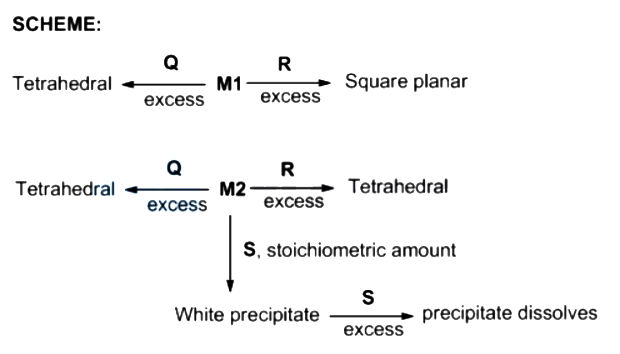
Question:
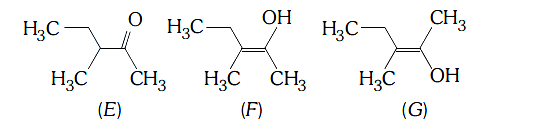
\(\mathbf{M} 1, \mathbf{Q}\) and \(\mathbf{R}\), respectively areJEE Advanced 2014 Easy - The correct statement(s) concerning the structures E, F and G is are
 JEE Advanced 2008 Easy
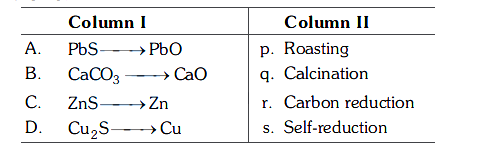
 - Match the conversions in Column I with the type(s) given in Column II. Indicate your answer by darkening the appropriate bubbles of the \(4 \times 4\) matrix given in the ORS.
 JEE Advanced 2008 Medium
 - At \(400 \mathrm{~K}\), the root mean square (rms) speed of a gas \(X\) (molecular weight \(=40\) ) is equal to the most probable speed of gas \(Y\) at \(60 \mathrm{~K}\). The molecular weight of the gas \(Y\) isJEE Advanced 2009 Easy
- Atom occupies the fcc lattice sites as well as alternate tetrahedral voids of the same lattice. The packing efficiency (in ) of the resultant solid is closest toJEE Advanced 2022 Medium
- In a constant volume calorimeter, \(3.5 \mathrm{~g}\) of a gas with molecular weight \(=28\) was burnt in excess oxygen at \(298.0 \mathrm{~K}\). The temperature of the calorimeter was found to increases from \(298.0 \mathrm{~K}\) to \(298.45 \mathrm{~K}\) due to the combustion process. Given, that the heat capacity of the calorimeter is \(2.5\) \(\mathrm{kJ} \mathrm{K}^{-1}\), the numerical value for the enthalpy of combustion of the gas in \(\mathrm{kJ} \mathrm{mol}^{-1}\) isJEE Advanced 2009 Easy
More PYQs from JEE Advanced
- A solution when diluted with \(\mathrm{H}_2 \mathrm{O}\) and boiled, it gives a white precipitate. On addition of excess \(\mathrm{NH}_4 \mathrm{Cl} / \mathrm{NH}_4 \mathrm{OH}\), the volume of precipitate decreases leaving behind a white gelatinous precipitate. Identify the precipitate which dissolves in \(\mathrm{NH}_4 \mathrm{OH} / \mathrm{NH}_4 \mathrm{Cl}\).JEE Advanced 2006 Hard
- For how many values of , the circle and the coordinate axes have exactly three common points?JEE Advanced 2017 Medium
- Let and be the following straight lines.
and
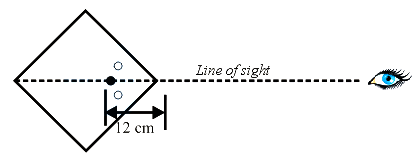
Suppose the straight line lies in the plane containing and , and passes through the point of intersection of and . If the line bisects the acute angle between the lines and , then which of the following statements is/are TRUE?JEE Advanced 2020 Medium - A large square container with thin transparent vertical walls and filled with water is kept on a horizontal table. A student holds a thin straight wire vertically inside the water from one of its corners, as shown schematically in the figure. Looking at the wire from this corner, another student sees two images of the wire, located symmetrically on each side of the line of sight as shown. The separation (in ) between these images is ________.
 JEE Advanced 2020 Hard
 - Paragraph :
\(\mathbf{P}_{17 \text { - } 19}\) : Paragraph for Questions Nos. 17 to 19 Two discs \(A\) and \(B\) are mounted coaxially on a vertical axle. The discs have moments of inertia I and 2I, respectively about the common axis. Disc \(A\) is imparted an initial angular velocity \(2 \omega\) using the entire potential energy of a spring compressed by a distance \(x_1\). Disc \(B\) is imparted an angular velocity \(\omega\) by a spring having the same spring constant and compressed by a distance \(x_2\). Both the discs rotate in the clockwise direction.
Question :
When disc \(B\) is brought in contact with disc \(A\), they acquire a common angular velocity in time \(t\). The average frictional torque on one disc by the other during this period isJEE Advanced 2007 Medium - Paragraph:
Consider the lines: \(L_1: \frac{x+1}{3}=\frac{y+2}{1}=\frac{z+1}{2}, L_2: \frac{x-2}{1}=\frac{y+2}{2}=\frac{z-3}{3}\)Question:
The distance of the point \((1,1,1)\) from the plane passing through the point \((-1,-2,-1)\) and whose normal is perpendicular to both the lines \(L_1\) and \(L_2\), isJEE Advanced 2008 Easy