


JEE Advanced · Chemistry · 16. Solutions
Paragraph:
Properties such as boiling point, freezing point and vapour pressure of a pure solvent change when solute molecules are added to get homogeneous solution. These are called colligative properties. Applications of colligative properties are very useful in day-to-day life. One of its examples is the use of ethylene glycol and water mixture as anti-freezing liquid in the radiator automobiles.
A solution \(M\) is prepared by mixing ethanol and water. The mole fraction of ethanol in the mixtrue is \(0.9\)
Given Freezing point depression constant of water \(\left(k^{\text {water }}\right)=1.86 \mathrm{~K} \mathrm{~kg} \mathrm{~mol}^{-1}\)
Freezing point depression constant of ethanol \(\left(k_f^{\text {ethanol }}\right)=2.0 \mathrm{Kkg} \mathrm{mol}^{-1}\)
Boiling point elevation constant of water \(\left(k_b^{\text {water }}\right)=0.52 \mathrm{Kkg} \mathrm{mol}^{-1}\)
Boiling point elevation constant of ethanol \(\left(k_b^{\text {ethanol }}\right)=1.2 \mathrm{Kkg} \mathrm{mol}^{-1}\)
Standard freezing point of water \(=273 \mathrm{~K}\)
Standard freezing point of ethanol \(=155.7 \mathrm{~K}\)
Standard boiling point of water \(=373 \mathrm{~K}\)
Standard boiling point of ethanol \(=351.5 \mathrm{~K}\)
Vapour pressure of pure water \(=328 \mathrm{~mm}\) of \(\mathrm{Hg}\)
Vapour pressure of pure ethanol \(=40 \mathrm{~mm}\) of \(\mathrm{Hg}\)
Molecular weight of water \(=18 \mathrm{~g} \mathrm{~mol}^{-1}\)
Molecular weight of ethanol \(=46 \mathrm{~g} \mathrm{~mol}^{-1}\)
In answering the following questions, consider the solutions to be ideal dilute solutions and solutes to be non-volatile and non-dissociative.
Question:
Water is added to the solution \(M\) such that the mole fraction of water in the solution becomes \(0.9\) The boiling point of this solutions is
- A \(380.4 \mathrm{~K}\)
- B \(376.2 \mathrm{~K}\)
- C \(375.5 \mathrm{~K}\)
- D \(354.7 \mathrm{~K}\)
Answer & Solution
Correct Answer
(B) \(376.2 \mathrm{~K}\)
Step-by-step Solution
Detailed explanation
\(\chi_{\mathrm{H}_2 \mathrm{O}}=0.9\) (solvent) \(\chi_{\mathrm{C}_2 \mathrm{H}_5 \mathrm{OH}}=0.1\) (solute)
\(
\Delta T_b=k_b \times m=0.52 \times \frac{1.0 \times 1000}{0.9 \times 18}=3.2 \mathrm{~K}
\)
Boiling point, \(T_b=373+3.2=376.2 \mathrm{~K}\)
\(
\Delta T_b=k_b \times m=0.52 \times \frac{1.0 \times 1000}{0.9 \times 18}=3.2 \mathrm{~K}
\)
Boiling point, \(T_b=373+3.2=376.2 \mathrm{~K}\)
See the Complete Solution
Get step-by-step explanations for this and 2.5 Lakh+ more JEE, NEET & CET questions.
- Unlock all solutions
- Practice the full chapter
- Track accuracy across PYQs
4.8 rated on Google Play · 14,000+ reviews
More questions from Chemistry
- The stoichiometric reaction of of dimethyldichlorosilane with water results in a tetrameric cyclic product in yield. The weight (in ) of obtained is ____________
\(\left[\right.\)Use, molar mass\(.\left(\text{gmol} ^{-1}\right):\text H =1,\text C =12,\)\(\text O =16, \text{Si} =28, \text{Cl} =35.5]\)JEE Advanced 2023 Hard - The IUPAC name of \(\left[\mathrm{Ni}\left(\mathrm{NH}_3\right)_4\right]\left[\mathrm{NiCl}_4\right]\) isJEE Advanced 2008 Easy
- For the process \(\mathrm{H}_2 \mathrm{O}(\mathrm{l})\) (1 bar, \(\left.273 \mathrm{~K}\right) \longrightarrow \mathrm{H}_2 \mathrm{O}(\mathrm{g})\) (1 bar, \(\left.373 \mathrm{~K}\right)\), the correct set of thermodynamic parameters isJEE Advanced 2007 Medium
- Paragraph:
The reactions of \(\mathrm{Cl}_{2}\) gas with cold-dilute and hot-concentrated \(\mathrm{NaOH}\) in water give sodium salts of two (different) oxoacids of chlorine, \(\boldsymbol{P}\) and \(\boldsymbol{Q}\), respectively. The \(\mathrm{Cl}_{2}\) gas reacts with \(\mathrm{SO}_{2}\) gas, in presence of charcoal, to give a product \(\boldsymbol{R}\). \(\boldsymbol{R}\) reacts with white phosphorus to give a compound \(\boldsymbol{S}\). On hydrolysis, \(\boldsymbol{S}\) gives an oxoacid of phosphorus, \(\boldsymbol{T}\).
Question:
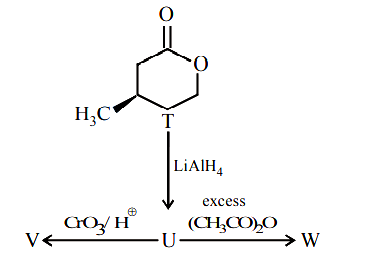
\(R, S\) and \(T\), respectively, areJEE Advanced 2013 Medium - With reference to the scheme given below, which of the given statement(s) about \(\mathrm{T}, \mathrm{U}, \mathrm{V}\) and \(\mathrm{W}\) is (are) correct?
 JEE Advanced 2012 Medium
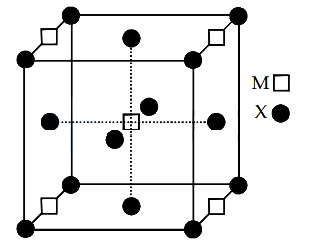
 - A compound \(\mathrm{M}_{\mathrm{p}} \mathrm{X}_{\mathrm{q}}\) has cubic close packing (ccp) arrangement of \(\mathrm{X}\). Its unit cell structure is shown below. The empirical formula of the compound is
 JEE Advanced 2012 Hard
More PYQs from JEE Advanced
- Let \(f\) be a real-valued function defined on the interval \((-1,1)\) such that \(e^{-x} f(x)=2+\int_0^x \sqrt{t^4+1} d t, \quad\) for all \(x \in(-1,1)\) and let \(f^{-1}\) be the inverse function of \(f\). Then \(\left(f^{-1}\right)^{\prime}(2)\) is equal toJEE Advanced 2010 Hard
- Let be a differentiable function with . If satisfies the differential equation , then the value of isJEE Advanced 2018 Easy
- Paragraph :
When liquid medicine of density \(\rho\) is to be put in the eye, it is done with the help of a dropper. As the bulb on the top of the dropper is pressed, a drop forms at the opening of the dropper. We wish to estimate the size of the drop.
We first assume that the drop formed at the opening is spherical because that requires a minimum increase in its surface energy. To determine the size, we calculate the net vertical force due to the surface tension \(T\) when the radius of the drop is \(R\). When this force becomes smaller than the weight of the drop, the drop gets detached from the dropper.
Question :
If \(r=5 \times 10^{-4} \mathrm{~m}, \rho=10^3 \mathrm{~kg} \mathrm{~m}^{-3}\), \(g=10 \mathrm{~ms}^{-2}, T=0.11 \mathrm{Nm}^{-1}\), the radius of the drop when it detaches from the dropper is approximatelyJEE Advanced 2010 Easy - Paragraph:
A fair die is tossed repeatedly until a six is obtained. Let \(X\) denotes the number of tosses required.Question:
The probability that \(X \geq 3\) equalsJEE Advanced 2009 Easy - If \(f(x)\) is twice differentiable function such that \(f(a)=0, f(b)=2, f(c)=1, f(d)=2\), \(f(e)=0\), where \(a < b < c < d < e\), then the minimum number of zeros of \(g(x)=\left\{f^{\prime}(x)\right\}^2+f^{\prime \prime}(x) \cdot f(x)\) in the interval \([a, e]\) isJEE Advanced 2006 Medium
- Paragraph:
A circle \(C\) of radius 1 is inscribed in an equilateral \(\triangle P Q R\). The points of contact of \(C\) with the sides \(P Q, Q R, R P\) are \(D, E, F\) respectively. The line \(P Q\) is given by the equation
\(\sqrt{3} x+y-6=0\) and the point \(D\) is \(\left(\frac{3 \sqrt{3}}{2}, \frac{3}{2}\right)\). Further, it is given that the origin and the centre of \(C\) are on the same side of the line \(P Q\).Question:
Equations of the sides \(Q R, R P\) areJEE Advanced 2008 Easy