


WBJEE · Physics · Alternating Current
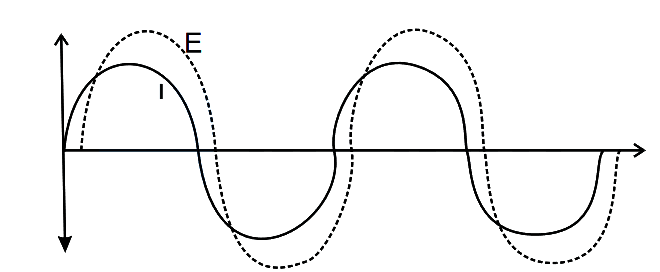
When an \(A C\) source of emf \(E\) with frequency \(\omega=100 \mathrm{~Hz}\) is connected across a circuit, the phase difference between
\(E\) and current I in the circuit is observed to be \(\frac{\pi}{4}\) as shown in the figure. If the circuit consist of only \(\mathrm{RC}\) or \(\mathrm{RL}\) in series, then
- A \(\mathrm{R}=1 \mathrm{k} \Omega, \mathrm{C}=5 \mu \mathrm{F}\)
- B \(\mathrm{R}=1 \mathrm{k} \Omega, \mathrm{L}=10 \mathrm{H}\)
- C \(\mathrm{R}=1 \mathrm{k} \Omega, \mathrm{L}=1 \mathrm{H}\)
- D \(\mathrm{R}=1 \mathrm{k} \Omega, \mathrm{C}=10 \mu \mathrm{F}\)
Answer & Solution
Correct Answer
(D) \(\mathrm{R}=1 \mathrm{k} \Omega, \mathrm{C}=10 \mu \mathrm{F}\)
Step-by-step Solution
Detailed explanation
.. Since supply voltage lags the current \(\operatorname{By}(\phi=\pi / 4)\)…
See the Complete Solution
Get step-by-step explanations for this and 2.5 Lakh+ more JEE, NEET & CET questions.
- Unlock all solutions
- Practice the full chapter
- Track accuracy across PYQs
4.8 rated on Google Play · 14,000+ reviews
More questions from Physics
- The decimal number equivalent to a binary number 1011001 isWBJEE 2012 Hard
- A hollow metal sphere of radius \(R\) is charged with a charge \(Q .\) The electric potential and intensity inside the sphere are respectivelyWBJEE 2016 Medium
- The elastic potential energy of a strained body isWBJEE 2024 Easy
- An object placed at a distance of \(16 \mathrm{cm}\) from a \(\begin{array}{llll}\text { convex lens } & \text { produces } & \text { an image } & \text { of }\end{array}\) magnification \(m(m>1)\). If the object is moved towards the lens by \(8 \mathrm{cm}\), then again an image of magnification \(m\) is obtained. The numerical value of the focal length of the lens isWBJEE 2013 Hard
- A quantity X is given by \(\varepsilon_0 \mathrm{~L} \frac{\Delta \mathrm{~V}}{\Delta t}\), where \(\varepsilon_0\) is the permittivity of free space, L is the length, \(\Delta \mathrm{V}\) is a potential difference and \(\Delta t\) is a time interval. The dimension of \(X\) is same as that ofWBJEE 2025 Medium
- A particle of mass \(M\) and charge \(q\), initially at rest, is accelerated by a uniform electric field \(E\) through a distance \(D\) and is then allowed to approach a fixed static charge \(Q\) of the same sign. The distance of the closest approach of the charge \(q\) will then beWBJEE 2013 Medium
More PYQs from WBJEE
- A particle of charge ' \(q\) ' and mass ' \(m\) ' moves in a circular orbit of radius ' \(r\) ' with angular speed ' \(\omega\) '. The ratio of the magnitude of its magnetic moment to that of its angular momentum depends onWBJEE 2025 Medium
- The orange solid on heating gives a colourless gas and a green solid which can be reduced to metal by aluminium powder. The orange and the green solids are, respectivelyWBJEE 2013 Easy
- The maximum value of \(|x|\), when the complex number \(z\) satisfies the condition \(\left|z+\frac{2}{z}\right|=2\) isWBJEE 2012 Hard
- A simple pendulum of length \(L\) swings in a vertical plane. The tension of the string when it makes an angle \(\theta\) with the vertical and the bob of mass \(m\) moves with a speed \(v\) is \(\mathrm{fg}\) is the gravitational acceleration)WBJEE 2015 Hard
- If \(\alpha, \beta\) are the roots of the quadratic equation \(x^{2}+p x+q=0,\) then the values of \(\alpha^{3}+\beta^{3}\) and \(\alpha^{4}+\alpha^{3} \beta^{2}+\beta^{4}\) are respectivelyWBJEE 2014 Medium
- The best method for the preparation of 2, 2-dimethylbutane is via the reaction ofWBJEE 2013 Easy