


WBJEE · Physics · Work Power Energy
A particle of mass \(M\) and charge \(q\), initially at rest, is accelerated by a uniform electric field \(E\) through a distance \(D\) and is then allowed to approach a fixed static charge \(Q\) of the same sign. The distance of the closest approach of the charge \(q\) will then be
- A \(\frac{q Q}{4 \pi \varepsilon_{0} D}\)
- B \(\frac{Q}{4 \pi \varepsilon_{0} E D}\)
- C \(\frac{q Q}{2 \pi \varepsilon_{0} D^{2}}\)
- D \(\frac{Q}{4 \pi \varepsilon_{0} E}\)
Answer & Solution
Correct Answer
(B) \(\frac{Q}{4 \pi \varepsilon_{0} E D}\)
Step-by-step Solution
Detailed explanation
At the distance of closest approach, the entire \(\mathrm{KE}\) of a particle is converted into electric potential energy. i.e.. \(\mathrm{KE}=\mathrm{PE}\) Here, KE of the particle = work done in moving the particle in uniform electric field (E) through a distance (D)…
See the Complete Solution
Get step-by-step explanations for this and 2.5 Lakh+ more JEE, NEET & CET questions.
- Unlock all solutions
- Practice the full chapter
- Track accuracy across PYQs
4.8 rated on Google Play · 14,000+ reviews
More questions from Physics
- A travelling acoustic wave frequency \(500 \mathrm{Hz}\) is moving along the positive \(x\) -direction with a velocity of \(300 \mathrm{ms}^{-1}\). The phase difference between two points \(x_{1}\) and \(x_{2}\) is \(60^{\circ} .\) Then the minimum separation between the two points isWBJEE 2013 Easy
- A particle is moving with a uniform speed \(v\) in a circular path of radius \(r\) with the centre at \(O\). When the particle moves from a point \(P\) to \(Q\) on the circle such that \(\angle P O Q=\theta\), then the magnitude of the change in velocity isWBJEE 2013 Easy
- A force \(\overrightarrow{\mathrm{F}}=a \hat{i}+b \hat{\mathrm{j}}+c \hat{k}\) is acting on a body of mass \(m\). The body was initially at rest at the origin. The co-ordinates of the body after time ' t ' will beWBJEE 2025 Medium
-
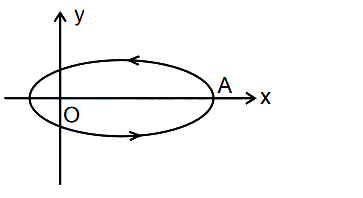
particle is moving in an elliptical orbit as shown in figure. If \(\vec{p}, \vec{L}\) and \(\vec{r}\) denote the linear momentum, angular momentum and position vector of the particle (from focus \(\mathrm{O}\) ) respectively at a point \(\mathrm{A}\), then the direction of \(\vec{\alpha}=\overrightarrow{\mathrm{p}} \times \overrightarrow{\mathrm{L}}\) is alongWBJEE 2022 Hard - A tennis ball hits the floor with a speed \(v\) at an angle \(\theta\) with the normal to the floor. If the collision is inelastic and the co-efficient of restitution is \(\varepsilon\), what will be the angle of reflection?WBJEE 2020 Easy
- A steel and a brass wire, each of length \(50 \mathrm{~cm}\) and cross-sectional area \(0.005 \mathrm{~cm}^{2}\) hang from a ceiling and are \(15 \mathrm{~cm}\) apart. Lower ends of the wires are attached to a light horizontal bar. A suitable downward load is applied to the bar so that each of the wires extends in length by \(0.1 \mathrm{~cm}\). At what distance from the steel wire the load must be applied? [Young's modulus of steel is \(2 \times 10^{12}\) dynes \(/ \mathrm{cm}^{2}\) and that of brass is \(1 \times 10^{12}\) dynes \(\left./ \mathrm{cm}^{2}\right]\)WBJEE 2020 Medium
More PYQs from WBJEE
- If the sum of two unit vectors is a unit vector, then the magnitude of their difference isWBJEE 2017 Easy
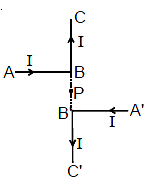
- Current through \(\mathrm{ABC}\) and \(\mathrm{A}^{\prime} \mathrm{B}^{\prime} \mathrm{C}^{\prime}\) is \(\mathrm{I}\). What is the magnetic field at \(\mathrm{P}\) ? \(\mathrm{BP}=\mathrm{PB}^{\prime}=\mathrm{r}\left(\right.\) Here \(\mathrm{C}^{\prime} \mathrm{B}^{\prime} \mathrm{PBC}\) are collinear)
 WBJEE 2011 Medium
 - \(A B C\) is an isosceles triangle with an inscribed circle with centre \(O\). Let \(P\) be the midpoint of \(B C\). If \(A B=A C=15\) and \(B C=10\), then \(\mathrm{OP}\) equalsWBJEE 2023 Medium
- Let \(S, T, U\) be three non-void sets and \(f: S \rightarrow T, g: T \rightarrow U\) be so that \(g o f: s \rightarrow U\) is surjective. Then,WBJEE 2019 Easy
- If \(\int \frac{d x}{(x+1)(x-2)(x-3)}=\frac{1}{k} \log _e\left\{\frac{|x-3|^3|x+1|}{(x-2)^4}\right\}+c\), then the value of \(k\) isWBJEE 2023 Medium
- The dimension of the universal constant of gravitation, \(G\) isWBJEE 2017 Easy