


WBJEE · Maths · Quadratic Equation
If \(\alpha, \beta\) are the roots of the quadratic equation \(x^{2}+p x+q=0,\) then the values of \(\alpha^{3}+\beta^{3}\) and \(\alpha^{4}+\alpha^{3} \beta^{2}+\beta^{4}\) are respectively
- A \(3 p q-p^{3}\) and \(p^{4}-3 p^{2} q+3 q^{2}\)
- B \(-p\left(3 q-p^{2}\right)\) and \(\left(p^{2}-q\right)\left(p^{2}+3 q\right)\)
- C \(p q-4\) and \(p^{4}-q^{4}\)
- D \(3 p q-p^{3}\) and \(\left(p^{2}-q\right)\left(p^{2}-3 q\right)\)
Answer & Solution
Correct Answer
(D) \(3 p q-p^{3}\) and \(\left(p^{2}-q\right)\left(p^{2}-3 q\right)\)
Step-by-step Solution
Detailed explanation
\(\because\) Sum of roots, \(\alpha+\beta=-p\) and \(\alpha \beta=q\) \(\therefore \quad\left(a^{3}+\beta^{3}\right)=(\alpha+\beta)^{3}-3 \alpha \beta(\alpha+\beta)\)…
See the Complete Solution
Get step-by-step explanations for this and 2.5 Lakh+ more JEE, NEET & CET questions.
- Unlock all solutions
- Practice the full chapter
- Track accuracy across PYQs
4.8 rated on Google Play · 14,000+ reviews
More questions from Maths
- The line through the points \((a, b)\) and \((-a,-b)\)
passes through the pointWBJEE 2016 Easy - The domain of the function \(f(x)=\sqrt{\cos ^{-1}\left(\frac{1-|x|}{2}\right)}\) isWBJEE 2010 Hard
- Let \(S=\{(a, b, c) \in N \times N \times N: a+b+c=21\), \(a \leq b \leq c\}\) and \(T=\{(a, b, c) \in N \times N \times N: a, b, c\) are in \(A P \}\) where \(N\) is the set of all natural numbers. Then, the number of elements in the set \(\mathrm{S} \cap T\)WBJEE 2015 Easy
- If \(\sin 6 \theta+\sin 4 \theta+\sin 2 \theta=0\) then the general value of \(\theta\) isWBJEE 2010 Hard
- If \(y=\tan ^{-1}\left[\frac{\log _e\left(\frac{e}{x^2}\right)}{\log _e\left(e x^2\right)}\right]+\tan ^{-1}\left[\frac{3+2 \log _e x}{1-6 \cdot \log _e x}\right]\), then \(\frac{d^2 y}{d x^2}=\)WBJEE 2024 Medium
- The value of \(\frac{2}{3 !}+\frac{4}{5 !}+\frac{6}{7 !}+\ldots \ldots\). isWBJEE 2010 Hard
More PYQs from WBJEE
- Which of the following mixtures will have the lowest pH at 298 K?WBJEE 2019 Hard
- The intercept on the line \(y=x\) by the circle \(x^2+y^2-2 x=0\) is \(A B\). Equation of the circle with \(A B\) as diameter isWBJEE 2011 Medium
- The locus of the midpoint of the system of parallel chords parallel to the line \(y=2 x\) to the hyperbola \(9 x^2-4 y^2=36\) isWBJEE 2024 Hard
- If \(P=1+\frac{1}{2 \times 2}+\frac{1}{3 \times 2^{2}}+\ldots\)
and \(Q=\frac{1}{1 \times 2}+\frac{1}{3 \times 4}+\frac{1}{5 \times 6}+\ldots,\) thenWBJEE 2013 Medium - Let \(\Delta=\left|\begin{array}{ccc}\sin \theta \cos \phi & \sin \theta \sin \phi & \cos \theta \\ \cos \theta \cos \phi & \cos \theta \sin \phi & -\sin \theta \\ -\sin \theta \sin \phi & \sin \theta \cos \phi & 0\end{array}\right|\). ThenWBJEE 2022 Hard
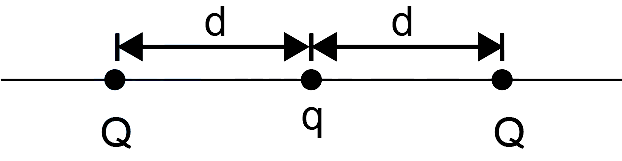
- A particle of mass \(M\) and charge \(q\) is at rest at the mid point between two other fixed similar charges each of magnitude \(Q\) placed a distance \(2 d\) apart. The system is collinear as shown in the figure. The particle is now displaced by a small amount \(x(x< < d)\) along the joining the two charges and is left to itself. It will now oscillate about the mean position with a time period \(\left(\varepsilon_{0}=\right.\) permittivity of free space)
 WBJEE 2013 Hard