


WBJEE · Physics · Ray Optics
An object placed at a distance of \(16 \mathrm{cm}\) from a \(\begin{array}{llll}\text { convex lens } & \text { produces } & \text { an image } & \text { of }\end{array}\) magnification \(m(m>1)\). If the object is moved towards the lens by \(8 \mathrm{cm}\), then again an image of magnification \(m\) is obtained. The numerical value of the focal length of the lens is
- A \(12 \mathrm{cm}\)
- B \(14 \mathrm{cm}\)
- C \(18 \mathrm{cm}\)
- D \(20 \mathrm{cm}\)
Answer & Solution
Correct Answer
(A) \(12 \mathrm{cm}\)
Step-by-step Solution
Detailed explanation
Linear magnification, \(m=\frac{f}{f+u}\) As given that magnification is same for both cases this is possible if the two different values of \(u\) are of opposite sign. \(i, \theta,+\frac{f}{f-16}=\frac{-f}{f-8}\) \(\Rightarrow \quad 16-f=f-8\) \(\Rightarrow \quad 2 f=24\) or…
See the Complete Solution
Get step-by-step explanations for this and 2.5 Lakh+ more JEE, NEET & CET questions.
- Unlock all solutions
- Practice the full chapter
- Track accuracy across PYQs
4.8 rated on Google Play · 14,000+ reviews
More questions from Physics
- A uniform rod of length \(L\) pivoted at one end \(P\) is freely rotated in a horizontal plane with an angular velocity \(\omega\) about a vertical axis passing through \(\mathrm{P}\). If the temperature of the system is increased by \(\Delta \mathrm{T}\), angular velocity becomes \(\frac{\omega}{2}\). If coefficient of linear expansion of the rod is \(\alpha(\alpha< < 1)\), then \(\Delta \mathrm{T}\) will beWBJEE 2021 Easy
- Sound waves are passing through two routes-one in atraight path and the other along a semicireular path of radius \(r\) and are again combined into one pipe and superposed as shown in the figure. If the velocity of sound waves in the pipe is \(v\), then frequencies of resultant waves of maximum amplitude will be integral multiples of
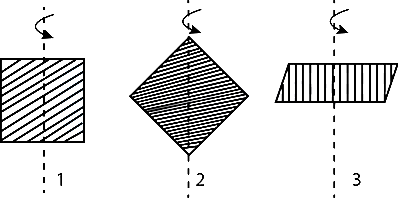 WBJEE 2014 Easy
 - Two long parallel wires separated by \(0.1 \mathrm{m}\) carry currents of 1 A and 2 A, respectively in opposite directions. A third current-carrying wire parallel to both of them is placed in the same plane such that it feels no net magnetic force. It is placed at a distance ofWBJEE 2017 Medium
- A car is moving with a speed of \(72 \mathrm{km}\mathrm{h}^{-1}\) towards a roadside source that emits sound at a frequency of \(850 \mathrm{Hz}\). The car driver listens to the sound while approaching the source and again while moving away from the source after crossing it. If the velocity of sound is \(340 \mathrm{ms}^{-1}\), the difference of the two frequencies, the driver hears isWBJEE 2014 Hard
- A shown in the figure, a liquid is at same levels in two arms of a U-tube of uniform cross-section when at rest. If the \(U\)-tube moves with an acceleration ' \(f\) ' towards right, the difference between liwuid height between two arms of the \(\mathrm{U}\)-tube will be, (acceleration due to gravity \(=\mathrm{g}\) )
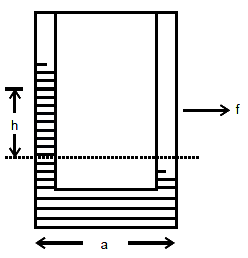 WBJEE 2023 Hard
 - An electric bulb, a capacitor, a battery and a switch are all in series in a circuit. How does the intensity of light vary when the switch is
turn on?WBJEE 2018 Easy
More PYQs from WBJEE
- Suppose that the equation \(f(x)=x^{2}+b x+c=0\) has two distinct real roots \(\alpha\) and \(\beta\). The angle between the tangent to the curve \(y=f(x)\) at the point \(\left(\frac{\alpha+\beta}{2}, f\left(\frac{\alpha+\beta}{2}\right)\right)\) and the positive direction of the \(x\) -axis isWBJEE 2014 Hard
- If \(\int \frac{d x}{(x+1)(x-2)(x-3)}=\frac{1}{k} \log _e\left\{\frac{|x-3|^3|x+1|}{(x-2)^4}\right\}+c\), then the value of \(k\) isWBJEE 2023 Medium
- Let \(f: N \rightarrow R\) be such that \(f(1)=1\) and \(f(1)+2 f(2)+3 f(3)+\ldots+n f(n)=n(n+1) f(n),\) for all \(n \in N, n \geq 2,\) where \(N\) is the set of natural numbers and \(R\) is the set of real numbers. Then, the value of \(f(500)\) isWBJEE 2015 Hard
- A problem in mathematics is given to 4 students whose chances of solving individually are \(\frac{1}{2}, \frac{1}{3}, \frac{1}{4}\) and \(\frac{1}{5},\) The probability that the problem will be solved at least by one student isWBJEE 2019 Easy
- In the following sequence of reaction compound M is
\(\mathrm{M} \xrightarrow{\mathrm{CH}_3 \mathrm{MgBr}} \mathrm{N}+\mathrm{CH}_4 \uparrow \xrightarrow{\mathrm{H}^{+}} \mathrm{CH}_3 \mathrm{COCH}_2 \mathrm{COCH}_3\)WBJEE 2024 Medium - At two different places, the angles of dip are respectively \(30^{\circ}\) and \(45^{\circ} .\) At these two places the ratio of horizontal component of earth's magnetic field isWBJEE 2013 Easy