


WBJEE · Physics · Kinetic Theory of Gases
What will be the molar specific heat at constant volume of an ideal gas consisting of rigid diatomic molecules?
- A \(\frac{3}{2} R\)
- B \(\frac{5}{2} R\)
- C \(R\)
- D \(3 R\)
Answer & Solution
Correct Answer
(B) \(\frac{5}{2} R\)
Step-by-step Solution
Detailed explanation
For a gas at temperature \(T\), the internal energy, \[ U=\frac{f}{2} \mu R T \] where, \(f=\) degree of freedom \(\Rightarrow\) Change in energy, \(\Delta U=\frac{f}{2} \mu R \Delta T\) Also, as we know for any gas heat supplied at constant volume…
See the Complete Solution
Get step-by-step explanations for this and 2.5 Lakh+ more JEE, NEET & CET questions.
- Unlock all solutions
- Practice the full chapter
- Track accuracy across PYQs
4.8 rated on Google Play · 14,000+ reviews
More questions from Physics
- From the top of a tower, \(80 \mathrm{m}\) high from the ground, a stone is thrown in the horizontal direction with a velocity of \(8 \mathrm{ms}^{-1}\). The stone reaches the ground after a time \(t^{\prime}\) and falls at a distance of " \(\mathrm{d}\) ' from the foot of the tower. Assuming \(g=10 \mathrm{m} / \mathrm{s}^{2}\), the time \(t\) and distance d are given respectively byWBJEE 2012 Medium
- A particle vibrating simple harmonically hat an acceleration of \(16 \mathrm{cms}^{-2}\) when it is at distance of \(4 \mathrm{cm}\) from the mean position, lt time period isWBJEE 2016 Medium
- Three vectors \(\mathbf{A}=a \mathbf{i}+\mathbf{j}+\mathbf{k} ; \mathbf{B}=\mathbf{i}+b \mathbf{j}+\mathbf{k}\)
and \(\mathbf{C}=\mathbf{i}+\mathbf{j}+c \mathbf{k}\) are mutually perpendicular (i, \(\mathbf{j}\) and \(\mathbf{k}\) are unit vectors along \(X, Y\) and \(Z\) axes respectively). The respective values of \(a\), \(b\) and \(c\) areWBJEE 2017 Medium - The magnetic field due to a current in a straight wire segment of length \(L\) at a point on
its perpendicular bisector at a distano \(r(r>>L)\)WBJEE 2017 Easy - Find the right condition(s) for Fraunhoffer difiraction due to a single slit.WBJEE 2015 Easy
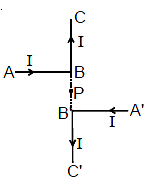
- Current through \(\mathrm{ABC}\) and \(\mathrm{A}^{\prime} \mathrm{B}^{\prime} \mathrm{C}^{\prime}\) is \(\mathrm{I}\). What is the magnetic field at \(\mathrm{P}\) ? \(\mathrm{BP}=\mathrm{PB}^{\prime}=\mathrm{r}\left(\right.\) Here \(\mathrm{C}^{\prime} \mathrm{B}^{\prime} \mathrm{PBC}\) are collinear)
 WBJEE 2011 Medium
More PYQs from WBJEE
- If \(a, b\) and \(c\) are in arithmetic progression, then the roots of the equation \(a x^{2}-2 h x+c=0\) areWBJEE 2012 Medium
- \(\lim _{x \rightarrow 0}\left(\frac{1}{x} \ln \sqrt{\frac{1+x}{1-x}}\right)\) isWBJEE 2022 Medium
- The number of points on the line \(x+y=4\) which are unit distance apart from the line \(2 x+2 y=5\) isWBJEE 2009 Hard
- On heating, chloric acid decomposes toWBJEE 2013 Easy
- If \(0 \leq A \leq \frac{\pi}{4},\) then \(\tan ^{-1}\left(\frac{1}{2} \tan 2 A\right)+\tan ^{-1}(\cot A)+\tan ^{-1}\left(\cot ^{3} A)\right.\)
is equal toWBJEE 2018 Medium - The range of the function \(y=3 \sin \left(\sqrt{\frac{\pi^{2}}{16}-x^{2}}\right)\) isWBJEE 2014 Easy