


WBJEE · Physics · Oscillations
A particle vibrating simple harmonically hat an acceleration of \(16 \mathrm{cms}^{-2}\) when it is at distance of \(4 \mathrm{cm}\) from the mean position, lt time period is
- A \(1 \mathrm{s}\)
- B \(2.572 \mathrm{s}\)
- C \(3.142 \mathrm{s}\)
- D \(6.028 \mathrm{s}\)
Answer & Solution
Correct Answer
(C) \(3.142 \mathrm{s}\)
Step-by-step Solution
Detailed explanation
In SHM, the acceleration of vibrating particle is proportional to displacement \[ \begin{aligned} |\mathbf{a}| &=\omega^{2} x \\ \text { Here } a=16 \mathrm{cm} / \mathrm{s}^{2} \\ &=16 \times 10^{-2} \mathrm{m} / \mathrm{s}^{2} \end{aligned} \] Displacement,…
See the Complete Solution
Get step-by-step explanations for this and 2.5 Lakh+ more JEE, NEET & CET questions.
- Unlock all solutions
- Practice the full chapter
- Track accuracy across PYQs
4.8 rated on Google Play · 14,000+ reviews
More questions from Physics
- A particle with charge \(Q\) coulomb, tied at the end of an inextensible string of length \(R\) metre, revolves in a vertical plane. At the centre of the circular trajectory, there is a fixed charge of magnitude \(Q\) coulomb. The mass of the moving charge \(M\) is such that \(M g=\frac{Q^{2}}{4 \pi \in_{0} R^{2}}\). If at the highest position of the particle, the tension of the string just vanishes, the horizontal velocity at the lowest point has to beWBJEE 2017 Hard
- If the kinetic energies of an electron, an alpha particle and a proton having same de-Broglie wavelength are \(\varepsilon_1, \varepsilon_2\) and \(\varepsilon_3\) respectively, thenWBJEE 2022 Easy
- A body of density \(1.2 \times 10^{3} \mathrm{~kg} / \mathrm{m}^{3}\) is dropped from rest from a height \(1 \mathrm{~m}\) into a liquid of density \(2.4 \times 10^{3} \mathrm{~kg} / \mathrm{m}^{3}\). Neglecting all dissipative effects, the maximum depth to which the body sinks before returning to float on the surface isWBJEE 2021 Medium
- If the electron in a hydrogen atom jumps from an orbit with level \(\mathrm{n}_1=2\) to an orbit with level \(\mathrm{n}_2=1\) the emitted radiation has a wavelength given byWBJEE 2009 Easy
- The velocity \((v)\) of a particle (under a force \(F\) ) depends on its distance \((x)\) from the origin (with \(x>0) v \propto\frac{1}{\sqrt{x}}\). Find how the magnitude
of the force \((F)\) on the particle depends on \(x ?\)WBJEE 2018 Medium - Figure below shows the distance-time graph of the motion of a car. If follows from the graph that the car is
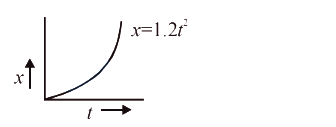 WBJEE 2009 Medium
More PYQs from WBJEE
- \([X]+\) dil. \(\mathrm{H}_{2} \mathrm{SO}_{4} \longrightarrow[Y]:\)
Colourless, suffocating gas
\([Y]+\mathrm{K}_{2} \mathrm{Cr}_{2} \mathrm{O}_{7}+\mathrm{H}_{2} \mathrm{SO}_{4} \longrightarrow\)
Green colouration of solution
Then, \([X]\) and \([Y]\) areWBJEE 2018 Medium - Let \(a_n=\left(1^2+2^2+\ldots n^2\right)^n\) and \(b_n=n^n(n !)\). ThenWBJEE 2022 Easy
- Ortho-and para-hydrogens haveWBJEE 2010 Medium
- The coefficient of \(x^{10}\) in the expansion of \(1+(1+x)+\dots+(1+x)^{20}\)WBJEE 2012 Medium
- If \(\frac{\mathrm{d}}{\mathrm{dx}}\{\mathrm{f}(\mathrm{x})\}=\mathrm{g}(\mathrm{x})\), then \(\int_a^b \mathrm{f}(\mathrm{x}) \mathrm{g}(\mathrm{x}) \mathrm{dx}\) is equal toWBJEE 2010 Medium
- If \(\frac{\cos A}{3}=\frac{\cos B}{4}=\frac{1}{5},-\frac{\pi}{2} < A < 0,-\frac{\pi}{2} < B < 0\) then value of \(2 \sin A+4 \sin B\) isWBJEE 2010 Medium