


WBJEE · Physics · Dual Nature of Matter
Electric field component of an EM radiation varies with time as \(\mathrm{E}=\mathrm{a}\left(\cos \omega_{0} \mathrm{t}+\sin \omega \mathrm{t} \cos \omega_{0} \mathrm{t}\right)\), where ' \(\mathrm{a}\) ' is a constant and \(\omega=10^{15} \mathrm{sec}^{-1}, \omega_{0}=5 \times 10^{15} \mathrm{sec}^{-1}\). This radiation falls on a metal whose stopping potential is \(-2 \mathrm{ev}\). Then which of the following statement \((\mathrm{s})\) is/are true \(?\left(\mathrm{~h}=6.62 \times 10^{-34} \mathrm{~J}-\mathrm{S}\right)\)
- A For light of frequency \(\omega\), photoelectric effect is not possible
- B Stopping potential vs. frequency graph will be a straight line
- C The work function of the metal is \(-2 \mathrm{ev}\)
- D The maximum kinetic energy of the photo electrons is \(1.95 \mathrm{ev}\).
Answer & Solution
Correct Answer
(B) Stopping potential vs. frequency graph will be a straight line
Step-by-step Solution
Detailed explanation
Stopping potential \(=-2 \mathrm{~V} \Rightarrow \mathrm{KE}_{\max }=2 \mathrm{ev}\) (Option D incorrect) \(\mathrm{E}=\mathrm{a}\left(\cos \omega_{0} \mathrm{t}+\sin \omega \mathrm{t} \cos \omega_{0} \mathrm{t}\right)\)…
See the Complete Solution
Get step-by-step explanations for this and 2.5 Lakh+ more JEE, NEET & CET questions.
- Unlock all solutions
- Practice the full chapter
- Track accuracy across PYQs
4.8 rated on Google Play · 14,000+ reviews
More questions from Physics
- Two blocks of \(2 \mathrm{~kg}\) and \(1 \mathrm{~kg}\) are in contact on a frictionless table. If a force of \(3 \mathrm{~N}\) is applied on \(2 \mathrm{~kg}\) block, then the force of contact between the two blocks will be :
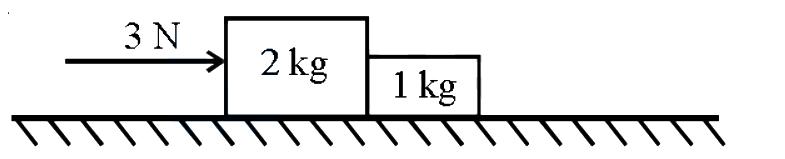 WBJEE 2010 Medium
 - The number of de-Broglie wavelengths contained in the second Bohr orbit of hydrogen atom isWBJEE 2016 Easy
- In the given network of AND and OR gates, output Q can be written as (assuming n even)
 WBJEE 2024 Easy
 -
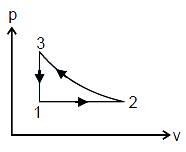
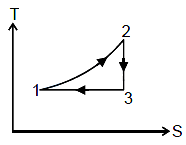
A cyclic process is shown in \(\mathrm{p}-\mathrm{v}\) diagram and \(\mathrm{T}-\mathrm{S}\) diagram. Which of the following statement(s) is/are true?WBJEE 2023 Easy - Average distance of the Earth from the Sun is \(L_{1}\) : If one year of the Earth \(=D\) days, one year of another planet whose average distance from the Sun is \(L_{2}\) will beWBJEE 2012 Easy
- A particle of charge ' \(q\) ' and mass ' \(m\) ' moves in a circular orbit of radius ' \(r\) ' with angular speed ' \(\omega\) '. The ratio of the magnitude of its magnetic moment to that of its angular momentum depends onWBJEE 2025 Medium
More PYQs from WBJEE
- If \(M\) is a \(3 \times 3\) matrix such that \((0~1~2) M=(1~0~0),(3~4~5) M=(0~1~0)\), then \((6~7~8) M\) is equal toWBJEE 2021 Easy
- Amongst \(\left[\mathrm{Ni}\left(\mathrm{H}_{2} \mathrm{O}\right)_{6}\right]^{2+}, \quad\left[\mathrm{Ni}\left(\mathrm{PPh}_{3}\right)_{2} \mathrm{Cl}_{2} ]\right.\), \(\left[\mathrm{Ni}(\mathrm{CO})_{4}\right.]\) and \(\left[\mathrm{Ni}\left(\mathrm{CN}_{4}\right)\right]^{2-}\) the paramagnetic species areWBJEE 2013 Medium
- A biconvex lens of focal length \(f\) and radii of curvature of both the surfaces \(R\) is made of a material of refractive index \(n_{1}\). This lens is placed in a liquid of refractive index \(n_{2}\). Now this lens will behave likeWBJEE 2013 Easy
- If \(\lim _{x \rightarrow 0} \frac{2 a \sin x-\sin 2 x}{\tan ^{3} x}\) exists and is equal to 1 then the value of \(a\) isWBJEE 2014 Easy
- If \(x_1\) be the size of the magnified image and \(x_2\) the size of the diminished image in Lens Displacement Method, then the size of the object is :WBJEE 2010 Easy
- \(4 f^2\) electronic configuration is found inWBJEE 2023 Medium