


WBJEE · Maths · Binomial Theorem
The coefficient of \(x^{10}\) in the expansion of \(1+(1+x)+\dots+(1+x)^{20}\)
- A \({ }^{19} C_{9}\)
- B \({ }^{20} C_{10}\)
- C \({ }^{21} C_{11}\)
- D \({ }^{22} C_{12}\)
Answer & Solution
Correct Answer
(C) \({ }^{21} C_{11}\)
Step-by-step Solution
Detailed explanation
The given series is in GP. Hence, its sum \(S=\frac{1\left\{(1+x)^{20+1}-1\right\}}{(1+x)-1}=\frac{(1+x)^{21}-1}{x}\) Therefore, the required coefficient of \(x^{10}\) in the expansion of \((1+x)^{21}-1\) \(=\) Coefficient of \(x^{11}\) in the expansion of \[ ={ }^{21} C_{11} \]
See the Complete Solution
Get step-by-step explanations for this and 2.5 Lakh+ more JEE, NEET & CET questions.
- Unlock all solutions
- Practice the full chapter
- Track accuracy across PYQs
4.8 rated on Google Play · 14,000+ reviews
More questions from Maths
- Let \(A=\left(\begin{array}{ccc}2 & 0 & 3 \\ 4 & 7 & 11 \\ 5 & 4 & 8\end{array}\right)\). ThenWBJEE 2023 Easy
- \(\int \frac{\log \sqrt{x}}{3 x} d x\) is equal toWBJEE 2016 Medium
- \(\int_0^{1.5}\left[x^2\right] d x\) is equal toWBJEE 2025 Medium
- The differential equation of \(\mathrm{y}=\mathrm{ae}^{\mathrm{bx}}\) (a & \(\mathrm{b}\) are parameters) isWBJEE 2011 Easy
- Let \(y\) be the solution of the differential equation
\(x \frac{d y}{d x}=\frac{y^{2}}{1-y \log x}\) satisfying \(y(1)=1 .\) Then, \(y\)
satisfiesWBJEE 2012 Medium - \({ }^{15} \mathrm{C}_3+{ }^{15} \mathrm{C}_5+\ldots \ldots+{ }^{15} \mathrm{C}_{15}=\)WBJEE 2011 Easy
More PYQs from WBJEE
- Which of the following statements regarding Lanthanides is false?WBJEE 2016 Easy
- A candidate is required to answer 6 out of 12 questions which are divided into two parts A and \(B\), each containing 6 questions and he/she is not permitted to attempt more than 4 questions from any part. In how many different ways can he/she make up hisher choice of 6 questions?WBJEE 2019 Medium
- A unit vector in \(X Y\)-plane making an angle \(45^{\circ}\) with \(\hat{i}+\hat{j}\) and an angle \(60^{\circ}\) with \(3 \hat{i}-4 \hat{j}\) isWBJEE 2024 Easy
- If a particle moves in a straight line according to the law \(x=a \sin (\sqrt{\lambda} t+b)\), then the particle will come to rest at two points whose distance is [symbols have their usual meaning]WBJEE 2024 Medium
-
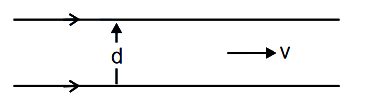
Two infinite line-charges parallel to each other are moving with a constant velocity \(v\) in the same direction as shown in the figure. The separation between two line-charges is \(d\). The magnetic attraction balances the electric repulsion when, [c = speed of light in free space]WBJEE 2022 Medium - If \(\left|\begin{array}{lll}x^k & x^{k+2} & x^{k+3} \\ y^k & y^{k+2} & y^{k+3} \\ z^k & z^{k+2} & z^{k+3}\end{array}\right|=(x-y)(y-z)(z-x)\left(\frac{1}{x}+\frac{1}{y}+\frac{1}{z}\right)\), thenWBJEE 2024 Easy