


WBJEE · Maths · Probability
Two integers \(r\) and \(s\) are drawn one at a time without replacement from the set \(\{1,2, \ldots ., n\}\). Then \(P(r \leq k / s \leq k)=\)
- A \(\frac{\mathrm{k}}{\mathrm{n}}\)
- B \(\frac{\mathrm{k}}{\mathrm{n}-1}\)
- C \(\frac{\mathrm{k}-1}{\mathrm{n}}\)
- D \(\frac{\mathrm{k}-1}{\mathrm{n}-1}\)
Answer & Solution
Correct Answer
(D) \(\frac{\mathrm{k}-1}{\mathrm{n}-1}\)
Step-by-step Solution
Detailed explanation
Hint: \(\mathrm{p}(\mathrm{r} \leq \mathrm{k} / \mathrm{s} \leq \mathrm{k})=\frac{\mathrm{p}(\mathrm{r} \leq \mathrm{k} \cap \mathrm{s} \leq \mathrm{k})}{\mathrm{p}(\mathrm{s} \leq \mathrm{k})}\) Now, \(\mathrm{p}(\mathrm{s} \leq \mathrm{k})=\frac{\mathrm{k}}{\mathrm{n}}\)…
See the Complete Solution
Get step-by-step explanations for this and 2.5 Lakh+ more JEE, NEET & CET questions.
- Unlock all solutions
- Practice the full chapter
- Track accuracy across PYQs
4.8 rated on Google Play · 14,000+ reviews
More questions from Maths
- Angle between the planes \(x+y+2 z=6\) and \(2 x-y+z=9\) isWBJEE 2016 Easy
- Let \(C_{1}\) and \(C_{2}\) denote the centres of the circles \(x^{2}+y^{2}=4\) and \((x-2)^{2}+y^{2}=1\) respectively and let \(P\) and \(Q\) be their points of intersection.Then, the areas of \(\Delta C_{1} P Q\) and \(C_{2} P Q\) are in the ratioWBJEE 2012 Medium
- If \(f(x)\) and \(g(x)\) are two polynomials such that \(\phi(x)=f\left(x^3\right)+x g\left(x^3\right)\) is divisible by \(x^2+x+1\), thenWBJEE 2025 Hard
- Let \(\vec{\alpha}=\hat{i}+\hat{j}+\hat{k}, \vec{\beta}=\hat{i}-\hat{j}-\hat{k}\) and
\(\vec{\gamma}=-\hat{i}+\hat{j}-\hat{k}\) be three vectors. A vector \(\vec{\delta},\) in the plane of \(\vec{\alpha}\) and \(\vec{\beta}\), whose projection on \(\vec{\gamma}\) is \(\frac{1}{\sqrt{3}},\) is given byWBJEE 2018 Medium - Let \(y=f(x)\) be any curve on the \(X-Y\) plane \& \(P\) be a point on the curve. Let \(C\) be a fixed point not on the curve. The length \(P C\) is either a maximum or a minimum, thenWBJEE 2024 Medium
- \(\mathrm{AB}\) is a chord of a parabola \(\mathrm{y}^2=4 \mathrm{ax},(\mathrm{a}>0)\) with vertex \(\mathrm{A} . \mathrm{BC}\) is drawn perpendicular to \(\mathrm{AB}\) meeting the axis at \(\mathrm{C}\). The projection of \(\mathrm{BC}\) on the axis of the parabola isWBJEE 2022 Easy
More PYQs from WBJEE
- The domain of \(f(x)=\sqrt{\left(\frac{1}{\sqrt{x}}-\sqrt{x+1}\right)}\) isWBJEE 2020 Medium
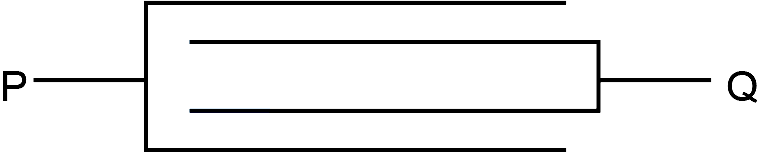
- Four identical plates each of area \(a\) are separated by a distance \(d\). The connection is shown below. what is the capacitance between \(P\) and \(Q ?\)
 WBJEE 2013 Hard
 - The remainder when \(7^{7^{7^{...7}}}(22\) times 7\()\) is divided by 48 isWBJEE 2021 Easy
- Supose in a hypothetical world the angular momentum is quantized to be even integral multiples of \(\frac{\mathrm{h}}{2 \pi}\). The largest possible wavelength emitted by hydrogen atoms in visible range in a world according to Bohr's model will be, (Consider hc \(=1242 \mathrm{Mev}-\mathrm{fm}\) )WBJEE 2022 Medium
- General solution of \(\sin \mathrm{x}+\cos \mathrm{x}=\min _{a \in I R}\left\{1, a^2-4 a+6\right\}\) isWBJEE 2009 Hard
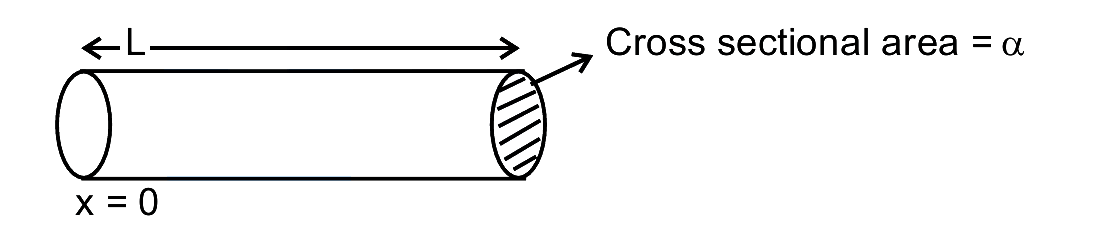
- The variation of density of a solid cylindrical rod of cross sectional area \(\alpha\) and length \(L\) is \(\rho=\rho_0 \frac{x^2}{L^2}\), where x is the distance from one end of the rod. The position of its centre of mass from one end \((x=0)\) is
 WBJEE 2025 Medium