


WBJEE · Maths · Sets and Relations
On \(R\), a relation \(\rho\) is defined by xpy if and only if \(x-y\) is zero or irrational. Then.
- A \(\rho\) is equivalence relation
- B \(\rho\) is reflexive but neither symmetric nor transitive
- C \(\rho\) is reflexive and symmetric but not transitive
- D \(\rho\) is symmetric and transitive but not reflexive
Answer & Solution
Correct Answer
(C) \(\rho\) is reflexive and symmetric but not transitive
Step-by-step Solution
Detailed explanation
On the set \(R\) \(x p y \Rightarrow x-y\) is zero or irrational number. Now, \(x p x\) \(\Rightarrow x-x=0\) \(\Rightarrow \rho\) is reflexive. If \(x \rho y \Rightarrow x-y\) is zero or irrational. \(=-(y-x)\) is zero or irrational. \(\Rightarrow\) yox is zero or irrational.…
See the Complete Solution
Get step-by-step explanations for this and 2.5 Lakh+ more JEE, NEET & CET questions.
- Unlock all solutions
- Practice the full chapter
- Track accuracy across PYQs
4.8 rated on Google Play · 14,000+ reviews
More questions from Maths
- The line \(y-\sqrt{3} x+3=0\) cuts the parabola \(y^2=x+2\) at the points \(P\) and \(Q\). If the co-ordinates of the point \(X\) are \((\sqrt{3}, 0)\), then the value of \(X P \cdot X Q\) isWBJEE 2025 Medium
- If \(\log _{e}\left(x^{2}-16\right) \leq \log _{e}(4 x-11)\), thenWBJEE 2012 Easy
- If \(x+\frac{1}{x}=2 \cos \theta\), then for any integer \(n, x^n+\frac{1}{x^n}=\)WBJEE 2011 Hard
- If the point of intersection of the lines \(2 a x+4 a y+c=0\) and \(7 b x+3 b y-d=0\) lies in the 4 th quadrant and is equidistant from the two axes, where \(a, b, c\) and \(d\) are non-zero numbers, then \(a d: b c\) equals toWBJEE 2019 Medium
- The variance of first 20 natural numbers isWBJEE 2015 Easy
- If \(a, b, c\) are in A.P. and if the equations \((b-c) x^2+(c-a) x+(a-b)=0\) and \(2(c+a) x^2+(b+c) x=0\) have a common root, thenWBJEE 2025 Hard
More PYQs from WBJEE
- The probability that a non-leap year selected at random will have 53 Sundays or 53 Saturdays isWBJEE 2025 Easy
- The values of \(\Delta H\) and \(\Delta S\) of a certain reaction are \(-400 \mathrm{k} \mathrm{J} \mathrm{mol}^{-1}\) and \(-20 \mathrm{kJ} \mathrm{mol}^{-1} \mathrm{K}^{-1}\) respectively. The temperature below which the reaction is spontaneous, isWBJEE 2014 Medium
- If \(\alpha, \beta\) are the roots of the equation \(a x^2+b x+c=0\) then \(\lim _{x \rightarrow \beta} \frac{1-\cos \left(a x^2+b x+c\right)}{(x-\beta)^2}\) isWBJEE 2024 Hard
- The molecule/molecules that has/have delocalised lone pair(s) of electrons is/are
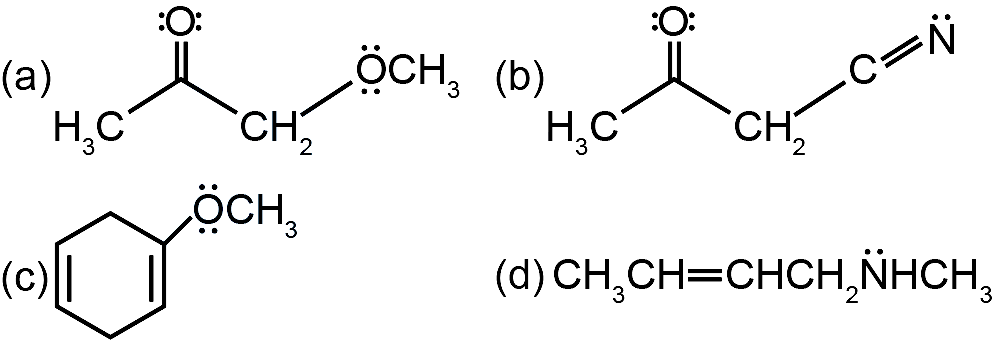 WBJEE 2019 Medium
 - Three infinite plane sheets carrying uniform charge densities \(-\sigma, 2 \sigma, 4 \sigma\) are placed parallel to \(X Z\) plane at \(Y=a, 3 a\), 4a respectively. The electric field at the point \((0,2 a, 0)\) isWBJEE 2021 Easy
- If \(\alpha, \beta\) are the roots of \(a x^{2}+b x+c=0(a \neq 0)\) and \(\alpha+h, \beta+h\) are the roots of \(p x^{2}+q x+r=0\) \((p \neq 0),\) then the ratio of the squares of their discriminants isWBJEE 2014 Easy