


WBJEE · Chemistry · General Organic Chemistry
The molecule/molecules that has/have delocalised lone pair(s) of electrons is/are
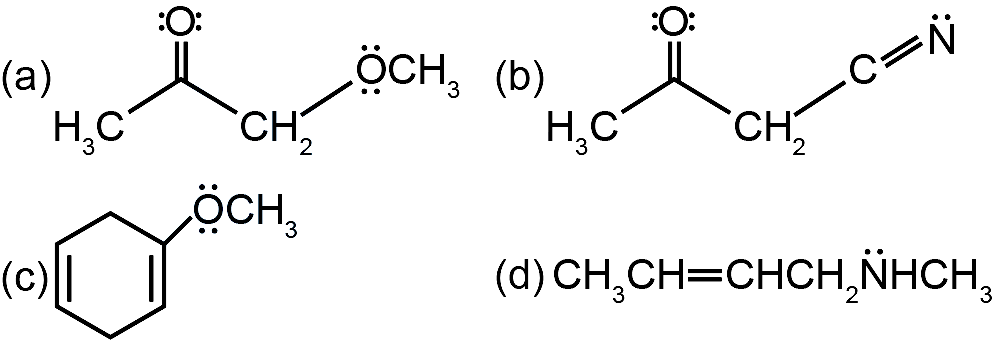
- A I, II and III
- B I, II and IV
- C I and III
- D only III
Answer & Solution
Correct Answer
(D) only III
Step-by-step Solution
Detailed explanation
The molecule in which a lone pair of electrons undergoes conjugation with an alternate double bond is said to be delocalised. The molecule that has delocalised lone-pair of electrons is, So, option (d) is correct.
See the Complete Solution
Get step-by-step explanations for this and 2.5 Lakh+ more JEE, NEET & CET questions.
- Unlock all solutions
- Practice the full chapter
- Track accuracy across PYQs
4.8 rated on Google Play · 14,000+ reviews
More questions from Chemistry
- In the compound \(\mathrm{HC} \equiv \mathrm{C}-\mathrm{CH}=\mathrm{CH}_2\) the hybridization of \(\mathrm{C}-2\) and \(\mathrm{C}-3\) carbons are respectively:WBJEE 2009 Easy
- Of the following molecules, which have shape similar to \(\mathrm{CO}_{2} ?\)WBJEE 2016 Medium
- The correct order of \(\mathrm{O}-\mathrm{O}\) bond length in \(\mathrm{O}_{2}, \mathrm{H}_{2} \mathrm{O}_{2}\) and \(\mathrm{O}_{3}\) isWBJEE 2016 Medium
- For a spontaneous process, the correct statement(s) is (are)WBJEE 2014 Easy
- Which one of the following electronic arrangements is absurd?WBJEE 2019 Medium
- How many electrons are needed to reduce \(\mathrm{N}_2\) to \(\mathrm{NH}_3\) ?WBJEE 2025 Easy
More PYQs from WBJEE
- A plot of In \(\mathrm{k}\) against \(\frac{1}{\mathrm{~T}}\) (abscissa) is expected to be a straight line with intercept on ordinate axis equal toWBJEE 2011 Medium
- Two point charges \(+\mathrm{q}_{1}\) and \(+\mathrm{q}_{2}\) are placed a finite distance ' \(\mathrm{d}\) ' apart. It is desired to put a third charge \(\mathrm{q}_{3}\) in between these two charges so that \(\mathrm{q}_{3}\) is in equilibrium. This isWBJEE 2021 Easy
- Sand \(T\) are the foci of an ellipse and \(B\) is the end point of the minor axis. If \(S T B\) is equilateral triangle, the eccentricity of the ellipse isWBJEE 2019 Easy
- The major products obtained during ozonolysis of 2,3 -dimethyl- 1 -butene and subsequent reductions with \(Z \mathrm{n}\) and \(\mathrm{H}_{2} \mathrm{O}\) àteWBJEE 2016 Medium
- If the vectors \(\vec{\alpha}=\hat{\mathbf{i}}+a \hat{\mathbf{j}}+\mathbf{a}^{2} \hat{\mathbf{k}}, \vec{\beta}=\hat{\mathbf{i}}+b \hat{\mathbf{j}}+\mathbf{b}^{2} \hat{\mathbf{k}}\), and \(\vec{\gamma}=\hat{\mathbf{i}}+c \hat{\mathbf{j}}+c^{2} \hat{k}\) are three non-coplanar vectors and \(\left|\begin{array}{lll}\mathbf{a} & \mathbf{a}^{2} & 1+\mathrm{a}^{3} \\ \mathbf{b} & \mathbf{b}^{2} & 1+\mathrm{b}^{3} \\ \mathrm{c} & \mathrm{c}^{2} & 1+\mathrm{c}^{3}\end{array}\right|=0\),
then the value of abc isWBJEE 2020 Easy - Let \(0 < \alpha < \beta < 1\). Then \(\lim {n \rightarrow \infty} \sum_{k=1}^{n} \int_{1/k+\beta}^{1 /(k+a)} \frac{d x}{1+x}\) isWBJEE 2020 Hard