


WBJEE · Maths · Quadratic Equation
If \(\alpha, \beta\) are the roots of \(a x^{2}+b x+c=0(a \neq 0)\) and \(\alpha+h, \beta+h\) are the roots of \(p x^{2}+q x+r=0\) \((p \neq 0),\) then the ratio of the squares of their discriminants is
- A \(a^{2}: p^{2}\)
- B \(a: p^{2}\)
- C \(a^{2}: p\)
- D \(a: 2 p\)
Answer & Solution
Correct Answer
(A) \(a^{2}: p^{2}\)
Step-by-step Solution
Detailed explanation
Given, \(\alpha, \beta\) are the roots of \(a x^{2}+b x+c=0\) and \(a+h, \beta+h\) are the roots of \(p x^{2}+q x+r=0\) \(\therefore \quad \alpha+\beta=-\frac{b}{a}, \alpha \beta=\frac{c}{a}\) and \(\alpha+h+\beta+h=-\frac{q}{p},(\alpha+h)(\beta+h)=\frac{r}{p}\) Now,…
See the Complete Solution
Get step-by-step explanations for this and 2.5 Lakh+ more JEE, NEET & CET questions.
- Unlock all solutions
- Practice the full chapter
- Track accuracy across PYQs
4.8 rated on Google Play · 14,000+ reviews
More questions from Maths
- A straight line through the point (3,-2) is ndined at an angle \(60^{\circ}\) to the line \(\sqrt{3} x+y=1\). If it intersects the \(X\) -axis, then its equation vill beWBJEE 2019 Medium
- S and \(T\) are the foci of an ellipse and B is end point of the minor axis. If STB is an equilateral triangle, the eccentricity of the ellipse isWBJEE 2010 Medium
- Let \(n \geq 2\) be an integer. \(A=\left[\begin{array}{ccc}\cos (2 \pi / n) & \sin (2 \pi / n) & 0 \\ -\sin (2 \pi / n) & \cos (2 \pi / n) & 0 \\ 0 & 0 & 1\end{array}\right]\) and \(I\) is the identity matrix of order 3 . Then,WBJEE 2014 Hard
- The number \((101)^{100}-1\) is divisible byWBJEE 2011 Medium
- If \(\sqrt{y}=\cos ^{-1} x\), then it satisfies the differential equation \(\left(1-x^{2}\right) \frac{d^{2} y}{d x^{2}}-x \frac{d y}{d x}=c,\) where \(c\) is equal toWBJEE 2014 Medium
- Let \(A\) and \(B\) be two non-singular skew symmetric matrices such that \(A B=B A\), then \(A^{2} B^{2}\left(A^{\top} B\right)^{-1}\left(A B^{-1}\right)^{\top}\) is equal toWBJEE 2021 Hard
More PYQs from WBJEE
- The differential equation representing the family of curves \(y^{2}=2 d(x+\sqrt{d})\) where \(d\) is a parameter, is ofWBJEE 2018 Easy
- \(\lim _{x \rightarrow 0} \frac{\pi^{x}-1}{\sqrt{1+x}-1}\)WBJEE 2012 Easy
- If \(I=\left(\begin{array}{ccc}1 & 0 & 0 \\ 0 & 1 & 0 \\ 0 & 0 & 1\end{array}\right)\) and \(P=\left(\begin{array}{ccc}1 & 0 & 0 \\ 0 & -1 & 0 \\ 0 & 0 & -2\end{array}\right)\) Then, the matrix \(P^{3}+2 P^{2}\) is equal toWBJEE 2013 Easy
- Find the equivalent capacitance between \(A\) and \(B\) of the following arrangement :
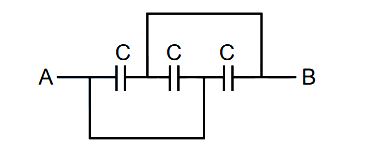 WBJEE 2022 Easy
 - The magnetic flux linked with a coil satisfies the relation \(\phi=4 t^{2}+6 t+9\) Wb, where \(t\) is the
time in second. The emf induced in the coil at \(t=2 \mathrm{s}\) isWBJEE 2012 Easy - If \(A=\left(\begin{array}{cc}3 & x-1 \\ 2 x+3 & x+2\end{array}\right)\) is a symmetric matrix, then the value of \(x\) isWBJEE 2011 Easy