


WBJEE · Maths · Continuity and Differentiability
Let \(f(x)=a_0+a_1|x|+a_2|x|^2+a_3|x|^3\), where \(a_0, a_1, a_2, a_3\) are real constants. Then \(f(x)\) is differentiable at \(x=0\)
- A whatever be \(a_0, a_1, a_2, a_3\)
- B for no values of \(a_0, a_1, a_2, a_3\)
- C only if \(a_1=0\)
- D only if \(a_1=0, a_3=0\)
Answer & Solution
Correct Answer
(C) only if \(a_1=0\)
Step-by-step Solution
Detailed explanation
\(f^{\prime}\left(0^{+}\right)=\lim _{x \rightarrow 0}\left(a_1+2 a_1 x+3 a_3 x^2\right)=a_1\) \(f^{\prime}\left(0^{-}\right)=\lim _{x \rightarrow 0}\left(-a_1+2 a_1 x-3 a_3 x^2\right)=-a_1\) \(f^{\prime}\left(0^{+}\right)=f^{\prime}\left(0^{-}\right) \quad \Rightarrow a_1=0\)
See the Complete Solution
Get step-by-step explanations for this and 2.5 Lakh+ more JEE, NEET & CET questions.
- Unlock all solutions
- Practice the full chapter
- Track accuracy across PYQs
4.8 rated on Google Play · 14,000+ reviews
More questions from Maths
- The acceleration \(f \mathrm{ft} / \mathrm{sec}^2\) of a particle after a time \(t\) sec starting from rest is given by \(f=6-\sqrt{1.2 t}\). Then the maximum velocity v and time T at attend this velocity areWBJEE 2024 Easy
- Let \(f(x)=x+1 / 2\). Then, the number of real values of \(x\) for which the three unequal terms \(f(x), f(2 x), f(4 x)\) are in \(\mathrm{HP}\) isWBJEE 2014 Hard
- Let \(0 < \alpha < \beta < 1\). Then \(\lim {n \rightarrow \infty} \sum_{k=1}^{n} \int_{1/k+\beta}^{1 /(k+a)} \frac{d x}{1+x}\) isWBJEE 2020 Hard
- Let \(y=f(x)\) be any curve on the \(X-Y\) plane \& \(P\) be a point on the curve. Let \(C\) be a fixed point not on the curve. The length \(P C\) is either a maximum or a minimum, thenWBJEE 2024 Medium
- The locus of the centre of the circles which touch both the circles \(x^{2}+y^{2}=a^{2}\) and \(x^{2}+y^{2}=4\)ax externally isWBJEE 2020 Medium
- The equation of the locus of the point of intersection of the straight lines \(x \sin \theta+(1-\cos \theta) y=a \sin \theta\) and \(x\) sin \(\theta-(1+\) \(\cos \theta) y+a \sin \theta=0\) isWBJEE 2011 Hard
More PYQs from WBJEE
- Let \(y=f(x)=2 x^{2}-3 x+2\). The differential of \(y\) when \(x\) changes from 2 to \(1.99\) isWBJEE 2020 Easy
- Let \(\left(1+x+x^{2}\right)^{9}=a_{0}+a_{1} x+a_{2} x^{2}\)
\(+\ldots+a_{18} x^{18} \cdot\) ThenWBJEE 2017 Medium - The expression \(\bar{A}(A+B)+(B+A A)(A+\bar{B})\) simplifies toWBJEE 2022 Easy
- Let \(A=\left(\begin{array}{lll}3 & 0 & 3 \\ 0 & 3 & 0 \\ 3 & 0 & 3\end{array}\right) .\) Then, the roots of the equation \(\operatorname{det}\left(A-\lambda I_{3}\right)=0\) (where \(I_{3}\) is the identity matrix of order 3 ) areWBJEE 2019 Easy
- A straight conductor \(0.1 \mathrm{m}\) long moves in uniform magnetic field \(0.1 \mathrm{T}\). The velocity the conductor is \(15 \mathrm{m} / \mathrm{s}\) and is directer perpendicular to the field. The emf inducod between the two ends of the conductor isWBJEE 2015 Easy
-
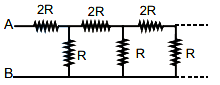
What will be the equivalent resistance between the terminals A and B of the infinite resistive network shown in the figure?WBJEE 2020 Hard