


WBJEE · Maths · Vector Algebra
Let \(\hat{\alpha}, \hat{\beta}, \hat{\gamma}\) be three unit vectors such that \(\hat{\alpha} \times (\hat{\beta} \times \hat{\gamma})=\frac{1}{2}(\hat{\beta}+\hat{\gamma})\) where \(\hat{\alpha} \times(\hat{\beta} \times \hat{\gamma})=(\hat{\alpha} \cdot \hat{\gamma}) \hat{\beta}-(\hat{\alpha} \cdot \hat{\beta}) \gamma \cdot\) If \(\hat{\beta}\) is not parallel to \(\hat{\gamma},\) then the angle between \(\hat{\alpha}\) and \(\hat{\beta}\) is
- A \(\frac{5 \pi}{6}\)
- B \(\frac{\pi}{6}\)
- C \(\frac{\pi}{3}\)
- D \(\frac{2 \pi}{3}\)
Answer & Solution
Correct Answer
(D) \(\frac{2 \pi}{3}\)
Step-by-step Solution
Detailed explanation
Given, \(|\hat{\alpha}|=|\hat{\beta}|=|\hat{\gamma}|=1\) and \(\quad \hat{\alpha} \times(\hat{\beta} \times \hat{\gamma})=\frac{1}{2}(\hat{\beta}+\hat{\gamma})\)…
See the Complete Solution
Get step-by-step explanations for this and 2.5 Lakh+ more JEE, NEET & CET questions.
- Unlock all solutions
- Practice the full chapter
- Track accuracy across PYQs
4.8 rated on Google Play · 14,000+ reviews
More questions from Maths
- The number of digits in \(20^{301}\) (given, \(\log _{10} 2=0.3010\) isWBJEE 2014 Medium
- The length of conjugate axis of a hyperbola is greater than the length of transverse axis. Then, the eccentricity e isWBJEE 2019 Easy
- Let \(p, q\) and \(r\) be the sides opposite to the angles \(P, Q\) and \(R,\) respectively in a \(\Delta P Q R .\) If \(r^{2} \sin P \sin Q=p q,\) then the triangle isWBJEE 2012 Easy
- The value of \(\lim _{n \rightarrow \infty}\left[\left(\frac{1}{2 \cdot 3}+\frac{1}{2^2 \cdot 3}\right)+\left(\frac{1}{2^2 \cdot 3^2}+\frac{1}{2^3 \cdot 3^2}\right)+\ldots+\left(\frac{1}{2^n \cdot 3^n}+\frac{1}{2^{n+1} \cdot 3^n}\right)\right]\) isWBJEE 2023 Medium
- Let \(A=\left(\begin{array}{cc}x+2 & 3 x \\ 3 & x+2\end{array}\right), B=\left(\begin{array}{cc}x & 0 \\ 5 & x+2\end{array}\right)\). Then
all solutions of the equation det \((A B)=0\) isWBJEE 2017 Easy - For any two sets \(\mathrm{A}\) and \(\mathrm{B}, \mathrm{A}-(\mathrm{A}-\mathrm{B})\) equalsWBJEE 2009 Easy
More PYQs from WBJEE
- What is the number of ways in which an examiner can assign 10 marks to 4 questions, giving not less than 2 marks to any questions?WBJEE 2021 Medium
- If \(\log _{e}\left(x^{2}-16\right) \leq \log _{e}(4 x-11)\), thenWBJEE 2012 Easy
- A mass \(M\) at rest is broken into two pieces having masses \(m\) and \((M-m) .\) The two masses are then separated by a distance \(r\) The gravitational force between them will be the maximum when the ratio of the masses \([m:(M-m)]\) of the two parts isWBJEE 2013 Medium
- If \(R\) be the set of all real numbers and \(f: R \rightarrow R\) is given by \(f(x)=3 x^{2}+1\). Then, the set \(f^{-1}([1,6])\) isWBJEE 2014 Medium
- The correct statement regarding the following compounds is
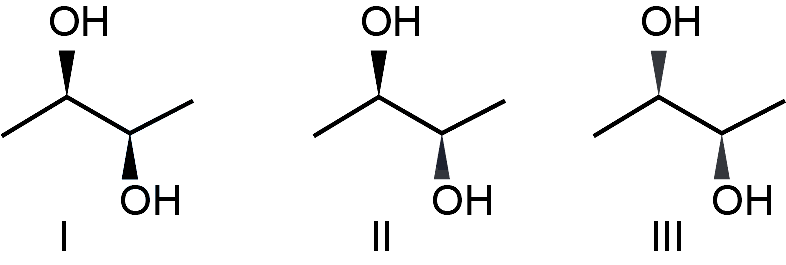 WBJEE 2014 Easy
 - \({ }_5 \mathrm{~B}^{10}+{ }_2 \mathrm{He}^4 \rightarrow \mathrm{X}+{ }_{\mathrm{o}} \mathrm{n}^1\)
In the above nuclear reaction ' X ' will beWBJEE 2025 Easy