


WBJEE · Maths · Vector Algebra
Let \(\vec{\alpha}, \vec{\beta}, \vec{\gamma}\) be three non-zero vectors which are pairwise non-collinear. If \(\vec{\alpha}+3 \vec{\beta}\) is collinear with \(\vec{\gamma}\) and \(\vec{\beta}+2 \vec{\gamma}\) is collinear with \(\vec{\alpha}\), then \(\vec{\alpha}+3 \vec{\beta}+6 \vec{\gamma}\) is
- A \(\vec{\gamma}\)
- B \(\overrightarrow{0}\)
- C \(\vec{\alpha}+\vec{\gamma}\)
- D \(\vec{\alpha}\)
Answer & Solution
Correct Answer
(B) \(\overrightarrow{0}\)
Step-by-step Solution
Detailed explanation
\(\vec{\alpha}+3 \vec{\beta}=\mathrm{k}_{1} \vec{\gamma} \Rightarrow \vec{\beta}=\frac{\mathrm{k}_{1}}{3} \vec{\gamma}-\frac{\vec{\alpha}}{3}\) \(\vec{\beta}+2 \vec{\gamma}=\mathrm{k}_{2} \vec{\alpha} \Rightarrow \vec{\beta}=\mathrm{k}_{2} \vec{\alpha}-2 \vec{\gamma}\)…
See the Complete Solution
Get step-by-step explanations for this and 2.5 Lakh+ more JEE, NEET & CET questions.
- Unlock all solutions
- Practice the full chapter
- Track accuracy across PYQs
4.8 rated on Google Play · 14,000+ reviews
More questions from Maths
- If \(\alpha, \beta\) are the roots of the equation \(a x^2+b x+c=0\) then \(\lim _{x \rightarrow \beta} \frac{1-\cos \left(a x^2+b x+c\right)}{(x-\beta)^2}\) isWBJEE 2024 Hard
- The co-ordinate of a point on the auxiliary circle of the ellipse \(x^{2}+2 y^{2}=4\) corresponding to the point on the ellipse whose eccentric angle is \(60^{\circ}\) will beWBJEE 2021 Easy
- \(F(x)=\cos x-1+\frac{x^2}{2!}, x \in \mathbb{R}\). Then \(f(x)\) isWBJEE 2024 Medium
- The equation \(8 x^2+12 y^2-4 x+4 y-1=0\) representsWBJEE 2011 Easy
- Let \(S\) be the set of points, whose abscissae and ordinates are natural numbers. Let \(P \in S\), such that the sum of the distance of \(P\) from (8,0) and (0,12) is minimum among all elements in \(S .\) Then, the number of such points \(P\) in \(S\) isWBJEE 2016 Medium
- The unit vector in ZOX plane, making angles \(45^{\circ}\) and \(60^{\circ}\) respectively with \(\vec{\alpha}=2 \hat{i}+2 \hat{j}-\hat{k}\) and \(\vec{\beta}=j-\hat{k}\) isWBJEE 2020 Medium
More PYQs from WBJEE
- Two black bodies \(A\) and \(B\) have equal surface areas and are maintained at temperatures \(27^{\circ} \mathrm{C}\) and \(177^{\circ} \mathrm{C}\) respectively. What will be the ratio of the thermal energy radiated per second by \(A\) to that by \(B ?\)WBJEE 2019 Medium
- A solution containing \(4 \mathrm{~g}\) of polymer in 4.0 litre solution at \(27^{\circ} \mathrm{C}\) shows an osmotic pressure of \(3.0 \times 10^{-4} \mathrm{~atm}\). The molar mass of the polymer in \(\mathrm{g} / \mathrm{mol}\) isWBJEE 2023 Hard
- If \((2+i)\) and \((\sqrt{5}-2 i)\) are the roots of the equation \(\left(x^{2}+a x+b\right)\left(x^{2}+c x+d\right)=0\) where \(a, b, c\) and \(d\) are real constants, then product of all the roots of the equation isWBJEE 2015 Easy
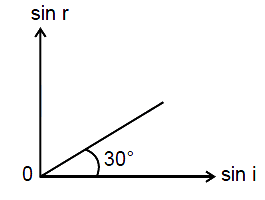
- A ray of monochromatic light is incident on the plane surface of separation between two media \(X\) and \(Y\) with angle of incidence 'i' in medium \(X\) and angle of refraction ' \(r\) ' in medium \(Y\). The given graph shows the relation between sin \(i\) and \(\sin r\). If \(V_x\) and \(V_{\mathrm{Y}}\) are the velocities of the ray in media \(X\) and \(Y\) respectively, then which of the following is true?
 WBJEE 2023 Hard
 - Let \(\theta\) be the angle between two vectors \(\vec{A}\) and \(\vec{B}\). If \(\hat{a}_{\perp}\) is the unit vector perpendicular to \(\vec{A}\), then the direction of \(\vec{B}-B \sin \theta \hat{a}_{\perp}\) isWBJEE 2024 Easy
- If one of the diameter of the circle, given by the equation \(x^{2}+y^{2}+4 x+6 y-12=0,\) is a chord of a circle \(S,\) whose centre is \((2,-3\) ), the radius of \(S\) isWBJEE 2018 Medium