


WBJEE · Maths · Differential Equations
If \(u(x)\) and \(v(x)\) are two independent solutions of the differential equation \(\frac{d^{2} y}{d x^{2}}+b \frac{d y}{d x}+c y=0\) then additional solution(s) of the given differential equation is(are)
- A \(y=5 u(x)+8 v(x)\)
- B \(y=c_{1}\{u(x)-v(x)\}+c_{2} v(x), c_{1}\) and \(c_{2}\) are arbitrary constants
- C \(y=c_{1}u(x) v(x)+c_{2} u(x) / v(x) . \quad c_{1}\) and \(c_{2}\) are arbitrary constants
- D \(y=u(x) \vee(x)\)
Answer & Solution
Correct Answer
(B) \(y=c_{1}\{u(x)-v(x)\}+c_{2} v(x), c_{1}\) and \(c_{2}\) are arbitrary constants
Step-by-step Solution
Detailed explanation
We know that \(u(x)\) and \(v(x)\) are two independent solutions of the given differential equation, then their linear combination is also the solution of the given equation. Here, we see that \(y=5 u(x)+8 v(x)\) is a linear combination and \(y=c_{1}\{u(x)-v(x)\}+c_{2} v(x)\) is…
See the Complete Solution
Get step-by-step explanations for this and 2.5 Lakh+ more JEE, NEET & CET questions.
- Unlock all solutions
- Practice the full chapter
- Track accuracy across PYQs
4.8 rated on Google Play · 14,000+ reviews
More questions from Maths
- Let \(f(x)=3 x^{10}-7
x^{8}+5 x^{6}-21 x^{3}+3 x^{2}-7\)
Then \(\lim _{h \rightarrow 0} \frac{f(1-h)-f(1)}{h^{3}+3 h}\)WBJEE 2018 Medium - The line joining \(A(b \cos \alpha, b \sin \alpha)\)
and
\(B(a \cos \beta, a \sin \beta),\) where \(a \neq b,\) is produced to the
point \(M(x, y)\) so that \(A M: M B=b: a\). Then, \(x \cos \frac{\alpha+\beta}{2}+y \sin \frac{\alpha+\beta}{2}\) is equal toWBJEE 2012 Easy - \(P Q\) is a double ordinate of the hyperbola \(\frac{x^2}{a^2}-\frac{y^2}{b^2}=1\) such that \(\triangle O P Q\) is an equilateral triangle, \(O\) being the centre of the hyperbola. Then the eccentricity e of the hyperbola satisfiesWBJEE 2022 Medium
- Let \(f(n)=2^{n+1}, g(n)=1+(n+1)^{2 n}\) for all \(n \in \mathbb{N}\). ThenWBJEE 2022 Medium
- In a group of 14 males and 6 females. 8 and 3 of the males and females, respectively are aged above 40 yr. The probability that a selected at random from the group is person aged above \(40 \mathrm{yr}\) given that the selected person is a female, isWBJEE 2016 Medium
- Twenty metres of wire is available to fence off a flower bed in the form of a circular sector. What must the radius of the circle be, if the area of the flower bed be greatest?WBJEE 2022 Easy
More PYQs from WBJEE
-
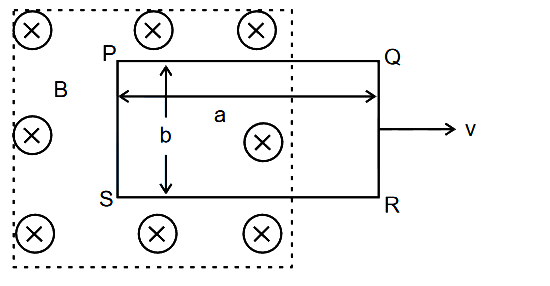
As shown in figure, a rectangular loop of length ' a' and width ' \(b\) ' and made of a conducting material of uniform crosssection is kept in a horizontal plane where a uniform magnetic field of intensity \(B\) is acting vertically downward. Resistance per unit length of the loop is \(\lambda \Omega / \mathrm{m}\). If the loop is pulled with uniform velocity ' \(v\) ' in horizontal direction, which of the following statement is / are true?WBJEE 2022 Hard - Given : The percentage error in the measurements of \(\mathrm{A}, \mathrm{B}, \mathrm{C}\) and \(\mathrm{D}\) are respectively, \(4 \%, 2 \%, 3 \%\) and \(1 \%\). The relative error in \(Z=\frac{A^4 B^{\frac{1}{3}}}{C D^{\frac{3}{2}}}\) isWBJEE 2022 Easy
- A particle vibrating simple harmonically hat an acceleration of \(16 \mathrm{cms}^{-2}\) when it is at distance of \(4 \mathrm{cm}\) from the mean position, lt time period isWBJEE 2016 Medium
- In the following electron - dot structure, calculate the formal charge from left to right nitrogen atom; \(\ddot{\mathrm{N}}=\mathrm{N}=\ddot{\mathrm{N}}\)WBJEE 2011 Medium
- Avogadro's law is valid forWBJEE 2022 Easy
- Magnetic field intensity \(\mathrm{H}\) at the centre of a circular loop of radius \(\mathrm{r}\) carrying current \(\mathrm{I}\) e m.u isWBJEE 2009 Hard