


WBJEE · Maths · Binomial Theorem
Let \(f(n)=2^{n+1}, g(n)=1+(n+1)^{2 n}\) for all \(n \in \mathbb{N}\). Then
- A \(f(n) > g(n)\)
- B \(f(n) < g(n)\)
- C \(f(n)\) and \(g(n)\) are not comparable
- D \(f(n) > g(n)\) if \(n\) be even and \(f(n) < g(n)\) if \(n\) be odd
Answer & Solution
Correct Answer
(B) \(f(n) < g(n)\)
Step-by-step Solution
Detailed explanation
\(g(n)-f(n)=1+(n+1) 2^n-2 \cdot 2^n=1+n \cdot 2^n-2^n=1+(n-1) 2^n > 0\) \(\because \mathrm{n} \geq 1 \Rightarrow(\mathrm{n}-1) \geq 0\)
See the Complete Solution
Get step-by-step explanations for this and 2.5 Lakh+ more JEE, NEET & CET questions.
- Unlock all solutions
- Practice the full chapter
- Track accuracy across PYQs
4.8 rated on Google Play · 14,000+ reviews
More questions from Maths
- Let \(f\) be a non-negative function defined on \(\left[0, \frac{\pi}{2}\right]\). If \(\int_0^x\left(f^{\prime}(t)-\sin 2 t\right) d t=\int_x^0 f(t) \tan t d t, f(0)=1\), then \(\int_0^{\frac{\pi}{2}} f(x) d x\) isWBJEE 2023 Hard
- The line \(y=x\) intersects the hyperbola \(\frac{x^{2}}{9}-\frac{y^{2}}{25}=1\) at the points \(P\) and \(Q .\) The eccentricity of ellipse with \(P Q\) as major axis and minor axis of length \(\frac{5}{\sqrt{2}}\) isWBJEE 2013 Hard
- Let for all \(x>0, f(x)=\lim _{n \rightarrow \infty} n\left(x^{1 / n}-1\right),\) thenWBJEE 2017 Easy
- G.M. and H. M. of two numbers are 10 and 8 respectively. The numbers are :WBJEE 2010 Easy
- The value of \(\int_0^{\pi / 2} \frac{(\cos x)^{\sin x}}{(\cos x)^{\sin x}+(\sin x)^{\cos x}} d x\) isWBJEE 2022 Easy
- If \(A\) is a square matrix then,WBJEE 2009 Easy
More PYQs from WBJEE
- Let \(g(x)=\int_{x}^{2 x} \frac{f(t)}{t} d t\) where \(x>0\) and \(f\) be continuous function and \(f(2 x)=f(x)\), thenWBJEE 2021 Easy
- Consider the function f(x) = x(x - 1) (x - 2) ... (x - 100). Which one of the following is correct?WBJEE 2024 Easy
- The number of real solutions of the equation \((\sin x-x)\left(\cos x-x^{2}\right)=0\) isWBJEE 2015 Medium
- An electric current is passed through an aqueous solution of a mixture of alanine (isoelectric point 6.0) glutamic acid (3.2) and arginine (10.7) buffered at \(\mathrm{pH}\) 6. What is the fate of the three acids?WBJEE 2011 Hard
- In aqueous alkaline solution, two electrons reduction of \(\mathrm{HO}_{2}^{-}\) givesWBJEE 2015 Easy
- Water in filled in a cylindrical vessel of height H. A hole is made at height z from the bottom, as shown in the figure.
The value of of z for which the range (R) of the emerging water through the hole will be maximum for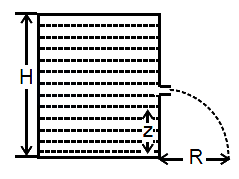 WBJEE 2024 Medium