


WBJEE · Chemistry · Chemical Kinetics
The half-life of \(C^{14}\) is 5760 years. For a \(200 \mathrm{mg}\) sample of \(\mathrm{C}^{14}\), the time taken to change to \(25 \mathrm{mg}\) is
- A 11520 years
- B 23040 years
- C 5760 years
- D 17280 years
Answer & Solution
Correct Answer
(D) 17280 years
Step-by-step Solution
Detailed explanation
Given. Half-life of \(\mathrm{C}^{4}, t_{1 / 2}=5760\) years Initial concentration of sample of \(\mathrm{C}^{4}, \mathrm{N}_{0}=200 \mathrm{mg}\) Final concentration of sample of \(\mathrm{C}^{4}, \mathrm{N}_{1}=2 \mathrm{S} \mathrm{mg}\) The given decay is radioactive and all…
See the Complete Solution
Get step-by-step explanations for this and 2.5 Lakh+ more JEE, NEET & CET questions.
- Unlock all solutions
- Practice the full chapter
- Track accuracy across PYQs
4.8 rated on Google Play · 14,000+ reviews
More questions from Chemistry
- The condition for a reaction to occur spontaneously isWBJEE 2016 Medium
- The metal-pair that can produce nascent hydrogen in alkaline medium isWBJEE 2022 Hard
- Arrange the following compounds in order of their increasing acid strength
 WBJEE 2025 Medium
 - The half-life for decay of \({ }^{14} \mathrm{~C, by~} \beta\) -emission is \(5730 \mathrm{yr}\). The fraction of \({ }^{14} \mathrm{C}\) decays, in a sample that is 22920 yr old, would beWBJEE 2013 Hard
- In which of the following mixed aqueous solutions, \(\mathrm{pH}=\mathrm{p} K_{a}\) at equilibrium?
(1) \(100 \mathrm{mL}\) of \(0.1 \mathrm{M} \mathrm{CH}_{3} \mathrm{COOH}+100 \mathrm{mL}\) of \(0.1 \mathrm{MCH}_{3} \mathrm{COONa}\)
(2) \(100 \mathrm{mL}\) of \(0.1 \mathrm{MCH}_{3} \mathrm{COOH}+50 \mathrm{mL}\) of 0.1 \(\mathrm{M} \mathrm{NaOH}\)
(3) \(100 \mathrm{mL}\) of \(0.1 \mathrm{M} \mathrm{CH}_{3} \mathrm{COOH}+100 \mathrm{mL}\) of \(0.1 \mathrm{M} \mathrm{NaOH}\)
(4) \(100 \mathrm{mL}\) of \(0.1 \mathrm{M} \mathrm{CH}_{3} \mathrm{COOH}+100 \mathrm{mL}\) of \(0.1 \mathrm{M} \mathrm{NH}_{3}\)WBJEE 2016 Hard - The mole fraction of ethanol in water is \(0.08\). Its molality isWBJEE 2020 Medium
More PYQs from WBJEE
- Let \(A\) and \(B\) be two events with \(P\left(A^{C}\right)=0.3\) \(P(B)=0.4 \quad\) and \(\quad P\left(A \cap B^{C}\right)=0.5 . \quad\) Then
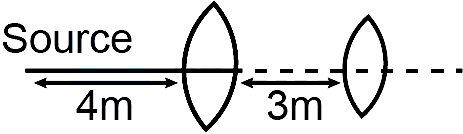
\(P\left(B \mid A \cup B^{c}\right)\) is equal toWBJEE 2012 Easy - An object is located \(4 \mathrm{m}\) from the first of two thin converging lenses of focal lengths \(2 \mathrm{m}\) and \(1 \mathrm{m},\) respectively. The lenses are separated by \(3 \mathrm{m}\). The final image formed by the second lens is located from the source at a distance of
 WBJEE 2015 Hard
 - The value of the integral \(\int_{-1}^{1}\left\{\frac{x^{2015}}{e^{\mid x \mid}\left(x^{2}+\cos x\right)}+\frac{1}{e^{\mid{x} \mid}}\right\} d x\) is equal toWBJEE 2019 Hard
- A charge of 0.8 coulomb is divided into two charges \(Q_{1}\) and \(Q_{2}\). These are kept at a separation of \(30 \mathrm{cm}\). The force on \(Q_{1}\) is maximum whenWBJEE 2017 Medium
- If \(y=4 x+3\) is parallel to a tangent to the parabola \(y^{2}=12 x\), then its distance from the normal parallel to the given line isWBJEE 2014 Medium
- Let \(f(x)=\sin x+\cos a x\) be periodic function. ThenWBJEE 2020 Easy