


WBJEE · Chemistry · Some Basic Concepts of Chemistry
The mole fraction of ethanol in water is \(0.08\). Its molality is
- A \(6.32 \mathrm{~mol} \mathrm{~kg}^{-1}\)
- B \(4.83 \mathrm{~mol} \mathrm{~kg}^{-1}\)
- C \(3.82 \mathrm{~mol} \mathrm{~kg}^{-1}\)
- D \(2.84 \mathrm{~mol} \mathrm{~kg}^{-1}\)
Answer & Solution
Correct Answer
(B) \(4.83 \mathrm{~mol} \mathrm{~kg}^{-1}\)
Step-by-step Solution
Detailed explanation
Hint: \(\begin{aligned} \text { Molality } &=\frac{\mathrm{x}_{\mathrm{EtOH}}}{\mathrm{x}_{\mathrm{H}_{2} \mathrm{O}}} \times \frac{1000}{\mathrm{MW}_{\text {solvent }}} \\ &=\frac{0.08}{0.92} \times \frac{1000}{18} \\ &=4.83 \mathrm{~mol} \mathrm{~kg}^{-1} \end{aligned}\)
See the Complete Solution
Get step-by-step explanations for this and 2.5 Lakh+ more JEE, NEET & CET questions.
- Unlock all solutions
- Practice the full chapter
- Track accuracy across PYQs
4.8 rated on Google Play · 14,000+ reviews
More questions from Chemistry
- Under the same reaction conditions, initial concentration of \(1.386 \mathrm{~mol} \mathrm{dm}^{-3}\) of a substance becomes half in \(40 \mathrm{~s}\) and 20 s through first-order and zero-order kinetics respectively. Ratio \(\left(\frac{k_{1}}{k_{0}}\right)\) of the rate constants for first-order \(\left(k_{1}\right)\) and zero-order \(\left(\mathrm{k}_{0}\right)\) of the reactions isWBJEE 2021 Medium
- Baeyer's reagent isWBJEE 2013 Easy
- At STP, the dissociation reaction of water is \(\mathrm{H}_2 \mathrm{O} \rightleftharpoons \mathrm{H}^{+}\)(aq.) \(+\mathrm{OH}^{-}\)(aq.), and the \(\mathrm{pH}\) of water is 7.0. The change of standard free energy \(\left(\Delta \mathrm{G}^{\circ}\right)\) for the above dissociation process is given byWBJEE 2023 Medium
- On heating, chloric acid decomposes toWBJEE 2013 Easy
- The \(\mathrm{H}_{3} \mathrm{O}^{+}\)ion has the following shapeWBJEE 2021 Easy
- The correct statement regarding the following compounds is
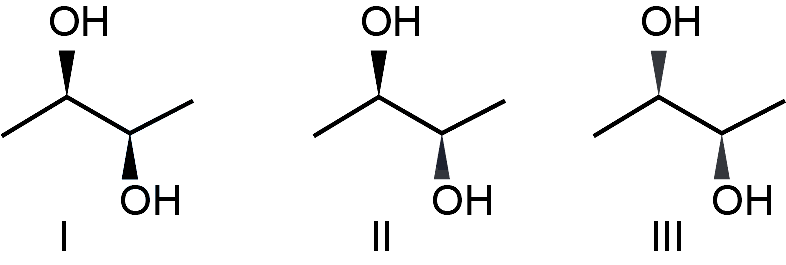 WBJEE 2014 Easy
More PYQs from WBJEE
- Reaction of silver nitrate solution with phosphorous acid produces:WBJEE 2021 Easy
- Let \(f: N \rightarrow R\) be such that \(f(1)=1\) and \(f(1)+2 f(2)+3 f(3)+\ldots+n f(n)=n(n+1) f(n),\) for all \(n \in N, n \geq 2,\) where \(N\) is the set of natural numbers and \(R\) is the set of real numbers. Then, the value of \(f(500)\) isWBJEE 2015 Hard
- If in a \(\triangle A B C, A D, B E\) and \(C F\) are the altitudes and \(R\) is the circumradius, then the radius of the circumcircle of \(\Delta D E F\) isWBJEE 2016 Medium
- What is the correct order of acidity of salicylic acid, 4-hydroxybenzoic acid, and \(2,6-\) dihydroxybenzoic acid?WBJEE 2022 Medium
- For nuclei with mass number close to 119 and 238 , the binding energies per nucleon are approximately \(7.6 \mathrm{MeV}\) and \(8.6 \mathrm{MeV}\) respectively. If a nucleus of mass number 238 breaks into two nuclei of nearly equal masses, what will be the approximate amount of energy released in the process of fission?WBJEE 2020 Medium
- A \(5 \mu F\) capacitor is connected in series with \(10 \mathrm{\mu F}\) capacitor. When a \(300 \mathrm{v}\) potentid dillerence is applied across this combination, the total energy stored in the capacitors isWBJEE 2015 Medium