


WBJEE · Chemistry · Ionic Equilibrium
In which of the following mixed aqueous solutions, \(\mathrm{pH}=\mathrm{p} K_{a}\) at equilibrium?
(1) \(100 \mathrm{mL}\) of \(0.1 \mathrm{M} \mathrm{CH}_{3} \mathrm{COOH}+100 \mathrm{mL}\) of \(0.1 \mathrm{MCH}_{3} \mathrm{COONa}\)
(2) \(100 \mathrm{mL}\) of \(0.1 \mathrm{MCH}_{3} \mathrm{COOH}+50 \mathrm{mL}\) of 0.1 \(\mathrm{M} \mathrm{NaOH}\)
(3) \(100 \mathrm{mL}\) of \(0.1 \mathrm{M} \mathrm{CH}_{3} \mathrm{COOH}+100 \mathrm{mL}\) of \(0.1 \mathrm{M} \mathrm{NaOH}\)
(4) \(100 \mathrm{mL}\) of \(0.1 \mathrm{M} \mathrm{CH}_{3} \mathrm{COOH}+100 \mathrm{mL}\) of \(0.1 \mathrm{M} \mathrm{NH}_{3}\)
- A (1) is correct
- B (2) is correct
- C (3) is correct
- D Both (1) and (2) are correct
Answer & Solution
Correct Answer
(D) Both (1) and (2) are correct
Step-by-step Solution
Detailed explanation
pH of buffer solutions is given by \[ \mathrm{pH}=\mathrm{pK}_{a}+\mathrm{log} \frac{[\mathrm{salt}]}{[\mathrm{acid}]} \] (1) \(\mathrm{CH}_{3} \mathrm{COOH}\) and \(\mathrm{CH}_{3} \mathrm{COONa}\) \(\quad \quad\) \(100 \times 0.1\) \(\quad \quad…
See the Complete Solution
Get step-by-step explanations for this and 2.5 Lakh+ more JEE, NEET & CET questions.
- Unlock all solutions
- Practice the full chapter
- Track accuracy across PYQs
4.8 rated on Google Play · 14,000+ reviews
More questions from Chemistry
- For the equilibrium, \(\mathrm{H}_{2} \mathrm{O}(l) \rightleftharpoons \mathrm{H}_{2} \mathrm{O}(\mathrm{v}),\) which of the following is correct?WBJEE 2019 Easy
- Case \(-1:\) An ideal gas of molecular weight \(M\) at temperature \(T\).
Case \(-2:\) Another ideal gas of molecular weight \(2 \mathrm{M}\) at temperature \(\mathrm{T} / 2\)
Identify the correct statement in context of above two cases.WBJEE 2023 Medium - \(20 \mathrm{mL~} 0 .1\) (N) acetic acid is mixed with \(10 \mathrm{mL}\) \(0.1(\mathrm{N})\) solution of NaOH. The pH of the resulting solution is \(\left(p K_{a}\right.\) of acetic acid is \(\left.4.74\right)\)WBJEE 2012 Hard
- In a close-packed body-centred cubic lattice of potassium, the correct relation between the atomic radius \((r)\) of potassium and the edge-length of the cube isWBJEE 2017 Easy
- Among the following, the one which is not a "green house gas", isWBJEE 2014 Easy
- Which of the following atoms should have the highest \(1^{\prime \prime}\) electron affinity?WBJEE 2017 Easy
More PYQs from WBJEE
- The kinetic energy \(\left(\mathrm{E}_{\mathrm{k}}\right)\) of a particle moving along \(X\)-axis varies with its position \((X)\) as shown in the figure. The force acting on the particle at \(X=10 \mathrm{~m}\) is
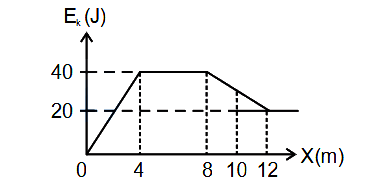 WBJEE 2022 Easy
 - \(\mathrm{AB}\) is a chord of a parabola \(\mathrm{y}^2=4 \mathrm{ax},(\mathrm{a}>0)\) with vertex \(\mathrm{A} . \mathrm{BC}\) is drawn perpendicular to \(\mathrm{AB}\) meeting the axis at \(\mathrm{C}\). The projection of \(\mathrm{BC}\) on the axis of the parabola isWBJEE 2022 Easy
- Within the list shown below, the correct pair of structures of alanine in \(\mathrm{pH}\) ranges \(2-4\) and \(9-11\) is
I. \(\mathrm{H}_{3} \mathrm{N}^{+}-\mathrm{CH}\left(\mathrm{CH}_{3}\right) \mathrm{CO}_{2} \mathrm{H}\)
II. \(\mathrm{H}_{2} \mathrm{N}-\mathrm{CH}\left(\mathrm{CH}_{3}\right) \mathrm{CO}_{2}^{-}\)
III. \(\mathrm{H}_{3} \mathrm{N}^{+}-\mathrm{CH}\left(\mathrm{CH}_{3}\right) \mathrm{CO}_{2}^{-}\)
\(\mathrm{IV} . \mathrm{H}_{2} \mathrm{N}-\mathrm{CH}\left(\mathrm{CH}_{3}\right) \mathrm{CO}_{2} \mathrm{H}\)WBJEE 2015 Medium - Aqueous solution of \(\mathrm{HNO}_{3}, \mathrm{KOH}, \mathrm{CH}_{3} \mathrm{COOH}\) and \(\mathrm{CH}_{3} \mathrm{COONa}\) of identical concentration are provided. The pair (s) of solutions which form a buffer upon mixing is (are)WBJEE 2021 Easy
- Match the flame colours of the alkaline earth metal salts in the Bunsen burner
\(\begin{array}{l|l}
\hline \text{A. Caicium} & \text{p. Brick red} \\
\hline \text{B. Strontium} & \text{q. Apple green} \\
\hline \text{C. Barium} & \text{r. Crimson} \\
\hline
\end{array}\)WBJEE 2015 Easy - Let \(f:[a, b] \rightarrow R\) be such that \(f\) is differentiable in \((a, b)\) is continuous at \(x=a\) and \(x=b\) and moreover \(f(a)=0=f(b)\). ThenWBJEE 2018 Medium