


WBJEE · Chemistry · Ionic Equilibrium
Aqueous solution of \(\mathrm{HNO}_{3}, \mathrm{KOH}, \mathrm{CH}_{3} \mathrm{COOH}\) and \(\mathrm{CH}_{3} \mathrm{COONa}\) of identical concentration are provided. The pair (s) of solutions which form a buffer upon mixing is (are)
- A \(\mathrm{HNO}_{3}\) and \(\mathrm{CH}_{3} \mathrm{COOH}\)
- B \(\mathrm{KOH}\) and \(\mathrm{CH}_{3} \mathrm{COONa}\)
- C \(\mathrm{HNO}_{3}\) and \(\mathrm{CH}_{3} \mathrm{COONa}\)
- D \(\mathrm{CH}_{3} \mathrm{COOH}\) and \(\mathrm{CH}_{3} \mathrm{COONa}\)
Answer & Solution
Correct Answer
(D) \(\mathrm{CH}_{3} \mathrm{COOH}\) and \(\mathrm{CH}_{3} \mathrm{COONa}\)
Step-by-step Solution
Detailed explanation
A Weak acid and its salt with a strong base forms a buffer.\(\therefore\) (D) \(\mathrm{HNO}_{3}\) being a strong acid, displaces weaker acid \(\mathrm{CH}_{3} \mathrm{COOH}\).…
See the Complete Solution
Get step-by-step explanations for this and 2.5 Lakh+ more JEE, NEET & CET questions.
- Unlock all solutions
- Practice the full chapter
- Track accuracy across PYQs
4.8 rated on Google Play · 14,000+ reviews
More questions from Chemistry
- \[
\text { The two structures written below represent }
\]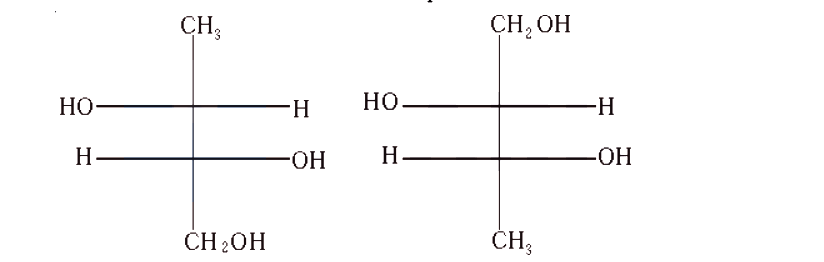 WBJEE 2009 Medium
 - The equivalent conductance of \(\mathrm{NaCl}, \mathrm{HCl}\) and \(\mathrm{CH}_3 \mathrm{COONa}\) at infinite dilution are \(126.45,426.16\) and 91 \(\mathrm{ohm}^{-1} \mathrm{~cm}^2 \mathrm{eq}^{-1}\) respectively at \(25^{\circ} \mathrm{C}\). The equivalent conductance of acetic acid (at infinite dilution) would beWBJEE 2023 Easy
- The amount of electrolytes required to coagulate a given amount of Agl colloidal solution (-ve charge) will be in the orderWBJEE 2014 Easy
- A sample of \(\mathrm{MgCO}_3\) is dissolved in dil. \(\mathrm{HCl}\) and the solution is neutralized with ammonia and buffered with \(\mathrm{NH} \mathrm{Cl}_4 /\) \(\mathrm{NH}_4 \mathrm{OH}\). Disodium hydrogen phosphate reagent is added to the resulting solution. A white precipitate is formed. What is the formula of the precipitate?WBJEE 2022 Hard
- At constant pressure, the heat of formation of a compound is not dependent on temperature, whenWBJEE 2019 Hard
- Of the following molecules, which have shape similar to \(\mathrm{CO}_{2} ?\)WBJEE 2016 Medium
More PYQs from WBJEE
-
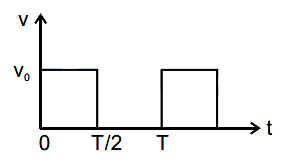
The rms value of potential difference \(v\) shown in the figure isWBJEE 2021 Easy - Choose the correct statement(s) among the following.WBJEE 2016 Medium
- An object weighs \(\mathrm{m}_1\) in a liquid of density \(\mathrm{d}_1\) and that in liquid of density \(\mathrm{d}_2\) is \(\mathrm{m}_2\). The density \(d\) of the object isWBJEE 2011 Easy
- A balloon starting from rest is ascending from ground with uniform acceleration of \(4 \mathrm{ft} / \mathrm{sec}^2\). At the end of \(5 \mathrm{sec}\), a stone is dropped from it. If \(\mathrm{T}\) be the time to reach the stone to the ground and \(\mathrm{H}\) be the height of the balloon when the stone reaches the ground, thenWBJEE 2023 Easy
- A shell of mass \(5 M\), acted upon by no external force and initially at rest, bursts into three fragments of masses \(M, 2 M\) and \(2 M\) respectively. The first two fragments move in opposite directions with velocities of magnitudes 2v and \(v\) respectively. The third fragment willWBJEE 2013 Easy
- P and Q combines to form two compounds \(\mathrm{PQ}_2\) and \(\mathrm{PQ}_3\). If \(1 \mathrm{~g} \mathrm{P} Q_2\) is dissolved in 51 g benzene the depression of freezing point becomes \(0.8^{\circ} \mathrm{C}\). On the other hand if \(1 \mathrm{~g} \mathrm{PQ}_3\) is dissolved in 51 g of benzene, the depression of freezing point becomes \(0.625^{\circ} \mathrm{C}\). The atomic mass of \(P\) and \(Q\) are \(\left(\mathrm{K}_{\mathrm{f}}\right.\) of benzene \(\left.=5.1 \mathrm{~K} \mathrm{~kg} \mathrm{~mol}^{-1}\right)\)WBJEE 2025 Hard