


TS EAMCET · Physics · Atomic Physics
The ratio of the centripetal accelerations of the electron in two successive orbits of hydrogen is \(81: 16\). Due to a transition between these two states, the angular momentum of the electron changes by ( \(h\) - Planck's constant)
- A \(\frac{h}{3 \pi}\)
- B \(\frac{3 h}{\pi}\)
- C \(\frac{h}{2 \pi}\)
- D \(\frac{2 h}{\pi}\)
Answer & Solution
Correct Answer
(C) \(\frac{h}{2 \pi}\)
Step-by-step Solution
Detailed explanation
When transition of electron takes place between two successive orbits, then Change in angular momentum, \(\Delta \mathrm{L}=\mathrm{L}_{\mathrm{n}}-\mathrm{L}_{\mathrm{n}-1}\)…
See the Complete Solution
Get step-by-step explanations for this and 2.5 Lakh+ more JEE, NEET & CET questions.
- Unlock all solutions
- Practice the full chapter
- Track accuracy across PYQs
4.8 rated on Google Play · 14,000+ reviews
More questions from Physics
- An achromatic combination of lenses producesTS EAMCET 2008 Medium
- The displacement of a particle moving in a straight line is given by the expression \(x=A t^3+B t^2+C t+D\) in metres, where \(t\) is in seconds and \(A, B, C\) and \(D\) are constants. The ratio between the initial acceleration and initial velocity isTS EAMCET 2015 Easy
- Power radiated by a black body at temperature \(T_1\) is \(P\) and it radiates maximum energy at a wavelength \(\lambda_1\). If the temperature of the black body is changed from \(T_1\) to \(T_2\), it radiates maximum energy at a wavelength \(\frac{\lambda_1}{2}\). The power radiated at \(T_2\) isTS EAMCET 2012 Easy
- The moment of inertia of a thin circular disc about an axis passing through its centre and perpendicular to its plane is \(I\). Then, the moment of inertia of the disc about an axis parallel to its diameter and touching the edge of the rim isTS EAMCET 2008 Medium
- Two wires \(A\) and \(B\) are of lengths \(40 \mathrm{~cm}\) and \(30 \mathrm{~cm}\). \(A\) is bent into a circle of radius \(r\) and \(B\) into an arc of radius \(r\). A current \(i_1\) is passed through \(A\) and \(i_2\) through \(B\). To have the same magnetic inductions at the centre, the ratio of \(i_1: i_2\) isTS EAMCET 2007 Hard
- The ratio of the wavelengths of radiation emitted when an electron in the hydrogen atom jumps from 4th orbit to 2 nd orbit and from 3 rd orbit to 2 nd orbit isTS EAMCET 2024 Easy
More PYQs from TS EAMCET
- An alternating voltage \(\varepsilon=30 \sin 200 t\) (in volts) is applied to the circuit below. The amplitude of the current through the circuit is
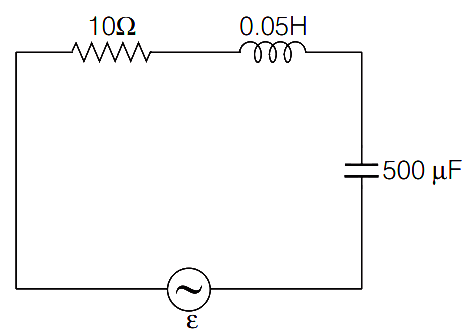 TS EAMCET 2020 Easy
 - The temperature at which the reading on Fahrenheit scale becomes \(90 \%\) more than the reading on Celsius scale isTS EAMCET 2025 Medium
- Two trains \(A\) and \(B\) travel in two parallel rail tracks in opposite direction with speed \(v_1\) and \(v_2\), respectively. They talse \(4 \mathrm{~s}\) to pass each other at this speed. If the speed of \(\operatorname{train} A\) is increased by \(50 \%\), then they talse \(3 \mathrm{~s}\) to pass each other. The ratio of \(v_1 / v_2\) isTS EAMCET 2018 Medium
- A river \(200 \mathrm{~m}\) wide is flowing at a rate of \(3.0 \mathrm{~m} / \mathrm{s}\). A boat is sailing at a velocity of \(15 \mathrm{~m} / \mathrm{s}\) with respect to the water in a direction perpendicular to the river. How far from the point directly opposite to the starting point does the boat reach on the opposite bank?TS EAMCET 2020 Medium
- Consider the following statements A and B and identify the correct answers given below. A. Peltier coefficient is numerically equal to the potential difference across the junctions of the thermocouple through which current is flowing. B. According to Thomson, energy is neither absorbed nor evolved at the junction of a thermocouple but is observed or evolved only along the lengths of both the conductors.TS EAMCET 2005 Hard
- A ball of mass \(m=1 \mathrm{~kg}\) is thrown from the top of a building with initial velocity \(\mathbf{v}=(20 \mathrm{~m} / \mathrm{s}) \hat{\mathbf{i}}+(24 \mathrm{~m} / \mathrm{s}) \hat{\mathbf{j}}\) at time \(t=0\). The change in the potential energy of the ball between \(t=0\) and \(t=6 \mathrm{~s}\), if the ball does not hit the ground, then (assume, \(g=10 \mathrm{~m} \mathrm{~s}^2\) )TS EAMCET 2020 Easy