


TS EAMCET · Physics · Nuclear Physics
The half-life of a radiocative isotope is \(30 \mathrm{~h}\). How long will it take to get reduced to \(12.5 \%\) of its initial amount?
- A 120 h
- B 90 h
- C 60 h
- D 50 h
Answer & Solution
Correct Answer
(B) 90 h
Step-by-step Solution
Detailed explanation
Half-life of radioactive isotope, \(T_{1 / 2}=30 \mathrm{~h}\) If \(N_0\) be the initial amount of radioactive isotope, then remaining amount \((N)\) in time \(t\) is given as \(N=125 \% \text { of } N_0=\frac{125}{100} \times N_0 \Rightarrow N=\frac{N_0}{8}\) We know that,…
See the Complete Solution
Get step-by-step explanations for this and 2.5 Lakh+ more JEE, NEET & CET questions.
- Unlock all solutions
- Practice the full chapter
- Track accuracy across PYQs
4.8 rated on Google Play · 14,000+ reviews
More questions from Physics
- A body is moved along a straight line by an engine which delivers a constant power. The distance moved by the body in time ' \(\mathrm{t}\) ' is proportional toTS EAMCET 2023 Easy
- A rocket motor consumes \(100 \mathrm{~kg}\) of fuel per second exhausting it with a speed of \(5 \mathrm{~km} / \mathrm{s}\). The speed of the rocket when its mass is reduced to \(\frac{1^{\text {th }}}{20}\) of its initial mass, is (Assume initial speed to be zero and ignored gravitational and viscous forces.)TS EAMCET 2019 Hard
- The work done to assemble the three charges in a configuration as shown in the figure below is
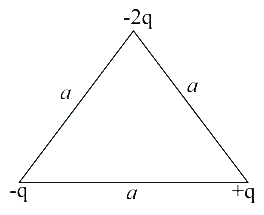 TS EAMCET 2018 Medium
 - Amotorcarmovingwithvelocity \(7 \mathrm{~m} / \mathrm{sstopsin} 10 \mathrm{mdistance}\) when brakes are applied. What is the relation between the resistance force \((\mathrm{R})\) and the weight \((\mathrm{W})\) of the car? \(\left(\right.\) Take value of \(g=9.8 \mathrm{~m} / \mathrm{s}^2\) )TS EAMCET 2022 Medium
- An electromagnetic wave of frequency 3.0 MHz passes from vacuum into a non-magnetic medium with permittivity, \(\epsilon=16 \epsilon_0\). Where, \(\epsilon_0\) is the free space permittivity. The change in wavelength isTS EAMCET 2019 Medium
- Two coherent sources whose intensity ratio is \(64: 1\) produce interference fringes. The ratio of intensities of maxima and minima isTS EAMCET 2010 Easy
More PYQs from TS EAMCET
- The driver of a bus moving with a velocity of 72 kmph observes a boy walking across the road at a distance of 50 m in front of the bus and decelerates the bus at \(5 \mathrm{~ms}^{-2}\) by applying brakes and is just able to avoid an accident. The reaction time of the driver isTS EAMCET 2025 Medium
- Assertion (A) Si and GaAs are the preferred materials for solar cells. Reason (R) Both these materials have energy band gaps much below the energy level corresponding to the maximum solar irradiance ln the solar spectrum. The correct answer isTS EAMCET 2019 Medium
- A rocket moves straight upward with zero initial velocity and with an acceleration \(20 \mathrm{~m} / \mathrm{s}^2\). It runs out of fuel and stops accelerating at the end of \(5^{\text {th }} \mathrm{sec}\). It reaches a maximum height and falls back to the earth. The speed when it hits the ground is. \(\left(\right.\) Take \(\left.g=10 \mathrm{~m} / \mathrm{s}^2\right)\)TS EAMCET 2022 Medium
- If the length of a rod is measured as 830600 mm, then the number of significant figures in the measurement isTS EAMCET 2025 Easy
- Two photons of energies twice and thrice the work function of a metal are incident on the metal surface. Then, the ratio of maximum velocities of the photoelectrons emitted in the two cases respectively, isTS EAMCET 2002 Easy
- Photodiodes are mostly operated in reverse biased condition becauseTS EAMCET 2023 Medium