


TS EAMCET · Physics · Rotational Motion
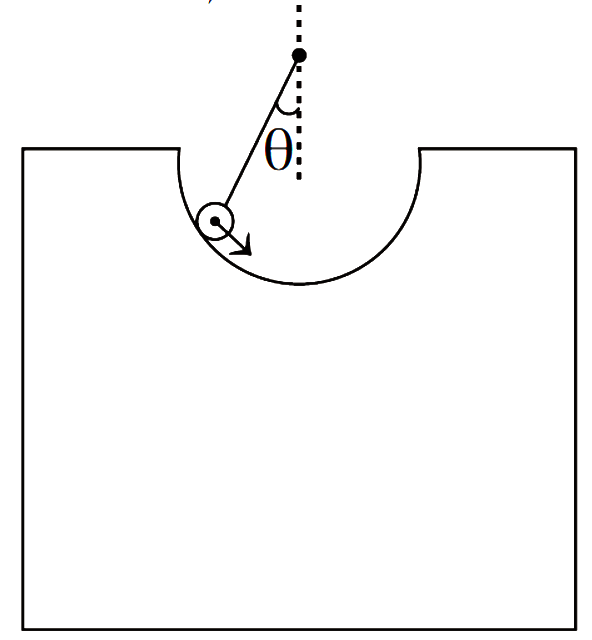
A solid sphere is rolling without slipping on a semi-circular track of radius \(10 \mathrm{~m}\) as shown in the figure. The radius of solid sphere is much smaller than the radius of semi-circular track. At the lowest point, it has a velocity \(10 \mathrm{~m} / \mathrm{s}\). To what maximum angle \(\theta\) from the vertical will the sphere travel before it comes back down? Neglect the rolling friction between the sphere and the track. (Take, \(g=10 \mathrm{~m} / \mathrm{s}^2\) )
- A \(\sin ^{-1}\left(\frac{3}{5}\right)\)
- B \(\sin ^{-1}\left(\frac{3}{7}\right)\)
- C \(\cos ^{-1}\left(\frac{3}{10}\right)\)
- D \(\cos ^{-1}\left(\frac{1}{3}\right)\)
Answer & Solution
Correct Answer
(C) \(\cos ^{-1}\left(\frac{3}{10}\right)\)
Step-by-step Solution
Detailed explanation
As there is no slip, energy is conserved. So, mechanical energy of ball at bottom \(=\) mechanical energy of ball at top \(\Rightarrow \quad m g r+\frac{1}{2} m v_{\mathrm{COM}}^2+\frac{1}{2} I_{\mathrm{COM}} \omega^2=m g h\)…
See the Complete Solution
Get step-by-step explanations for this and 2.5 Lakh+ more JEE, NEET & CET questions.
- Unlock all solutions
- Practice the full chapter
- Track accuracy across PYQs
4.8 rated on Google Play · 14,000+ reviews
More questions from Physics
- A stone projected from the ground with a velocity \(50 \mathrm{~ms}^{-1}\) at an angle of \(30^{\circ}\) with the horizontal crosses a wall after a time of \(3 \mathrm{~s}\). Then the horizontal distance beyond the wall that the stone strikes the ground is \(\left(\right.\) acceleration due to gravity \(\left.=10 \mathrm{~ms}^{-2}\right)\)TS EAMCET 2023 Easy
- A rigid body of mass and radius rolls without slipping on an inclined plane of inclination under gravity. Match the type of body Column I with magnitude of the force of friction Column II.
Column I Column II A) For ring I) B) For solid sphere II) C) For solid cylinder III) D) For hallow cylinder IV) TS EAMCET 2021 Medium - A body of mass \(5 \mathrm{~kg}\) makes an elastic collision with another body at rest and continues to move in the original direction after collision with a velocity equal to \(\frac{1}{10}\) th of its original velocity. Then the mass of the second body isTS EAMCET 2009 Medium
- The centre of mass of three particles of masses \(1 \mathrm{~kg}, 2 \mathrm{~kg}\) and \(3 \mathrm{~kg}\) is at \((2,2,2)\). The position of the fourth mass of \(4 \mathrm{~kg}\) to be placed in the system as that the new centre of mass is at \((0,0,0)\) is.TS EAMCET 2005 Easy
- Assertion (A) Si and GaAs are the preferred materials for solar cells. Reason (R) Both these materials have energy band gaps much below the energy level corresponding to the maximum solar irradiance ln the solar spectrum. The correct answer isTS EAMCET 2019 Medium
- In a circuit \(L, C\) and \(R\) are connected in series with an alternating voltage source of frequency \(f\). When current in the circuit leads the voltage by \(45^{\circ}\), the value of \(C\) isTS EAMCET 2015 Medium
More PYQs from TS EAMCET
- A particle of mass \(4 m\) explodes into three pieces of masses \(m, m\) and \(2 \mathrm{~m}\). The equal masses move along \(X\)-axis and \(Y\)-axis with velocities \(4 \mathrm{~ms}^{-1}\) and \(6 \mathrm{~ms}^{-1}\) respectively. The magnitude of the velocity of the heavier mass isTS EAMCET 2009 Medium
- A solenoid of length 50 cm and radius 10 cm has two closely wound layers of windings 100 turns each. If a current of 2.5 A is passing through the windings, the magnetic field (in \(10^{-4} \mathrm{~T}\) ) at a point 5 cm from the axis isTS EAMCET 2025 Medium
- Which of the following statement is not true?TS EAMCET 2017 Easy
- How much thermal energy is required to change a \(40 \mathrm{~g}\) ice cube from solid at \(-10^{\circ} \mathrm{C}\) to steam at \(110^{\circ} \mathrm{C}\) ? [Assume, latent heat of fusion for water \(=80 \mathrm{kcal} / \mathrm{kg}\), specific heat of water \(=1 \mathrm{kcal} / \mathrm{kg}^{\circ} \mathrm{C}\), specific heat of ice \(=0.5 \mathrm{kcal} / \mathrm{kg}^{\circ} \mathrm{C}\), specific heat of steam \(=0.48 \mathrm{kcal} / \mathrm{kg}^{\circ} \mathrm{C}\), latent heat of vaporisation of water \(\left.=540 \mathrm{kcal} / \mathrm{kg}^{\circ} \mathrm{C}\right]\)TS EAMCET 2020 Easy
- A thin uniform wire of mass ' \(m\) ' and linear density ' \(\rho\) ' is bent in the form of a circular ring. The moment of inertia of the ring about a tangent parallel to its diameter isTS EAMCET 2025 Medium
- A body starting at from origin and oscillates simple harmonically with a period of . After what time will its kinetic energy be of its total energyTS EAMCET 2022 Hard