


TS EAMCET · Physics · Work Power Energy
A particle of mass is moving along a circle of radius such that its tangential acceleration varies with distance covered as , where is a constant. The kinetic energy of the particle varies with the distance as , where and are constants. The values of and are
- A
- B
- C
- D
Answer & Solution
Correct Answer
(A)
Step-by-step Solution
Detailed explanation
Given, Tangential acceleration, at=αx2 and Kinetic energy, K=βxc. If F is the tangential force acting on the particle thenF=mαx2 Now applying work energy theorem, W=∆KE ⇒ ∫F dx=K ⇒ ∫mαx2dx=K…
See the Complete Solution
Get step-by-step explanations for this and 2.5 Lakh+ more JEE, NEET & CET questions.
- Unlock all solutions
- Practice the full chapter
- Track accuracy across PYQs
4.8 rated on Google Play · 14,000+ reviews
More questions from Physics
- The position vector of a particle moving in a plane is given by \(\mathbf{r}=a \cos \omega t \hat{\mathbf{i}}+b \sin \omega t \hat{\mathbf{j}}\), where \(\hat{\mathbf{i}}\) and \(\hat{\mathbf{j}}\) are the unit vectors along the rectangular axes \(X\) and \(Y ; a, b\) and \(\omega\) are constants and \(t\) is time. The acceleration of the particle is directed along the vectorTS EAMCET 2018 Easy
- Two slabs \(A\) and \(B\) of different materials but of the same thickness are joined end to end to form a composite slab. The thermal conductivities of \(A\) and \(B\) are \(k_1\) and \(k_2\) respectively. A steady temperature difference of \(12^{\circ} \mathrm{C}\) is maintained across the composite slab. If \(k_1=\frac{k_2}{2}\), the temperature difference across slab \(A\) isTS EAMCET 2011 Easy
- A mass \(M \mathrm{~kg}\) is suspended by a weightless string. The horizontal force required to hold the mass at \(60^{\circ}\) with the vertical isTS EAMCET 2014 Easy
- With the help of a telescope that has an objective of diameter \(200 \mathrm{~cm}\), it is proved that light of wavelengths of the order of \(6400 Å\) coming from a star can be easily resolved. Then, the limit of resolution isTS EAMCET 2016 Easy
- The direction of Earth's magnetic field at the magnetic poles isTS EAMCET 2021 Easy
- Some physical constants are given in List-I and their dimensional formulae are given in List-II. Match the following
List-I
(1) Planck's constant
(2) Gravitational constant
(3) Bulk modulus
(4) Coefficient of viscosity
List-II
(i) \(\left[\mathrm{ML}^{-1} \mathrm{~T}^{-2}\right]\)
(ii) \(\left[\mathrm{ML}^{-1} \mathrm{~T}^{-1}\right]\)
(iii) \(\left[\mathrm{ML}^2 \mathrm{~T}^{-1}\right]\)
(iv) \(\left[\mathrm{M}^{-1} \mathrm{~L}^3 \mathrm{~T}^{-2}\right]\)
The correct answer isTS EAMCET 2007 Easy
More PYQs from TS EAMCET
- The current through the ammeter (neglecting internal resistance) in the following circuit is
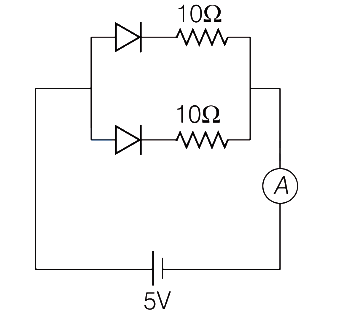 TS EAMCET 2021 Easy
 - The wavelengths of two sound notes in air are \(\frac{40}{195} \mathrm{~m}\) and \(\frac{40}{193} \mathrm{~m}\). Each note produces 9 beats per second separately with a third note of fixed frequency. The velocity of sound in air in \(\mathrm{m} / \mathrm{s}\) isTS EAMCET 2011 Medium
- A small sphere of radius \(r\) is placed as a concave surface of radius of curvature \(R\) a little away from the centre. When the sphere is released, it oscillates. Assuming, the oscillation to be simple harmonic motion and \(r< < R\), then the time period isTS EAMCET 2020 Easy
- Match the physical quantities given in List - I with dimensions in List - II.
(The dimensions of mass, length, time, temperature and current are and respectively)List - I List - II A Gravitational potential I B Stefan's constant II C Permittivity III D Specific heat capacity IV TS EAMCET 2019 Medium - Two particles executing simple harmonic motion as described by \(y_1=30 \sin \left(2 \pi t+\frac{\pi}{3}\right)\) and \(y_2=10(\sin 2 \pi t+\sqrt{3} \cos 2 \pi t)\) have amplitudes \(A_1\) and \(A_2\) respectively. The ratio \(A_1: A_2\) isTS EAMCET 2019 Easy
- A metal ball of mass \(1 \mathrm{~kg}\) is heated using a \(40 \mathrm{~W}\) heated in a room at \(30^{\circ} \mathrm{C}\). The temperature of the ball becomes stady at \(70^{\circ} \mathrm{C}\). Assuming Newton's law of cooling, the rate of loss of heat to the surrounding when the ball is at \(40^{\circ} \mathrm{C}\) isTS EAMCET 2021 Medium