


TS EAMCET · Physics · Thermodynamics
A monoatomic gas does of work when it is expanded isobarically. How much of heat is given to the gas in the process
- A
- B
- C
- D
Answer & Solution
Correct Answer
(C)
Step-by-step Solution
Detailed explanation
Work done in an isobaric process is given by W=nR∆T⇒nR∆T=100 J. For isobaric process heat is calculated by Q=nCP∆T⇒Q=n52R∆T⇒Q=250 J
See the Complete Solution
Get step-by-step explanations for this and 2.5 Lakh+ more JEE, NEET & CET questions.
- Unlock all solutions
- Practice the full chapter
- Track accuracy across PYQs
4.8 rated on Google Play · 14,000+ reviews
More questions from Physics
- In the Bohr model an electron of mass \(m\) moves in a circular orbit around the proton. Considering the orbiting electron to be a circular current loop, the magnetic moment of the hydrogen atom, when the electron is in \(n\)th excited state. (Assume, \(h=\) Planck's constant)TS EAMCET 2020 Easy
- The scientific principle that forms the basis of the Tokamak technology isTS EAMCET 2020 Medium
- A flat circular coil has turns of wire of radius . A uniform magnetic field exists in a direction perpendicular to the plane of the coil and it grows at a rate of , the induced emf in the coil is:TS EAMCET 2022 Easy
- The highest temperature, density and pressure is found on Earth:TS EAMCET 2019 Easy
- If \(A\) is the areal velocity of a planet of mass \(M\), its angular momentum isTS EAMCET 2002 Easy
- If the escape velocity on earth is \(11.2 \mathrm{~km} / \mathrm{s}\), its value for a planet having double the radius and 8 time the mass of earth isTS EAMCET 2020 Easy
More PYQs from TS EAMCET
- Two identical containers A and B with frictionless pistons contain the same ideal gas at the same temperature and same volume \(\mathrm{V}\). The mass of the gas in \(\mathrm{A}\) is \(\mathrm{m}_{\mathrm{A}}\) and that in \(B\) is \(m_B\). The gas in each cylinder is now allowed to expand isothermally to the same final volume \(2 \mathrm{~V}\). The changes in the pressures of the gases in A and B are found to be \(2 \Delta \mathrm{P}\) and \(3 \Delta \mathrm{P}\) respectively. Then the relation between \(\mathrm{m}_{\mathrm{A}}\) and \(\mathrm{m}_{\mathrm{B}}\) isTS EAMCET 2023 Medium
- The energy required to take a body from the surface of the earth to a height equal to the radius of the earth is ' \(W\) '. The energy required to take this body from the surface of the earth to a height equal to twice the radius of the earth isTS EAMCET 2024 Hard
- A ball of mass \(m=1 \mathrm{~kg}\) is thrown from the top of a building with initial velocity \(\mathbf{v}=(20 \mathrm{~m} / \mathrm{s}) \hat{\mathbf{i}}+(24 \mathrm{~m} / \mathrm{s}) \hat{\mathbf{j}}\) at time \(t=0\). The change in the potential energy of the ball between \(t=0\) and \(t=6 \mathrm{~s}\), if the ball does not hit the ground, then (assume, \(g=10 \mathrm{~m} \mathrm{~s}^2\) )TS EAMCET 2020 Easy
- The radiation energy emitted per second by a point source is \(100 \mathrm{~W}\). If the efficiency of the source is \(4 \%\), then the rms value of the electric field at distance of \(2 \mathrm{~m}\) is [use \(\frac{1}{4 \pi \varepsilon_0}=9 \times 10^9\) in SI unit]TS EAMCET 2020 Medium
- 3 moles of an ideal monoatomic gas performs \(A B C D A\) cyclic process as shown in figure below. The gas temperatures are \(T_A=400 \mathrm{~K}\), \(T_B=800 \mathrm{~K}, T_C=2400 \mathrm{~K}\) and \(T_D=1200 \mathrm{~K}\). The work done by the gas is (approximately) \((R=8.314 \mathrm{~J} / \mathrm{mol} \mathrm{K})\)
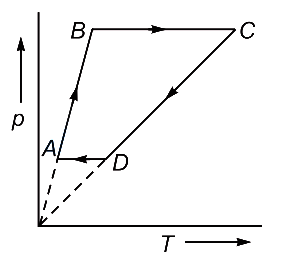 TS EAMCET 2010 Hard
 - A compound microscope has an objective of focal length 1.25 cm and an eyepiece of focal length 5 cm separated by a distance of 7.5 cm. The total magnification produced by the microscope when the final image forms at infinity isTS EAMCET 2025 Medium