


TS EAMCET · Physics · Laws of Motion
A force separately produces accelerations of \(18 \mathrm{~ms}^{-2}, 9 \mathrm{~ms}^{-2}\) and \(6 \mathrm{~ms}^{-2}\) in three bodies of masses \(\mathrm{P}, \mathrm{Q}\) and R respectively. If the same force is applied on a body of mass \(\mathrm{P}+\mathrm{Q}+\mathrm{R}\), then the acceleration of that body is
- A \(3 \mathrm{~ms}^{-2}\)
- B \(6 \mathrm{~ms}^{-2}\)
- C \(2 \mathrm{~ms}^{-2}\)
- D \(33 \mathrm{~ms}^{-2}\)
Answer & Solution
Correct Answer
(A) \(3 \mathrm{~ms}^{-2}\)
Step-by-step Solution
Detailed explanation
\(P = \frac{F}{18}, Q = \frac{F}{9}, R = \frac{F}{6}\) \(M_{total} = P+Q+R = \frac{F}{18} + \frac{F}{9} + \frac{F}{6} = F \left( \frac{1+2+3}{18} \right) = F \left( \frac{6}{18} \right) = \frac{F}{3}\) \(a = \frac{F}{M_{total}} = \frac{F}{F/3} = 3 \mathrm{~ms}^{-2}\)
See the Complete Solution
Get step-by-step explanations for this and 2.5 Lakh+ more JEE, NEET & CET questions.
- Unlock all solutions
- Practice the full chapter
- Track accuracy across PYQs
4.8 rated on Google Play · 14,000+ reviews
More questions from Physics
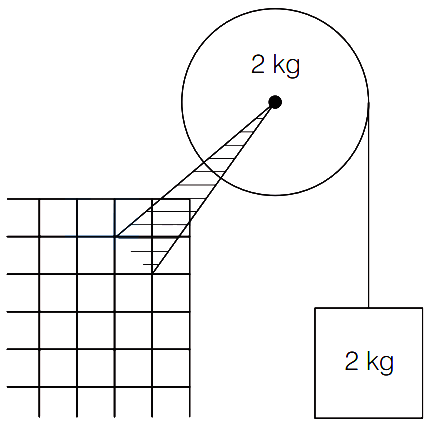
- An object of mass \(2 \mathrm{~kg}\) is hanging from a rope that is wrapped around a pulley of radius \(25 \mathrm{~cm}\). The mass of pulley is \(2 \mathrm{~kg}\). Find the acceleration of the object. (Assume, pulley to be a solid disk \(g=10 \mathrm{~m} / \mathrm{s}^2\) )
 TS EAMCET 2020 Hard
 - Consider a frictionless ramp on which a smooth object is made to slide down from an initial height \(h\). The distance \(d\) necessary to stop the object on a flat track (of coefficient of friction \(\mu\) ), kept at the ramp end isTS EAMCET 2017 Medium
- A rocket lifts off from the ground and accelerates upwards at . seconds after liftoff a piece breaks off from the bottom of the rocket. After breaking off, how much time it takes approximately to reach the ground? (Take )TS EAMCET 2021 Medium
- A body cools from a temperature of \(60^{\circ} \mathrm{C}\) to \(50^{\circ} \mathrm{C}\) in 10 minutes and \(50^{\circ} \mathrm{C}\) to \(40^{\circ} \mathrm{C}\) in 15 minutes. The time taken in minutes for the body to cool from \(40^{\circ} \mathrm{C}\) to \(30^{\circ} \mathrm{C}\) isTS EAMCET 2025 Medium
- If a brass sphere of radius 36 cm is submerged in a lake at a depth where the pressure is \(10^7 \mathrm{~Pa}\), then the change in the radius of the sphere is \((\) Bulk modulus of brass \(=60 \mathrm{GPa})\)TS EAMCET 2025 Medium
- Two particles of equal mass have velocities \(\overrightarrow{\mathbf{v}}_1=4 \hat{\mathbf{i}}\) and \(\overrightarrow{\mathbf{v}}_2=4 \hat{\mathbf{j}} \mathrm{ms}^{-1}\). First particle has an acceleration \(\overrightarrow{\mathbf{a}}_1=(5 \hat{\mathbf{i}}+5 \hat{\mathbf{j}}) \mathrm{ms}^{-2}\) while the acceleration of the other particle is zero. The centre of mass of the two particles moves in a path ofTS EAMCET 2004 Easy
More PYQs from TS EAMCET
- If the lengths of the open and closed pipes are in the ratio of \(2: 3\), then the ratio of the frequencies of the third harmonic of the open pipe and the fifth harmonic of the closed pipe isTS EAMCET 2025 Medium
- A wire of length \(50 \mathrm{~cm}\) and weighing \(10 \mathrm{gm}\) is attached to a spring at one end and to a fixed wall at the other end. The spring has a spring constant of \(50 \mathrm{~N} / \mathrm{m}\) and is stretched by \(1 \mathrm{~cm}\). If a wave pulse is produced on the string near the wall, then how much time will it take to reach the spring?TS EAMCET 2018 Easy
- A cyclist leans with the horizontal at angle \(30^{\circ}\), while negotiating round a circular road of radius \(20 \sqrt{3} \mathrm{~m}\). The speed of the cycle should beTS EAMCET 2020 Easy
- If \(\mathbf{r}_1=2 \hat{\mathbf{x}}, \mathbf{r}_2=2 \hat{\mathbf{y}}\), where \(\hat{\mathbf{x}}\) and \(\hat{\mathbf{y}}\) are unit vectors along the \(X\)-axis and \(Y\)-axis respectively, then the magnitude of \(\mathbf{r}_1+\mathbf{r}_2\) isTS EAMCET 2020 Easy
- A thin metallic spherical shell of radius \(r\) contains a charge \(Q\) on its surface. A point charge \(q_1\) is placed at the centre of shell and another charge \(q_2\) is placed outside the shell at a distance \(x\) from the centre. Then, the forces on charges \(q_1\) and \(q_2\) respectively areTS EAMCET 2020 Easy
- A carrier wave of peak voltage is used to transmit a message signal. What should be the peak voltage of the modulating signal in order to have a modulation index ofTS EAMCET 2021 Easy