


TS EAMCET · Maths · Indefinite Integration
If \(\int e^x\left(\frac{1-\sin x}{1-\cos x}\right) d x=f(x)+\) constant, then \(f(x)\) is equal to
- A \(e^x \cot \left(\frac{x}{2}\right)+c\)
- B \(e^{-x} \cot \left(\frac{x}{2}\right)+c\)
- C \(-e^x \cot \left(\frac{x}{2}\right)+c\)
- D \(-e^{-x} \cot \left(\frac{x}{2}\right)+c\)
Answer & Solution
Correct Answer
(C) \(-e^x \cot \left(\frac{x}{2}\right)+c\)
Step-by-step Solution
Detailed explanation
\begin{aligned} & \int e^x\left(\frac{1-\sin x}{1-\cos x}\right) d x \\ & \quad=\int e^x\left(\frac{1-2 \sin \frac{x}{2} \cos \frac{x}{2}}{2 \sin ^2 \frac{x}{2}}\right) d x \\ & \quad=\frac{1}{2} \int e^x\left(\operatorname{cosec}^2 \frac{x}{2}\right) d x-\int e^x \cot…
See the Complete Solution
Get step-by-step explanations for this and 2.5 Lakh+ more JEE, NEET & CET questions.
- Unlock all solutions
- Practice the full chapter
- Track accuracy across PYQs
4.8 rated on Google Play · 14,000+ reviews
More questions from Maths
- Let P be a point on the ellipse \(\frac{x^2}{9}+\frac{y^2}{4}=1\) and let the perpendicular drawn through P to the major axis meet its auxiliary circle at Q. If the normals drawn at P and Q to the ellipse and the auxiliary circle respectively meet in R, then the equation of the locus of \(R\) isTS EAMCET 2025 Hard
- \(\int \frac{d x}{\left(x^2+1\right)\left(x^2+4\right)}=\)TS EAMCET 2023 Medium
- If \((h, k)\) is the new origin to be chosen to eliminate first degree terms from the equation \(\mathrm{S} \equiv 2 x^2-x y-y^2-3 x+3 y=0\) by translation and if \(\theta\) is the angle with which the axes are to be rotated about the origin in anticlockwise direction to eliminate xy-term from \(\mathrm{S}=0\), then \(\tan 2 \theta=\)TS EAMCET 2025 Medium
- If \(x^2+y^2=t-\frac{1}{t}, x^4+y^4=t^2+\frac{1}{t^2}\) then \(\frac{d y}{d x}=\)TS EAMCET 2022 Medium
- In a quadrilateral \(A B C D\), the point \(P\) divides \(D C\) in the ratio \(1: 2\) and \(Q\) is the mid point of \(A C\). If \(\overrightarrow{\mathbf{A B}}+2 \overrightarrow{\mathbf{A D}}+\overrightarrow{\mathbf{B C}}-2 \overrightarrow{\mathbf{D C}}=k \overrightarrow{\mathbf{P Q}}\), then \(k\) is equal toTS EAMCET 2009 Medium
- \(\int \frac{\cos 2 x \cdot \sin 4 x}{\cos ^4 x\left(1+\cos ^2 2 x\right)} d x=\)TS EAMCET 2018 Medium
More PYQs from TS EAMCET
- Particle A moving with a velocity \(v=10 \mathrm{~m} / \mathrm{s}\) experienced a head on collision with a stationary particle B of the same mass.Asaresultof collision, thekinetic energyofthesystem decreased by \(1 \%\). The speed of particle A after collision inTS EAMCET 2022 Medium
- If \(a, b\) and \(n\) are natural numbers, then \(a^{2 n-1}+b^{2 n-1}\) is divisible byTS EAMCET 2011 Medium
- Maximum number of bromine atoms present in the final product \(P\) upon complete bromination are
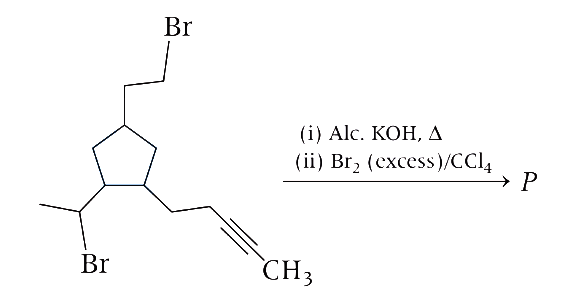 TS EAMCET 2020 Hard
 - If \(2 \hat{i}+3 \hat{j}-4 \hat{k}\) and \(-\hat{i}+2 \hat{j}+\hat{k}\) are the two diagonals of a parallelogram, then the area of the parallelogram in square units isTS EAMCET 2022 Easy
- Two cylinders \(A\) and \(B\) fitted with pistons, contain equal number of moles of an ideal monoatomic gas at \(400 \mathrm{~K}\). The piston of \(A\) is free to move while that of \(B\) is held fixed. Same amount of heat energy is given to the gas in each cylinder. If the rise in temperature of the gas in \(A\) is \(42 \mathrm{~K}\), the rise in temperature of the gas in \(B\) is \((\gamma=5 / 3)\)TS EAMCET 2007 Medium
- Let \(f: D \rightarrow R, D \subseteq R, c \in D\) and \(r\) be a non zero real number. Consider the following statements: Y. \(c\) is an extreme point of \(f \Rightarrow c\) is an extreme point of \(f f\) M. \(c\) is an extreme point of \(f \Rightarrow c\) is an extreme point of \(r+f\) Which of the following is correct?TS EAMCET 2019 Medium